Need help?
Do you have a question about the Huazheng VLF Hipot and is the answer not in the manual?
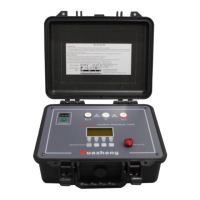
Details the layout of the controller panel and the physical structure of the booster unit.
Covers startup, parameter setting, boosting, equal amplitude, downtime, and discharging.
Explains shutdown modes, protection, printing, and historical data viewing.
Covers clock setting and the upper computer management software.
Outlines cable preparation, voltage setting, and test duration requirements for cable testing.
Provides formulas for calculating capacitive current and setting overcurrent protection limits.
Covers safe transportation, storage conditions, moisture control, and exposure prevention.
Details the warranty period, maintenance services, user training, and customer support policies.
Provides step-by-step instructions for replacing the paper roll in the built-in printer.
The VLF Hipot Tester is a sophisticated instrument designed for high-voltage withstand testing of electrical equipment, particularly those with large insulation equivalent capacitance such as power cables, power capacitors, and large/medium-sized generators and motors. This device utilizes 0.1Hz ultra-low frequency technology, which is the latest international electrotechnical commission recommendation, offering a modern alternative to traditional power frequency and DC withstand voltage tests.
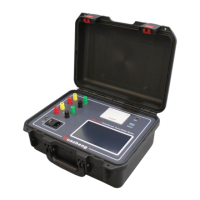
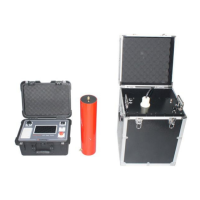
The primary function of the VLF Hipot Tester is to perform insulation withstand voltage tests. It operates by generating an ultra-low frequency high voltage output to stress the insulation of the test object. The instrument consists of two main parts: a controller and a booster. The controller, equipped with a 7-inch capacitive touch screen, serves as the central interface for operation, displaying test data and output waveforms. It allows users to set various test parameters, including output frequency (0.1Hz, 0.05Hz, and 0.02Hz options), test time, test voltage, and overcurrent/overvoltage protection values.
The test process is largely automated, encompassing self-inspection, boosting, constant amplitude output, and shutdown. During self-inspection, the controller detects the load; if no load is connected, it prompts the user. Upon successful self-test, the instrument automatically enters the boosting state, gradually raising the voltage to the set value. Once the set voltage is reached, it maintains a constant amplitude sine wave output for the specified test duration. The instrument provides comprehensive protection features, including over-voltage and over-current protection on both high and low voltage sides, with rapid action (within 10ms) to ensure safety and reliability.
The VLF Hipot Tester offers two normal shutdown modes: timed shutdown, where the instrument automatically stops when the set test time is reached, and manual shutdown, activated by pressing the "stop" key. Additionally, it features abnormal shutdown mechanisms for over-voltage and over-current protection, automatically cutting off the output and saving data history if limits are exceeded.
Beyond testing, the instrument facilitates data management. It automatically saves test results as historical data, capable of storing up to 64 records. Users can view this historical data directly on the touch screen or print test reports using the built-in printer. The device also includes a clock setting function to manage system date and time. For more advanced data management and analysis, the instrument can be connected to a computer via USB, utilizing a background management software that supports various Windows operating systems. This software allows for remote operation of controller functions, including parameter setting, test initiation, and historical data saving.
The VLF Hipot Tester is designed for ease of use and reliability. Its "fool operation" design, coupled with a simple wiring method, makes it accessible even for operators with varying levels of experience. The capacitive touch screen with Chinese character display enhances user interaction, providing clear information and intuitive control.
A significant advantage of this instrument is its energy-saving capability, particularly for the electronic type, which feeds back excess power to the grid. This contrasts with mechanical types that consume excess energy through high-power resistors. The electronic design also contributes to a longer lifespan and lower noise levels during operation.
The instrument's compact size and light weight make it highly portable and convenient for outdoor operations. It offers a large test range with multiple frequency selections (0.1Hz, 0.05Hz, and 0.02Hz), catering to diverse testing requirements. The closed-loop negative feedback control circuit for high and low voltage ensures stable output without a capacity rise effect.
For specific applications like power cable withstand voltage testing, the manual provides detailed guidance on setting test voltage values based on the cable's rated phase voltage and estimating capacitive current for overcurrent protection. This ensures accurate and safe testing procedures.
Maintenance and preservation of the VLF Hipot Tester are crucial for its longevity and performance. During transportation, the product must be securely packed in cartons or wooden boxes with foam protection to prevent mechanical damage. It is designed to withstand transportation by road, railway, and air, though it should not be left in open trucks.
For storage, the instrument should be kept in a room with an ambient humidity range of -20℃ to +60℃ and relative humidity not exceeding 85%. The storage area should be well-ventilated, free from corrosive gases, and not directly on the floor or against walls to prevent moisture accumulation.
To combat moisture, especially in humid environments or seasons, it is recommended to power on the instrument for about two hours once a month if it's not in regular use. This helps to emit moisture and protect internal components. When used outdoors, direct sunlight exposure should be avoided or minimized to prevent overheating and potential damage.
The instrument comes with a one-year warranty period, during which the company provides free warranty services and life-long after-sales support. This includes maintenance, use training, and software upgrades throughout the instrument's service life. In case of any operational issues, users are encouraged to contact the company for prompt assistance.
Replacing the printer paper roll is a simple process, designed to be user-friendly without requiring the removal of the entire printer. Clear instructions are provided for opening the front cover, replacing the paper roll, and ensuring proper paper alignment for printing. The thermal coating of the thermal paper must be correctly oriented for successful printing.
 General
| Overvoltage Protection | Yes |
|---|---|
| Overcurrent Protection | Yes |
| HV Short Circuit Protection | Yes |
| Voltage Accuracy | ±1% |
| Current Accuracy | ±1% |
| Power Supply | 220V AC, 50/60Hz |

 To Next Page