14 FUEL—CARBURETION
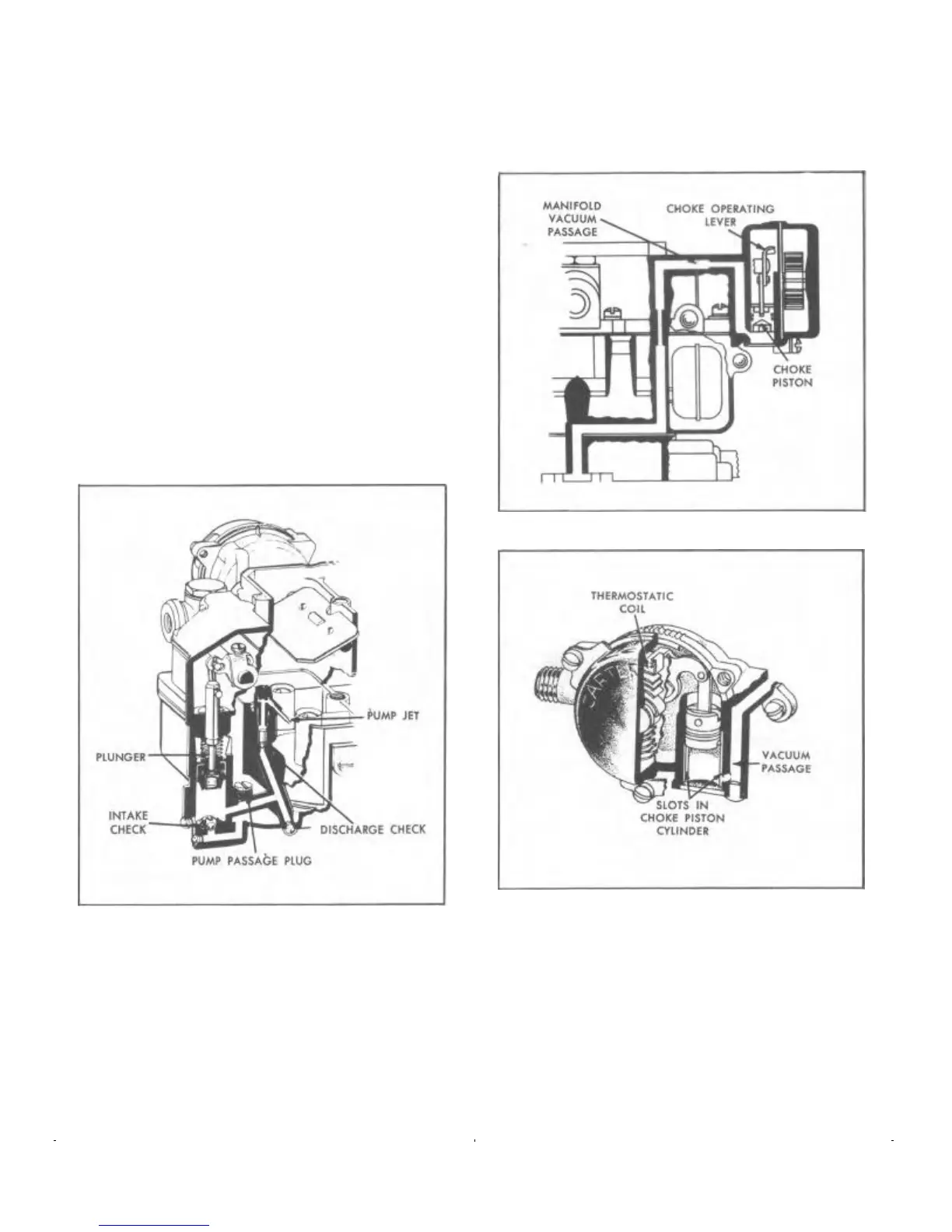
The accelerating pump circuit provides the measured
amount of fuel necessary to insure smooth engine opera-
tion during acceleration at speeds below approximately 30
MPH.
When the throttle is closed, the pump plunger moves
upward in its cylinder and fuel is drawn into the pump
cylinder through the inlet passage. The discharge needle is
seated at this time to prevent air being drawn into the
cylinder. When the throttle is opened, the pump plunger
moves downward forcing fuel out through the discharge
passage, past the discharge needle, and out of the pump
jets. When the plunger moves downward, the inlet valve is
closed preventing fuel from being forced back into the
bowl.
If the throttle is opened suddenly, the pump spring will
be compressed by the plunger shaft telescoping, resulting
in a smoother pump discharge of longer duration.
At speeds above approximately 30 MPH, pump dis-
charge is no longer necessary to insure smooth accelera-
tion. When the throttle valves are opened a predetermined
amount, the pump plunger bottoms in the pump cylinder
eliminating pump discharge.
FIGURE 5—Accelerating Pump Circuit
CHOKE CIRCUIT
The Climatic ® control circuit provides a correct mixture
necessary for quick cold engine starting and warm-up.
When the engine is cold, tension of the thermostatic coil
holds the choke valve closed. When the engine is started,
air velocity against the off-set choke valve causes the
valve to open slightly against the thermostatic coil tension.
Intake manifold vacuum applied to the choke piston also
tends to pull the choke valve open. The choke valve
assumes a position where tension of the thermostatic coil
is balanced by the pull of vacuum on the piston and air
velocity on the off-set choke valve.
FIGURE 6—Choke Circuit
FIGURE 7—Choke Housing Assembly
When the engine starts, slots located in the sides of the
choke piston cylinder are uncovered allowing intake man-
ifold vacuum to draw air heated by the exhaust manifold,
through the Climatic ® control housing. The flow of warm
air heats the thermostatic coil and causes it to lose some of
its tension. The thermostatic coil loses its tension gradu-
ally until the choke valve reaches wide open position.
When the engine is accelerated during the warm- up peri-
od, the corresponding drop in manifold vacuum allows the
thermostatic coil to momentarily close the


 To Next Page
 Loading...