18
Check the following before asking for repair. For follow-up service and any inquiry you may have while using
the product, please contact our Customer Center, or homepage at http://www.globalhurom.com Check the
manufacturer’s number or the number under the barcode when requesting for follow-up service or parts.
12. Before Requesting for Repair
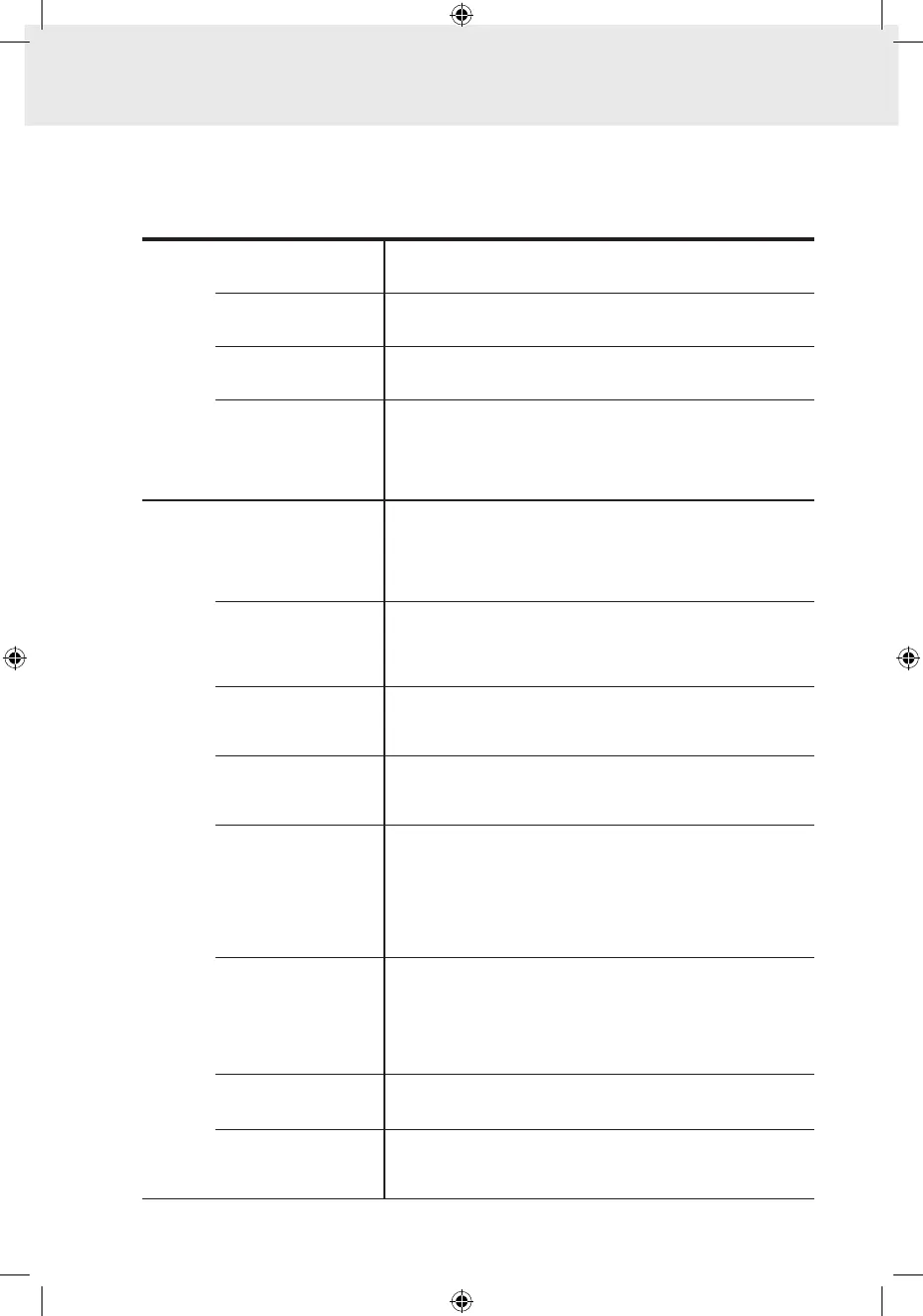
Common
It does not operate only
with the product body.
Check if the chamber set of the juicer or the container of the blender and
the product body are properly assembled. Make sure to turn the power off
when assembling or disassembling the product.
Assemble it so that it is
aligned with the safety
sensor.
Check if it is assembled in accordance with the guide mark. Make sure to
turn the power off when assembling or disassembling the product.
There are cracks or
scratch marks on the
product.
In the process of making the molding, curve-shaped marks are created in
addition to the straight-lined mold marks. They are normal parts and do not
affect the operation at all.
It does not work.
Check if the power cord is properly inserted. The machine may not
work after a long period of use. It will operate normally after the heat of
the product body (motor) cools down. Check if the product is properly
assembled. If the product is assembled incorrectly, it will not work. Check
if the product is assembled according to the steps specified in the assembly
guide. Refer to the assembly guide page.
The juicer stops operating
during juicing.
Juice may leak through the pulp outlet immediately after inserting
ingredients. Have an excessive amount of ingredients or extremely thick
ingredients been inserted? Refer to Page 11 of the manual to activate a
reverse rotation. For safety, a timer, which automatically stops after about 5
minutes from the start of operation, is set. Press the [START/STOP] button
again briefly to start operation.
Juice leaks through the
pulp outlet immediately
after
the ingredients are
inserted.
Depending on the inserted ingredients, small amounts of juice may
leak through the pulp outlet. This is not a product defect but, rather, a
phenomenon caused by the characteristics of the ingredients. The leakage
will stop once the product starts running. If the leakage continues, contact
the Customer Service Center.
Juicer
Juice flows back into the
hopper.
Did you extract juice with the juice cap closed? When juicing with the juice
cap closed, the juice may flow backward into the hopper. If the contents are
not sufficiently discharged even after opening the juice cap again, open the
hopper cover and empty out the contents.
Juice leaks between the
hopper and the chamber,
or between the chamber
and the product body.
Is the hopper packing or chamber packing assembled correctly? The juice
will leak if the hopper packing or chamber packing has been assembled
upside-down or incompletely. Check if the packing is assembled properly.
The hopper does not open.
There may be excessive pulp remaining inside. Operate the product to
discharge the pulp inside or repeat the process of activating a reverse
rotation for about 10 seconds and then stopping 2 to 3 times. Then, the
hopper will open without any issue. Were any foreign substances or solid
matter (hard seeds such as persimmon seed) inserted? If any foreign
substances or solid matters are inserted, parts may be damaged more
seriously when attempting a reverse rotation so contact the Customer
Service Center and request after-sales service.
The chamber shakes
during juicing.
The product may wobble slightly due to the motions of the product body's
motor. Depending on the ingredients' characteristics (hard or tough),
motions are generated in various magnitudes. This is not a malfunction
but, rather, a normal phenomenon observed when the screw rotates.
Compared to soft ingredients with much water content, relatively harder
ingredients may seem to produce a greater vibration. (e.g., carrots,
potatoes, radishes, beets, kohlrabi, etc.)
The discharge cover is
closed but the pulp is
discharged.
Even if the lever is closed, pulp will be discharged naturally. Depending on
the ingredients used, there may be a difference in the amount and speed of
discharge.
An unusual noise is heard
while juicing.
It is a natural sound produced when ingredients are being crushed. If the
ingredients are hard or tough like apples, carrots, cabbage, celery, beets,
etc., the extraction noise may be louder than that heard when juicing softer
ingredients.


 To Next Page
 Loading...