
 Need help?
Do you have a question about the Husqvarna PW3300 and is the answer not in the manual?
Torque values for standard metric machine hardware, including size, grade, and torque in ft/lbs and Nm.
Torque values for standard machine hardware (SAE grades), including size, grade, and torque in ft/lbs and Nm.
This document serves as an illustrated parts list for a Husqvarna pressure washer, providing a comprehensive guide for identifying and ordering replacement components. The manual is designed to assist users in maintaining and repairing their pressure washer, ensuring its continued optimal performance.
A pressure washer is a powerful cleaning tool that uses a high-pressure stream of water to remove dirt, grime, mold, and other stubborn contaminants from various surfaces. It operates by drawing water from a source (such as a garden hose), pressurizing it through a pump, and then expelling it through a nozzle at a significantly increased force. This high-pressure water stream is highly effective for a wide range of cleaning tasks, making it a versatile tool for both residential and commercial applications.
The core function of this Husqvarna pressure washer is to deliver a consistent and powerful water jet for efficient cleaning. The device is equipped with an engine that drives a pump, which is the heart of the pressure washing system. The engine provides the necessary power, while the pump converts this power into hydraulic energy, creating the high-pressure water flow. The water is then directed through a high-pressure hose to a spray gun, which allows the user to control the direction and intensity of the water stream. Various nozzles can be attached to the spray gun to alter the spray pattern and pressure, adapting the tool to different cleaning requirements.
Beyond basic cleaning, pressure washers can also be used for more specialized tasks. For instance, with the appropriate attachments, they can be used for applying detergents or other cleaning solutions, further enhancing their cleaning capabilities. The chemical tank, as indicated in the parts list, allows for the integration of cleaning agents directly into the water stream, making it easier to tackle heavily soiled areas. The ability to switch between different cleaning modes—from high-pressure blasting to gentle detergent application—underscores the versatility of this device.
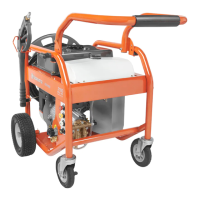
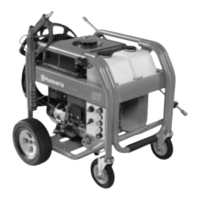
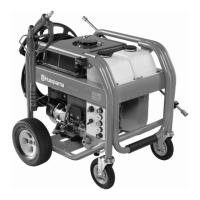
The Husqvarna pressure washer is designed with several features to enhance its usability and effectiveness. The main unit, as depicted in the illustrations, includes a robust frame with wheels and a handle, facilitating easy maneuverability around the cleaning area. This portability is crucial for tackling large or spread-out cleaning projects, allowing the user to move the heavy equipment with minimal effort. The handle also provides a comfortable grip for pushing or pulling the unit, reducing user fatigue during extended operation.
The inclusion of a chemical tank is a significant usage feature, enabling the user to apply cleaning solutions directly through the pressure washer. This eliminates the need for separate buckets and applicators, streamlining the cleaning process. The chemical tank valve allows for controlled dispensing of the cleaning agent, ensuring efficient usage and preventing waste. This feature is particularly useful for tasks requiring degreasing, mold removal, or deep cleaning, where detergents are essential for achieving optimal results.
The spray gun, hose, and various nozzles are integral to the user experience. The spray gun provides precise control over the water stream, allowing the user to target specific areas with accuracy. The high-pressure hose is designed to withstand the intense pressure generated by the pump, ensuring safety and durability. The different nozzles, such as the QC (Quick Connect) nozzles in various colors (Black, Red, Green, Yellow, White), offer a range of spray patterns—from a concentrated pencil jet for tough stains to a wide fan spray for general cleaning or delicate surfaces. This quick-change nozzle system allows for rapid adaptation to different cleaning tasks without interrupting the workflow.
Safety features are also implicitly integrated into the design. The robust construction of the unit, including the heat shields for the engine and muffler, helps protect the user from hot components during operation. The vibration mounts further enhance user comfort by reducing engine vibrations, contributing to a smoother and more stable operation. The presence of a thermal relief valve indicates a mechanism to prevent overheating of the pump, which is a critical safety and longevity feature.
Maintaining the Husqvarna pressure washer is crucial for its longevity and consistent performance, and the parts list highlights several components relevant to maintenance. The pump, being a central component, is designed with various kits for repair and servicing, such as the unloader kit, check valve kit, piston kit, chemical injector kit, water seal kit, support ring kit, hardware kit, oil seals kit, and O-ring kit. These kits suggest that individual pump components can be replaced, allowing for targeted repairs rather than requiring a complete pump replacement, which can be more cost-effective. Regular inspection and replacement of these wear-and-tear parts are essential for maintaining pump efficiency and preventing leaks.
The engine, while not fully detailed in this parts list (as engine parts are available through the engine manufacturer), is a critical component requiring its own maintenance. The presence of a fuel tank and fuel hose indicates the need for proper fuel management, including using the correct type of fuel and ensuring the fuel system is clean. The air cleaner, mentioned in the diagrams, is another vital engine component that requires regular cleaning or replacement to ensure proper air intake and engine performance.
Other maintenance-related components include the garden hose filter, which prevents debris from entering the pump, thereby protecting it from damage. Regular cleaning or replacement of this filter is a simple yet effective maintenance task. The oil bottle and oil funnel suggest that regular oil changes are necessary for the engine, a standard maintenance practice for internal combustion engines. The battery and charger components indicate that if the unit has an electric start, the battery needs to be maintained and charged to ensure reliable starting.
The torque specification chart provided in the manual is a crucial maintenance feature, guiding users on the correct tightening specifications for various fasteners. Using the correct torque prevents overtightening, which can strip threads or damage components, and undertightening, which can lead to loose parts and potential failure. This attention to detail in assembly and maintenance is vital for the structural integrity and safe operation of the pressure washer. The detailed breakdown of hardware types and sizes further aids in correct reassembly and replacement.
 General
| Pressure | 3300 PSI |
|---|---|
| Power Source | Gasoline |
| Pump Type | Axial Cam |
| Nozzle Type | Quick Connect |
| Hose Length | 25 feet |



 To Next Page