CVH8, HVH8, TVH8, VA9, HVA9, TVA9: APPLICATION GUIDELINE & SERVICE MANUAL
Manufacturer reserves the right to change, at any time, specifications and designs without notice and without obligations.
5
Inverter
The inverter is located inside the control box. This is an air-cooled
device that communicates with the control board and drives the
compressor and fan motor to the demanded RPM. The inverter is always
powered with line voltage since no contactor is used. The inverter
changes the line voltage to DC volts and then recreates 3 phase sine
waves that vary in frequency to drive the compressor and fan motor at
the desired RPM.
NOTE: The unit may be operated with an Observer Wall Control or a
standard 2-stage HP thermostat. Observer Wall Control will utilize 5
stages of heating and cooling, while 2-stage HP thermostat will only
allow 2 discrete stages of heating and cooling operation.
Variable Speed Compressor
This unit contains a variable speed rotary compressor that has a wide
operating range. It operates on a variable 3 phase sine wave provided by
the inverter. This compressor can only be operated by the specific
inverter supplied with the unit.
Electronic Expansion Valve (EXV)
This unit uses an electronic expansion valve for refrigerant metering in
the heating mode. The control board drives the EXV to its proper
position based on the operating mode and conditions. The Observer Wall
Control Service mode allows for manual opening and closing of the
EXV for troubleshooting and pump down.
Outdoor Fan Motor
The compact ECM outdoor fan motor is a variable-speed brushless DC
(BLDC) motor that operates at speeds from 400 to 1050 RPM. The
motor is a 3-phase permanent magnet-type motor. Just like the
compressor, this motor speed is determined by the inverter output
frequency and amplitude.
Motor speed is controlled through the inverter board in the outdoor unit
and no electronic module is attached. Motor speed is slowed as the
building load decreases, maintaining the proper condensing temperature
for both cooling and dehumidification. As the building load increases,
the motor will increase speed until it is at maximum speed at the
maximum building load.
At unit start-up, there is a slight delay and thrust motion of the fan
motor/blade in the reverse direction, prior to ramping-up the fan
assembly.
Pressure Transducer (SPT)
A 5 VDC output low pressure transducer that provides a 0-5 VDC data
for interpretation by the control board for a 0 to 200 psig range of
pressure at the suction tube. This interpreted pressure data is then
intelligently used by the AOC control board for low pressure cut-out,
loss of charge management, compressor protection, oil circulation
management, lubrication management and EXV control.
Pressure Equalizer Valve (PEV)
At the end of every compressor operation (after the 3.5 minute Time
Guard period), the equalizer valve opens for 150 seconds plus an
additional 15 seconds of protection before allowing the compressor to
start ramping up.
The PEV is located next to the suction and discharge of the compressor.
The function of this valve is to prevent the compressor from starting with
a high refrigerant pressure differential, thus helping the reliability of the
compressor.
NOTE: A hissing sound may be heard during the equalization process.
This is normal.
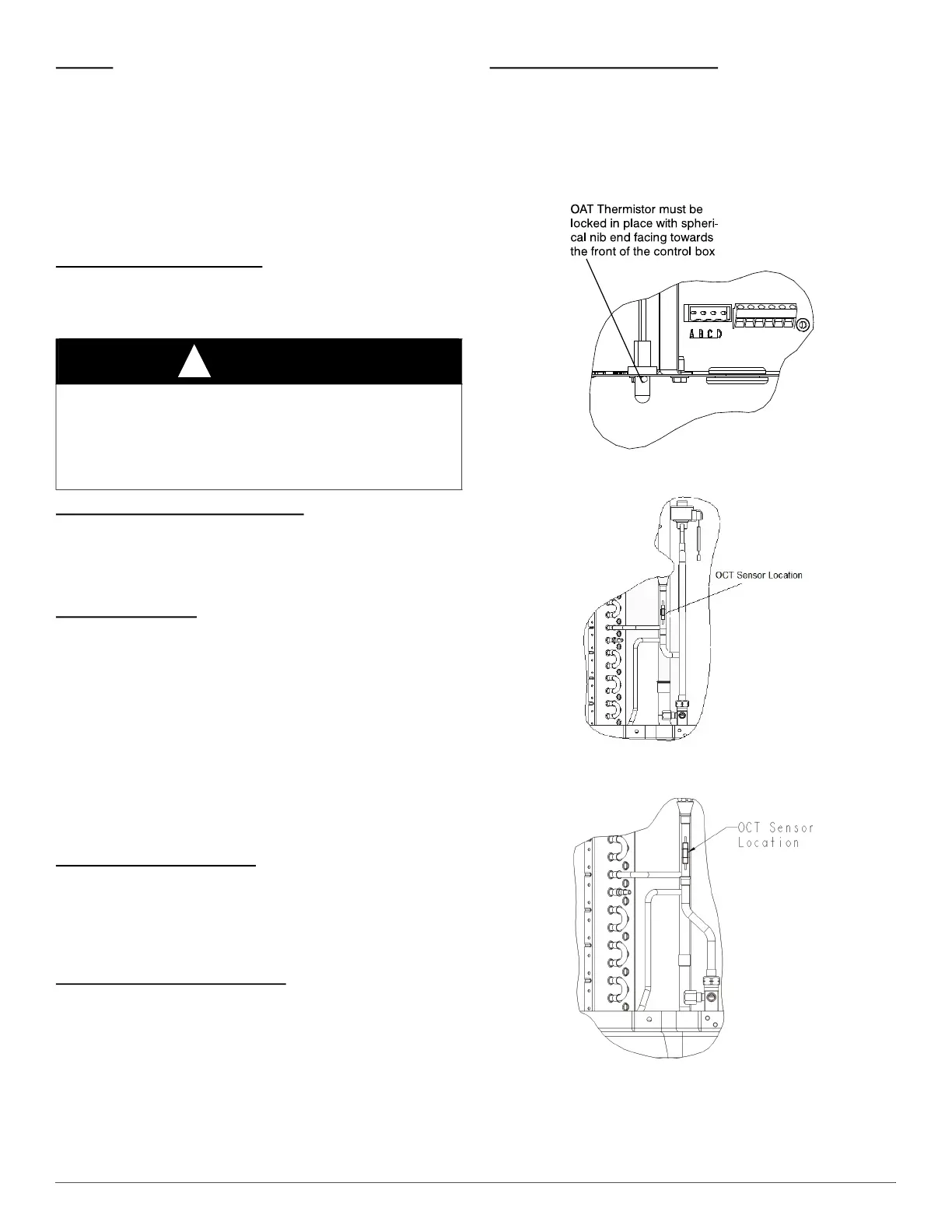
Outdoor Coil Thermistor (OCT)
The outdoor coil thermistor is a 10Kohm resistor used for multiple
system operations. It provides the coil/liquid line temperature to the heat
pump board and user interface. Low ambient operation, defrost
initiation, defrost termination and assistance with OAT temperature
measurement of some of the functions (see Fig.2) . The sensor must be
securely mounted to the tube connecting the EXV and distributor. See
Fig. 3 and Fig. 4 for proper placement. See Table 5 for proper
resistances.
A11142
Fig. 2 – OAT Thermistor Location (Bottom of Control Box)
A14302
Fig. 3 – HP Outdoor Coil Thermistor (OCT) Attachment
(On Distributor Tube)
A14328
Fig. 4 – AC Outdoor Coil Thermistor (OCT) Attachment
(On Distributor Tube)
CAUTION
!
EQUIPMENT DAMAGE HAZARD
Failure to follow this caution may result in equipment damage and/or
improper operation.
Do not attempt to apply line voltage directly to the compressor. This
will destroy the compressor.



 To Next Page