5. MAKE HEATER PLUMBING CONNECTIONS
Connect ALL the plumbing valves in the sequence shown in diagram 1.
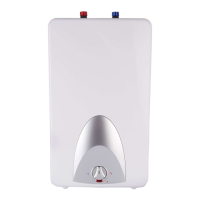
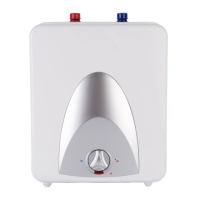
The cold water inlet to the heater is marked BLUE and the hot water outlet is marked RED.
OBSERVE FLOW DIRECTION ARROWS ON SUPPLIED VALVES.
The drain valve must be fi tted close to the COLD inlet to allow drain down if necessary.
An isolating valve should be fi tted UPSTREAM of all of the valves to allow the heater to be maintained without impacting on
other facilities.
Do NOT fi t a service or other valves between the heater and the pressure relief (safety) valve as this could impede its
correct operation.
The pressure reducing valve is factory set at 3 bar. If a balanced cold water draw off is required this should be tee-ed off
down stream of this valve.
A balanced cold water feed is recommended as it ensures hot and cold water is supplied at the same pressure. Some mixer
taps and thermostatic showers require hot and cold water to be to be at the same pressure for correct operation.
The expansion vessel supplied must be supported using a bracket or similar fi xing. Do not rely on the pipework alone – it will
not be strong enough. The orientation of the vessel is not important.
When all valves are correctly fi tted, open a hot tap and wait until the water fl ow is steady and without traces of air. Close the
tap to allow the system to reach full pressure and carefully check system for leaks.
CONTROL VALVES MAY BE SUPPLIED LOOSELY CONNECTED FOR IDENTIFICATION PURPOSES, BUT THESE
JOINS HAVE NOT BEEN LEAK TESTED. THIS MUST BE DONE AT INSTALLATION.
IT IS ESSENTIAL TO ALSO CHECK THE TEMPERATURE PRESSURE RELIEF VALVE CONNECTION TO THE
HEATER FOR LEAKS. NOTE THAT A LEAK FROM THE TEMPERATURE AND PRESSURE RELIEF VALVE MAY NOT
BE IMMEDIATELY OBVIOUS, AS THE CONNECTION IS AT THE TOP OF THE HEATER AND LEAKING WATER
MAY IN THE FIRST INSTANCE RUN DOWN THE PIPEWORK AND COLLECT IN THE HEATER INSULATION.
6. DISCHARGE PIPE CONNECTIONS (SEE DIAGRAM 3, PAGE 4)
This product falls within the scope of Building Regulation G3 which stipulates certain conditions relating to the way any water
discharge from relief valves is transported away.
These conditions are designed to ensure that any discharge will not present a hazard to people or to property, and that any
discharge is clearly visible so that the underlying cause is likely to be rectifi ed promptly.
The essential requirement of G3 in relation to water discharge is that the discharge pipe MUST terminate in a safe, visible
position.
In achieving this aim the G3 regulations strongly recommended that:
1. The tundish is located within 500mm of the Temperature and Pressure Relief valve and it is wherever possible oriented
vertically. It must be visible to occupants and positioned away from electrical devices.
2. The discharge pipe has a vertical fall of at least 300mm immediately below the tundish.
3. The discharge pipe below the tundish is at least 22mm diameter (i.e. one size larger than the Temperature and Pressure
Relief valve outlet).
4. The discharge pipe should be as straight and as short as is possible and positioned away from electrical components.
Diagram 3 illustrates an acceptable discharge pipe arrangement. The table below the diagram specifi es how the maximum
acceptable pipe length from the tundish to the fi nal outlet depends on the pipe diameter and the number of bends (reference
the chart on page 4 for pipe sizing).
For example in 22mm copper with no bends the pipe could be up to 9m long. With two bends present the maximum length
drops to 9.0m - (2 x 0.80m) = 7.4m.
7. ELECTRICAL CONNECTIONS
The heater is supplied pre-wired with appropriate cable.
Electrical installation should conform to the latest edition of the IEE Wiring Regulations.
Electrical supply should be capable of isolation via a user-accessible double pole isolation switch rated for a 13A supply.
3
8. COMMISSIONING
Visually re-confi rm all plumbing and electrical connections are sound.
• Open a hot water tap and turn on mains water supply to the Powerfl ow heater
• Allow unit to fi ll and leave tap running for a short time to fl ush out the pipework and purge any air from the system
before closing the hot tap and checking the system for any leaks.
Check the operation of the Temperature and Pressure relief valve located at the top of the heater twisting the knob at the
top of the valve. This lifts the valve seat and water will fl ow rapidly and be visible at the tundish. Ensure the discharge pipe can
cope with this fl ow rate continuously. Release the Temperature and Pressure relief valve. The fl ow should stop completely.
Open the expansion relief valve and likewise check that water fl ows freely through the discharge pipe, that the discharge pipe
can cope with the fl ow rate and that the water fl ow ceases when the valve is released.
Switch on the electrical supply and select an appropriate heater setting on the thermostat knob (the thermostat is adjustable
in the approximate range 20°C to 65°C.
The neon indicator light comes on when the element is heating.
9. DRAINING THE UNIT
To drain the unit disconnect electrical supply and close service valve on cold inlet.
Open the drain cock on cold inlet and open a hot water outlet to enable air to replace draining water.
NOTE THAT A SMALL QUANTITY OF WATER WILL REMAIN IN THE TANK. THIS RESIDUAL WATER CAN
ONLY BE DRAINED BY REMOVING THE HEATING ELEMENT.
4
Diagram 3
Safety Device
Tundish
500mm MAXIMUM
Metal Discharge Pipe (D1) from
Temperature Relief to Tundish
Discharge Below
Fixed Grating
300mm MINIMUM
Metal Discharge Pipe (D2) from
Tundish with Continuous Fall
Fixed Grating
Trapped Gully
Sizing of D2 Copper Discharge pipe for common temperature relief valve outlet size
Valve
outlet
size
Minimum size of
discharge pipe (D1)
Minimum size of
discharge pipe (D2)
from Tundish
Maximum resistance allowed,
expressed as a length of straight
pipe (I.E. no elbows or bends)
Resistance
created by each
elbow or bend
G1/2 15mm 22mm up to 9m 0.8m
28mm up to 18m 1.0m
25mm * to 27m 1.4m


 To Previous Page
 Loading...