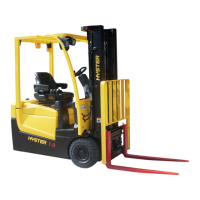
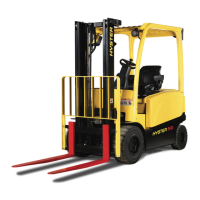
This document is a service and repair manual for Hyster C203 (A1.00XL, A1.25XL, A1.50XL Europe) electric lift trucks, focusing on the operation, maintenance, and repair of their DC motors.
Function Description
Electric lift trucks utilize Direct Current (DC) motors to convert electrical energy into mechanical energy, enabling various functions such as traction, hoisting, and power steering. The manual delves into the fundamental principles of magnetism and electromagnetism that govern DC motor operation. It explains how magnetic fields are generated by permanent magnets and current-carrying conductors, and how these fields interact to produce rotational movement in a motor. The "Right Hand Rule" is introduced to determine the direction of lines of force around a conductor and the magnetic polarity of a coil. Electromagnets, formed by winding wire around a core, are described as creating strong magnetic fields with distinct north and south poles, their strength dependent on the number of turns and current flow. Electromagnetic induction, the principle behind transformers, is also covered, explaining how a changing magnetic field can induce voltage. The core function of the motor is to generate a magnetic force on a conductor, causing it to move and produce rotation. This is achieved by the interaction of magnetic fields from permanent magnets or field windings and the magnetic field generated by current flowing through the armature conductors. The commutator plays a crucial role as a reversing switch, ensuring continuous rotation by changing the direction of current in the armature coils as they travel past the neutral point.
Important Technical Specifications
The manual details several types of DC motors used in lift trucks, each with distinct characteristics:
- Permanent-Magnet Motors: These motors use permanent magnets for their field, eliminating the need for field windings. They are typically smaller and less expensive, often used in power steering systems.
- Series Wound Motors: In these motors, field coils are connected in series with the armature circuit, meaning the same current flows through both. They exhibit high starting torque and quick acceleration, making them ideal for lift truck traction systems. Torque varies inversely with speed; high speed and low torque under light loads, and low speed and high torque under heavy loads. This characteristic is beneficial for hydraulic systems requiring varying speeds for different loads.
- Parallel or Shunt Wound Motors: Here, current divides between armature and field windings. These motors tend to maintain a constant speed under varying load conditions but have very little starting torque. Pure shunt motors are not typically used in Hyster lift truck systems.
- Compound Wound Motors: Combining features of series and shunt motors, these have both series and shunt windings. They offer good starting characteristics (like series motors) and reasonably constant speed between loaded and no-load conditions (like shunt motors). They are used in power steering and hydraulic systems.
Motor Insulation Class: Most motors in Hyster Electric Trucks are Class "H," meaning they can withstand an armature temperature of 177°C (350°F). The motor's frame temperature is usually 10 to 37°C (50 to 100°F) lower than the armature. Permanent magnet motors are not given an insulation class rating due to their lower maximum operating temperature (around 93°C or 200°F).
Bearings: Most bearings are double-sealed and pre-lubricated, not requiring further lubrication (except for traction motor drive ends on E20–100 series). Hyster-approved bearings are Class 3 (loose fit) with high-temperature grease and seals with correct shaft contact and high-temperature properties, lubricated with multi-purpose grease containing 2-4% molybdenum disulfide.
Commutator Structure: The commutator is made of alternate copper segments (bars) and mica plates, which physically separate and electrically insulate the bars. Mica plates are undercut below the commutator surface to prevent interference with brush sliding. The bars are wedge-shaped and held by a clamping action with a wedge ring and lock nut. Mica cones insulate the bars from ground.
Motor Frame Temperature: Exceeding 121°C (250°F) can damage internal components.
Usage Features
The manual highlights several aspects related to the usage of these motors:
- Motor Speed Control: In lift trucks, the voltage to the traction motor is controlled by either a resistor or an SCR-controlled circuit. Pump and power steering motors receive full battery voltage, with speed changing based on load.
- Direction of Rotation: Armature rotation depends on the direction of both the field and the armature current. Reversing either one reverses motor rotation. However, reversing both simultaneously maintains the original direction. Traction motor direction is changed by F/R contactors, while hoist and steering motors have a fixed direction.
- Torque: Motor torque is directly related to the current drawn from the battery; greater load requires more torque and current.
- Counter Electromotive Force (Counter-emf): This induced voltage opposes the applied terminal voltage and limits armature current. It depends on speed, direction, and field strength. A higher counter-emf reduces the effective voltage acting on the armature, thus limiting current.
Maintenance Features
The manual provides extensive guidance on maintenance, particularly for the commutator and brush assembly, which are identified as the primary areas requiring attention.
Break-in Operation:
- Critical Period: The break-in period (40 to 100 hours) is crucial for the commutator and brushes. Proper care ensures reasonable service life.
- Commutator Film: A protective film builds up on the commutator, and brushes conform to its surface. A properly seated-in commutator will have a dull, thin, dark chocolate coating.
- Battery Charge: Never break in a motor with an inadequate battery charge (1.240 or lower).
- Traction Motor: No special break-in procedure, but light duty operation (avoiding ramps, high-speed plugging, and stalling) is beneficial.
- Hoist Motor: Reduce the frequency of starts to mitigate in-rush currents. Avoid "jogging" (rapidly turning the motor on and off for fine positioning) as it is detrimental to brushes and commutator film. "Stoning" procedure can improve brush life for motors immediately put into heavy-duty service.
Cleaning:
- Periodic Cleaning: Essential to prevent overheating and electrical grounds.
- Motor Exterior: Wipe with a solvent-moistened cloth to remove dirt/grease.
- Carbon Dust: Remove brush inspection cover and use clean, dry compressed air (less than 3.52 kg/cm² or 50 psi) to blow dust from housing, brush holders, and commutator area.
- Disassembled Motor Interior: Preferably clean by suction first, then brush out dust from windings and blow clear with compressed air. Remove grease/oil from commutator by wiping with a clean cloth dampened with Perchloroethylene.
- Cautions: Solvents are inflammable and toxic; ensure good ventilation. Liquid solvent can carry conducting dirt into insulation cracks. Sealed bearings should not be submerged in solvent.
Handling Motors:
- Heavy Motors: Lift vertical drive motors with a lifting eye screwed onto the shaft.
- Horizontal Motors: Lift with a sling around the frame.
- Protection: Exercise care to protect terminals, shaft extensions, and accessories.
- Permanent Magnet Motors: Ceramic magnets are brittle; do not strike or drop PM motors.
Basic Repair Guidelines (Disassembly/Reassembly):
- Match Marks: Match mark the motor field case and end housings before separation for reassembly.
- Brushes: Before lifting off the brush-end housing, remove tension from brushes and keep them clear of the commutator during installation to prevent damage.
- Armature Assembly: Carefully lift out or install with the drive-end frame attached. Do not lose the wave washer behind the commutator-end bearing on some motors.
- Field Windings: Do not remove unless replacement is necessary; ensure they are securely mounted.
- Brush Holder Assembly: Match mark if removed from end housing.
- Terminal Torque: For specific Prestolite motors (MDV, MFD, MMW, MUD, MHG), terminal nuts and bolts have a maximum torque of 3.4 to 4.0 N.m (30 to 35 lb in).
Brushes and Brush Holders:
- Assembly: Consists of brushes, springs, holders, and a mounting device (insulated from the electrical circuit).
- Inspection: Before installing, inspect holders for burned spots and remove any roughness. Holders should be parallel to the commutator.
- Specifications: Brushes are vital replacement parts, carefully designed for specific operations. Width, thickness, length, and material properties (electrical, chemical, mechanical) must match the holder and commutator. Shunt length is important for brush travel, and shunt connections must withstand vibration and maintain positive electrical contact.
- Hyster Approved Parts: Use only Hyster-approved brushes and do not mix or change brush grades, as this can affect commutation, surface film, and brush life.
Commutator Surface Maintenance:
- Satisfactory Surface: A proper film of carbon, graphite, copper oxide, and water vapor, deposited by electrochemical action and brush wiping, is essential. This film takes hours or days to establish. A smooth, polished surface, even if varying in color (light brown to dark chocolate brown), indicates a satisfactory film.
- Unsatisfactory Surface Conditions:
- Streaking and Threading: Indicates metal transfer to the carbon brush, causing grooves. Light threading disturbs the surface film, while heavy threading creates a rippled surface. This disrupts brush-commutator contact, leading to arcing and commutation disruption. Causes include low current density, abrasive dirt/foreign material in the brush face, mica flakes/copper in the brush face, or wrong brush grade.
- Grooving: Smooth, slotted wear, usually from abrasive dust in the atmosphere. The rate of wear determines if it's detrimental. Causes are similar to threading: dirty/abrasive conditions, light load operation, low brush pressure, or worn brushes.
- Copper Drag: Small metal flakes or feathers dragged over trailing edges of commutator bars. Caused by particles that don't bond firmly to the surface. This reduces the distance between bars, leading to flashover. Temporary solution: clean with a brush-seater stone. If severe, slots must be raked and cleaned. Causes include contaminated atmosphere, copper in brush face, hard spots in brush, wrong brush grade, excessive vibration, or low current density.
- Electrical Burns: On opposite sides of commutator bars, indicating an open armature winding or a stalled motor.
- Flashover/Burning: Burning of commutator bar ends, deep burning of adjacent bars (open circuit in winding), or damage to varnish insulation (overheating). Causes: motor too hot, wrong lift truck for application, stalled motor, open armature winding, open field coil.
- Stalling Causes High Bars: If the motor stalls with power applied, commutator bars under brushes overheat and expand, rising above adjacent bars. This "kicks" brushes, causing arcing and burning. If uncorrected, brushes may shatter and flashover.
Overheating: Any condition causing excessive heat to a small area or the entire motor is detrimental, leading to flashover and discolored insulation varnish.

 Need help?

 To Next Page
 General