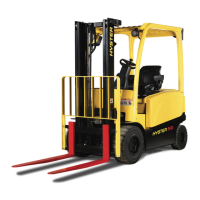
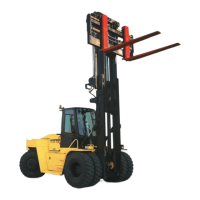
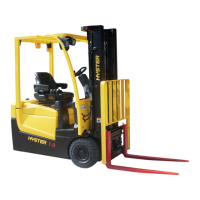
This document is a Service Repair Manual for Hyster A380 series forklifts, specifically covering models H40XT, H50XT, and H60XT. It focuses on mast repair, with detailed procedures for two-stage Limited Free-Lift (LFL) and three-stage Full Free-Lift (FFL) masts, as well as carriage and fork maintenance.
Function Description
The Hyster A380 series forklifts are designed for material handling, utilizing a mast system to lift and lower loads. The manual covers two primary mast types:
- Two-Stage LFL Mast: This mast type provides limited free-lift, meaning the forks can only rise a short distance before the inner mast begins to extend. It is covered for serial numbers A389 and A399.
- Three-Stage FFL Mast: This mast type offers full free-lift, allowing the forks to be raised to a significant height without increasing the overall mast height, which is beneficial in low-overhead environments. This type is covered for serial numbers A387 and A397.
The manual also details the repair and adjustment of various carriage types, including standard, integral sideshift, and fork positioner carriages, which enhance the forklift's versatility in handling different load sizes and types.
Important Technical Specifications
The manual provides specific technical data for various components, particularly concerning fork tip alignment and wear limits for carriage components.
- Mast Serial Numbers: The manual specifies applicability for mast serial numbers A387, A389, A397, and A399. The mast serial number location is on the right side of the outer mast, and it includes information such as the mast serial number series, manufacturing plant, production sequence, mast lift height (in millimeters), and mast assembly part number.
- Fork Tip Alignment: The difference in height between fork tips must be no more than 3% of the total fork length. A table provides specific maximum fork tip differences for various standard fork lengths, ranging from 914 mm (36 in.) with a maximum difference of 27.4 mm (1.08 in.) to 1829 mm (72 in.) with a maximum difference of 54.9 mm (2.20 in.).
- Fork Weight: Each hook fork for these lift trucks can weigh between 50 to 98 kg (110 to 216 lb), emphasizing the need for lifting devices during removal or installation.
- Lower Mounting Hook Wear Limit: The wear limit for lower mounting hooks is specified as 0.76 mm (0.03 in.) minimum and 1.52 mm (0.06 in.) maximum.
- Clearance Adjustment (Lower Mounting Hook): The clearance adjustment range is 0.76 mm (0.03 in.) minimum and 1.52 mm (0.06 in.) maximum.
- Sideshift Bearing Thickness: If either upper or lower sideshift bearing is worn to less than 2.5 mm (0.1 in.) thickness, both bearings must be replaced.
- Capscrew Torque: Capscrews for securing the inner fork carrier to the outer fork carrier should be tightened to 35 N·m (25 lbf ft). Capscrews for installing the load backrest on the carriage should be tightened to 195 N·m (144 lbf ft). Lower mounting hooks should be tightened to 150 to 180 N·m (108 to 132 lbf ft).
- Lifting Device Capacity: A crane with a capacity of at least 700 kg (1550 lb) is required to raise the inner mast. For lifting the outer frame of an integral sideshift carriage, a crane with a capacity of at least 78 kg (172 lb) is needed. For lifting the outer frame of a fork positioner carriage, a lifting device with a capacity of 92 kg (202 lb) is required.
Usage Features
The manual outlines procedures for:
- Fork Replacement: Detailed steps for removing and installing forks on standard, integral sideshift, and fork positioner carriages. It emphasizes replacing forks in sets by trained personnel only and never individually.
- Carriage Repair: Procedures for disassembling, cleaning, inspecting, and assembling standard, integral sideshift, and fork positioner carriages. This includes checking load rollers, chain anchors, and sideshift bearings.
- Mast Repair: Comprehensive instructions for removing, disassembling, cleaning, inspecting, assembling, and installing two-stage LFL and three-stage FFL masts.
- Hydraulic Hose Adjustment: Specific instructions for adjusting header hoses and fork positioner hydraulic hoses.
- Adjustments: Guidance on carriage adjustments, lift chain adjustments, and mast adjustments (load roller and mast side kicking).
- Hydraulic Quick Disconnect Hoses: Procedures for disconnecting and connecting attachment hydraulic quick disconnect hoses for both E-Hydraulic and Manual Hydraulic Controls.
Maintenance Features
The manual emphasizes safety and proper maintenance practices:
- Safety Precautions: A dedicated section highlights critical safety procedures, including disconnecting battery connectors, using correct blocks, wearing safety glasses, and using DO NOT OPERATE tags. It also provides specific warnings for working near the mast, such as lowering all parts or installing safety chains, and cautions regarding compressed air, cleaning solvents, and hot hydraulic oil.
- Inspection: Regular inspection of forks for cracks and wear, alignment of fork tips, and proper operation of fork lock pins is crucial. Carriage bars, chain anchors, and sideshift bearings also require thorough inspection for wear and damage.
- Replacement: Damaged forks must never be repaired by heating or welding; they must always be replaced as a pair. Worn or unserviceable chain anchors and pins, as well as damaged fork lock pins or components, should be replaced. Hoses should be replaced if leaking, worn through, damaged (cracked cover, exposed braiding, kinked, crushed, or no longer flexible), or if tensioned beyond adjustment range.
- Lubrication: Applying a 1 mm (0.040 in.) layer of multipurpose grease to upper and lower bearing surfaces during integral sideshift carriage assembly is specified.
- Cleaning: Instructions for cleaning carriage frames, but with a caution against using cleaning solvent, compressed air, or steam on lift chain sheaves or load rollers due to potential damage to sealed and lubricated bearings.
- Welding: A strict warning against improper welding procedures that could damage the mast structure or cause incorrect function. Consultation with a Hyster lift truck dealer or Resident Service Engineering is required before any welding on the mast.
- Approved Parts: Always use Hyster-approved parts that meet or exceed original equipment manufacturer specifications for repairs.
- Documentation: The manual advises making notes of shim locations and numbers when replacing load rollers to ensure correct adjustment. It also recommends tagging hydraulic lines and fittings prior to disconnection to aid in correct re-connection.

 Need help?

 To Next Page
 General