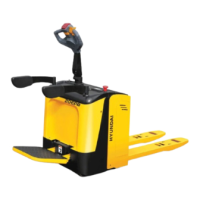
This document outlines the operation and maintenance of the 20EP electric pallet truck, a robust and efficient solution for material handling and stacking tasks. Designed for ease of use and reliability, this electric stacker leverages storage batteries as its power source and an AC motor for propulsion, with a DC motor and hydraulic system managing fork lifting. Its design emphasizes energy efficiency, high operational stability, and a low noise profile, making it suitable for various industrial environments without contributing to pollution.
The truck's primary function is the movement and stacking of goods, offering significant convenience in work processes. However, proper use and adherence to operational guidelines are crucial to prevent damage to the truck and ensure the safety of both operators and goods. Untrained personnel are strictly prohibited from operating the truck, underscoring the importance of following ISO 3691 "Safety Specification for Industrial Vehicles."
Usage Features
Before operation, a thorough check of the truck's condition is mandatory. This includes inspecting for any hydraulic oil leakage, ensuring supporting wheels operate normally without obstruction, and verifying battery charge levels. The electric lock on the handle must be unlocked, and the general power supply switch pulled out to activate the system. An illuminated zero-end grid on the electric energy meter indicates a depleted battery, necessitating immediate charging. Operating the truck with insufficient power is forbidden, as it can significantly reduce battery lifespan and cause damage.
Brake functionality is another critical pre-operation check. Operators must test the lifting, dropping, forward, and backward travel actions, as well as the emergency reverse mechanism. The control handle features distinct divisions (A, B, C) for different operations. In divisions A or C, the truck can only lift or lower goods, while travel is enabled in division B. The emergency reverse switch, located on top of the control handle, allows for quick backward movement in emergencies. Any detected failures must be repaired immediately, and trucks with problems are not to be operated.
During operation, the truck's side-magnetic brake and fine motion switch ensure controlled movement. Power and operation are only possible when the rotary arm is within a 30°±20° angle. Outside this range, the stacker is braked and loses power, though lifting goods remains possible. When lifting, the truck cannot travel.
For handling operations, the general power supply switch is pulled out, and the electric door lock unlocked. The travel knob controls forward and backward movement, with speed adjusted gradually. The truck should be positioned near the goods pile, ensuring the fork head is approximately 30cm from the goods. The lowering button adjusts fork height for insertion into the pallet, which should be as deep as possible. Goods are then lifted to at least 30cm from the ground before moving the truck to the desired location. After stopping, the lowering button is pressed until the fork is completely clear of the pallet, and the truck is driven away.
Operators must remain alert to obstacles, slow down at turns, and immediately switch off power if the truck becomes uncontrollable. The quick advance switch on the handle assembly provides an emergency reverse function.
Maintenance Features
Maintenance is crucial for the truck's satisfactory operation, safety, and longevity. Untrained personnel are prohibited from performing maintenance. Routine inspections are essential to identify and address abnormal conditions promptly.
Maintenance is categorized into three levels: routine, level I, and level II.
- Routine maintenance involves daily cleaning of the truck body and battery surface, along with checking the power supply cable's firmness.
- Level I maintenance is performed weekly. This includes all daily tasks plus a careful inspection of all parts for normal operation, loose fasteners, hydraulic oil leaks, abnormal wear, and any signs of overheating or sparks in electrical components. Any issues found require immediate adjustment or troubleshooting.
- Level II maintenance is conducted according to a planned schedule and involves an overall inspection of the truck.
Specific maintenance tasks include:
- Mechanical system maintenance (biannual): Lubricating transmission gears, drive wheel bearings, and rotary joints. Checking the firmness of fixing fittings and wheel flexibility. Ensuring normal fork lifting and lowering. Cleaning dirt and dust from the electromagnetic arrester's friction plate and adjusting its clearance to 0.2-0.3mm. The brake clearance adjustment involves loosening fixed screw 2, adjusting set screw 1, and then fastening retention screws. After adjustment, the brake should produce a clear sound with 24V DC power. The operation noise level after maintenance should not exceed 70dB.
- Hydraulic system maintenance (biannual): Inspecting the oil cylinder for external or internal leakage, and verifying the reliability of hydraulic connections and hoses. Hydraulic oil should be kept clean and replaced every 12 months, using ISO oil product standards. The type of hydraulic oil depends on ambient temperature (HL-N46 or HL-N68 for -5~40°C; HV-N46 or HV-N68 for -35~-5°C). Waste oil must be disposed of according to local regulations.
- Electric equipment maintenance (quarterly): Checking the specific gravity of the storage battery's electrolytic solution (1.24 at 25°C in tropical areas, 1.26 at 25°C elsewhere) and ensuring clean terminals. Adjusting specific gravity and cleaning/tightening terminals with Vaseline as needed. Verifying the reliability of electrical device connections, switch functionality, and insulation (resistance above 0.5MΩ). Cleaning dirt, dust, and carbon fouling from the motor, and checking/replacing electric brushes if worn.
Battery Use, Maintenance, and Charge
Battery care is critical for performance and lifespan.
- Initial charge: Batteries that have never been used require an initial charge in a well-ventilated area, free from open flames. Before charging, clean the battery surface, inspect for damage, and tighten bolts for reliable connections. Remove sealing covers and replace with open cover type liquid hole plugs. Pour sulfuric acid electrolytic solution (density 1.260±0.005 at 25°C, temperature below 30°C) into batteries, ensuring the liquid surface is 15-25mm above the protective board. Allow 3-4 hours for the solution to penetrate, with charging only commencing when the solution temperature is below 35°C. If the solution level drops, add more electrolytic solution. The sulfuric acid solution must be prepared with battery-grade sulfuric acid and distilled water, avoiding industrial sulfuric acid or running water.
- Charging process: Clean any electrolytic solution from battery surfaces. Connect positive and negative poles to the DC power supply (charger). Begin charging at 18A (first stage). When voltage reaches 28.8V, switch to 9A (second stage). Maintain solution temperature below 45°C; if it approaches 45°C, reduce current by 50% or stop charging until temperature drops to 35°C, then resume, prolonging charging time accordingly.
- Fully charged basis: Batteries are fully charged when voltage reaches 31.2V during second-stage charging, voltage variation is no more than 0.005V, electrolytic solution density is 1.080±0.005 (25°C) with no significant variation over 2 hours, and fine air bubbles appear violently. The charged capacity is 4-5 times the rated capacity, with a charging time of about 70 hours. During the final charging period, verify and adjust electrolytic solution density and liquid surface to stipulated values using distilled water or 1.40 density sulfuric acid. After initial charging, clean battery surfaces and close the liquid hole plugs.
- Regular use and maintenance: Batteries must be fully charged for optimal service life. Avoid over-discharge (voltage below 1.7V per battery, or total voltage below 20.4V). If electrolytic solution density drops to 1.17, stop discharge and charge immediately. Do not leave batteries idle for extended periods; conduct supplementary "common charges" frequently.
- Common charge: First stage current is 20A, second stage is 10A. Charging method is similar to initial charge. Charged volume is 130-140% of discharged volume, with a charging time of about 12 hours.
- Equalizing charge: Conducted every 2-3 months for normally used batteries, or for "lag-behind" batteries (those with lower voltage during discharge or repaired batteries), and for batteries unused for long periods. Charge with 4A current. When charge voltage reaches 31.2V and air bubbles appear, reduce current to 2A and continue. Once fully charged, stop for 0.5 hour, then charge with 1A for another hour. Repeat this stop-and-charge cycle until air bubbles appear violently when the charger is switched on.
- Storage: Store batteries in a clean, dry, well-ventilated warehouse at 5-40°C. Valid shelf life is 2 years. Avoid direct sunlight, keep at least 2m from heat sources, prevent contact with harmful substances or metallic objects, and do not place them upright down or subject them to mechanical impact or heavy compression. If batteries must be stored with electrolytic solution, they should be fully charged, and solution density/liquid surface adjusted to stipulated values. For storage exceeding one month, complementary common charges are required.
Warnings
- Always read the manual carefully and understand truck performance before operation.
- Do not press lift or lower buttons while the truck is moving or frequently switch between them, as this can damage the truck and goods.
- Avoid rapid or high-frequency lever shaking.
- Do not rapidly place heavy goods onto the forks.
- Never overload the truck; it will not operate normally when overloaded.
- Center goods between the forks to prevent damage and goods falling.
- Do not load loose or unstable goods.
- Avoid leaving goods on the forks for extended periods.
- Do not turn rapidly on narrow roads; turn slowly for safety.
- Lower forks to the lowest position when the truck is not in use.
- Never place any body part under heavy goods or forks.
- Use the truck on plane ground only; do not park on slopes for long periods.
- Over-load or over-slope operation is strictly forbidden; it can cause wheel slip, damage the wheel and motor, and compromise safety.
- Untrained individuals are forbidden from performing repairs.
- Operating the truck under the stipulated voltage of 20.4V is strictly forbidden.
- Do not directly connect the plug to an AC power supply for charging.

 Need help?
 General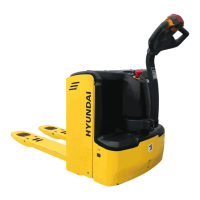

 To Next Page