Need help?
Do you have a question about the IMO Dash 4g and is the answer not in the manual?
Identifies and explains the physical components and buttons of the mobile device.
Instructions for inserting the SIM card, specifying nano-SIM compatibility and correct orientation.
Guide on inserting the battery and connecting the charger for the initial charge.
Instructions on how to power the device on and off using the End/Power key.
Steps to lock the phone screen using the power key and unlock it with soft keys.
Guide on dialling numbers, selecting contacts, and completing calls using keypad and soft keys.
Instructions on how to accept or reject incoming calls using soft keys.
Guide to composing and sending SMS messages from the home screen.
Instructions for sending MMS messages with attachments like pictures or audio.
Protecting the phone with PIN, Password, and understanding SIM card protection.
Using the screen as a viewfinder to position objects and take photos.
This document outlines the features and functionalities of the Imo Dash 4G mobile phone. It covers everything from basic phone operations to multimedia, internet, and security settings, providing a comprehensive guide for users.
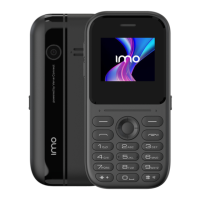
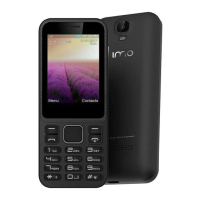
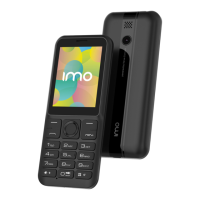
The Imo Dash 4G is a mobile phone designed for essential communication and multimedia functions. It features a standard keypad, a display screen, and various ports for connectivity.
The phone's layout includes a receiver for calls, a display for viewing information, and a Centre soft key for confirming options. The Left and Right soft keys are used for navigation and returning to previous screens or closing dialog boxes. A Dial key allows access to the call log, while the End key is used to terminate calls. Navigation keys provide shortcut access to menus and allow movement within selections. Special keys like "*" and "#" have multiple functions, including inputting symbols and changing input methods. The "0" key can be long-pressed to switch the torch on or off. A microphone is integrated for voice input.
To access internal components like the battery and SIM card, the back cover needs to be removed. Ensure the device is turned off before proceeding. Hold the device with the front panel facing down and gently pull the lower half of the back cover with your thumb or fingers to detach it from the opening.
The SIM card is crucial for phone number, service details, and memory for contacts and messages. Before installation, ensure the phone is turned off. Insert the SIM card into the designated slot with the gold contacts facing down and the cut-off corner facing outwards, as illustrated in the diagram. The Imo Dash 4G supports only nano-SIM cards. Attempting to insert other SIM types like micro or mini cards may damage the phone.
After the SIM card is installed, the battery can be inserted. For first-time use, the battery needs to be charged. Connect the adaptor to the charger jack, ensuring correct orientation to avoid forcing the connector. Plug the charger into a standard AC wall outlet. Disconnect the charger once the battery is fully charged.
To expand storage for media and applications, insert a microSD card into its slot with the gold contacts facing down. The camera and photo gallery applications require an SD card to function, so it's recommended to keep it installed and avoid random removal or replacement.
To power on the phone, press and hold the End / Power on key for approximately 5 seconds until the device powers up. To power off, navigate to the main menu, then press and hold the End / Power key for about 5 seconds.
The Home Screen features a Status bar at the top, which displays notifications and status icons such as phone status, battery strength, and the current time. The main display shows any scheduled appointments. Users can change the Home screen wallpaper by accessing Settings > Display > Wallpaper from the Home screen, selecting a new image, and saving it.
The phone's App list can be accessed by pressing either the Left soft key or the Centre soft key from the Home screen.
To lock the screen, press the Power key once to turn off the display. Pressing it again will lock the screen. To unlock, press the Left soft key once, followed by the Right soft key.
The Imo Dash 4G supports basic phone call functionalities, including making, answering, and declining calls, as well as accessing voicemail.
To make a call, dial the desired number using the keypad and press the Call key. Alternatively, press the Right soft key to select a contact from your Contacts list, navigate to the desired contact using the Navigation key, and then press the Call key. Incorrect digits can be deleted using the Left soft key. To end a call, press the End key.
The call list, accessible by pressing the Call key once, displays previously dialed numbers and contacts, including Missed, Dialed, Received, and Rejected Calls.
For international calls, press the "*" key twice to enter "+" before dialing the country prefix and phone number, then press the Call key. Emergency calls can be made by dialing the emergency number and pressing the Call key, even without a SIM card.
When a call is received, press the Left soft key or Call key to answer. To decline, press the Right soft key or End key.
Voicemail is a service provided by your network operator. To call voicemail, press and hold "1" on the phone keypad. Follow the voice prompts to set up your account and listen to messages.
The Contacts feature allows users to manage their phonebook efficiently.
Contacts can be accessed by pressing the Centre soft key from the Home screen and selecting "Contacts," or by pressing the Right soft key from the Home screen.
In the Contacts screen, press the Left soft key to access "Options," where you can select "Add a contact," "Import / Export," or "Others." The "Others" option allows setting up speed dial numbers and checking memory status, with up to 2000 contact spaces available.
To edit a contact, select it, press the Centre soft key to view "Details," then select "Options > Edit" and press the Centre soft key to make changes.
From the Contacts list screen, press the Left soft key to access "Options," select "Delete," and then press the Centre soft key to confirm deletion.
The Contacts list offers various options:
The phone supports sending and receiving text (SMS) and multimedia (MMS) messages.
To send a text message:
MMS allows sending video clips, images, photos, contacts, and sounds:
To access the phone's settings, press the Centre soft key from the Home screen and select "Settings."
This menu allows modification of various phone settings:
This option allows users to customize wallpaper settings, idle and screen savers, contrast, backlight, and auto keypad lock time.
Users can protect their phone by activating and changing the PIN and Password. The preset phone unlock password is "1234."
This menu allows configuration of call-related features:
This menu allows setting network preferences:
The Internet function allows users to browse the web. Simply type the desired web page URL into the "Input URL" bar. Users can bookmark favorite pages for quick access and view previous pages through the History option.
This menu provides access to various multimedia functions on the phone.
The phone has an in-built FM radio. A wired headset, supplied with the phone, acts as an antenna and must be inserted to enable the radio function. When listening, users can switch to speaker mode if desired.
This function allows recording digital video. Press this option and then "Record" to start video recording.
This option allows users to turn on the camera and view photos in the Photo menu.
This option allows users to select and listen to audio files stored on the phone.
This option allows users to view video files stored on the phone.
This function is used to record audio files. Recorded files are saved in AVI format and stored automatically in the Audio folder.
The mobile phone includes a camera for taking photos and shooting videos. To access the camera, press the Centre soft key from the home screen and select "Camera."
To access this function, press the Centre soft key from the Home screen and select "My Files." This feature provides internal storage space for file management and supports a Micro SD card. The contents of the Micro SD card are editable, allowing users to create new folders, delete, edit, search, mark, and view file details.
The Tools menu provides several utility functions.
This function allows users to turn the torch on or off.
The calendar helps keep track of meetings and appointments. Select a date and press the Centre soft key to enter a subject, date, time, and set a ringtone for a reminder. The "Options" menu allows adding new appointments, viewing schedules, clearing schedules, and viewing by day or week.
The calculator allows basic arithmetic operations. Use the up, down, left, right, and Centre soft keys to select the required symbols.
This function allows users to set alarms for their phone.
Users can select a city to add to their view of the World Clock by selecting "Options" and searching for the desired city.
This function allows users to read Ebook files saved on their phone.
This menu provides access to the Facebook application. Users can log in with an existing Facebook account or register for a new one.
This menu allows users to set the sound mode to Normal, Silent, Meeting, Indoor, or Outdoor.
Bluetooth enables data exchange (video, images, audio) with other Bluetooth-supported devices within a limited range after pairing.
 General
| Network | 4G |
|---|---|
| Processor | 1.3GHz Quad-Core |
| RAM | 1 GB |
| Internal Storage | 8 GB |
| Expandable Storage | microSD up to 32 GB |
| Rear Camera | 5 MP |
| Front Camera | 2 MP |
| SIM | Dual SIM |
| Weight | 150 grams |

 To Next Page