
 Need help?
Do you have a question about the Infinity Crescendo Series and is the answer not in the manual?
Advises on selecting amplifiers with sufficient power and current for optimal performance.
Details recommended speaker wire gauge, polarity, and connection for stereo systems.
Explains the importance of connecting speakers in phase for optimal sound localization and bass.
Details how to connect speakers for bi-amplification using two power amplifiers.
Explains the tweeter protection circuit and troubleshooting when it activates.
Advice on setting controls like equalizer, tone, and volume for safe operation.
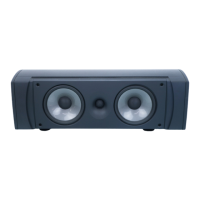
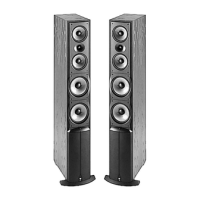
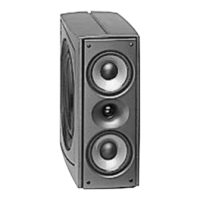
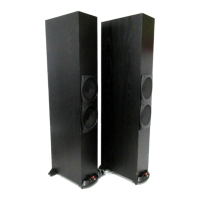
Detailed technical specifications for the CS 3006, CS 3007, CS 3008, and CS 3009 models.
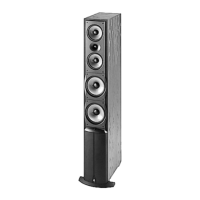
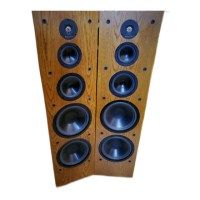
This document serves as an owner's manual for the Infinity Crescendo Series speakers, specifically models CS3006-3009. It provides comprehensive instructions and recommendations for the installation, operation, and maintenance of these high-fidelity audio devices, aiming to help users achieve optimal sound performance.
The Infinity Crescendo Series speakers are designed to deliver a highly musical and revealing audio experience. They incorporate advanced technology in their drivers, crossover networks, and cabinet construction, positioning them at the forefront of contemporary speaker design. The manual emphasizes that these speakers are capable of reproducing both music and any inherent distortions in the audio chain, underscoring the importance of carefully selecting associated audio components. When upgrading to a Crescendo Series system, users should expect an audible improvement in sonic quality, provided that other components meet similar standards for low distortion, phase linearity, and frequency response. If no improvement or even a deterioration in sound is observed, it suggests that existing components might be of a lower standard, as the revealing nature of Crescendo speakers can make musical colorations and other distortions more noticeable.
For optimal performance, the manual strongly recommends employing an amplifier with as much power as possible. Quality speakers, especially those in the Crescendo Series, perform best when driven by high current. Therefore, an amplifier with a robust, adequate power supply and a heavy-duty output stage is crucial. Such an amplifier generally leads to cleaner, better-defined bass response. While low distortion, excellent phase characteristics, and low noise are vital, continuous power delivery into a low impedance load is equally important. A critical point highlighted is that a lower power amplifier operating at its maximum output can damage speakers more quickly than a high power amplifier playing at loud levels. This is because overdriven amplifiers "clip" their output severely, generating high-frequency distortion that can cause the tweeter's voice coil to overheat and fail. Users are advised to always choose a high-power amplifier and consult their authorized Infinity dealer for recommendations. The Crescendo Series speakers are exceptionally revealing, capable of quickly identifying sonic anomalies within the listening system. Poor quality speaker cables and component interconnects can introduce harshness, detract from spaciousness, and reduce the airiness surrounding instruments and vocals.
The manual provides detailed instructions for unpacking the speakers. Upon opening the carton, users should carefully inspect the speakers for any signs of transit damage. In case of damage, it is imperative to immediately contact the dealer or the trucking firm that made the delivery, as delays can complicate the claims process. Users are also advised to fold the carton flat and store it for future use.
Connecting the speakers correctly is paramount for achieving the best sound. The manual instructs users to always turn off the entire audio system before making any connections. Each speaker should be connected to the amplifier's output terminals using the heaviest gauge wire available. The choice of speaker wire is critical for sonically revealing speakers like the Crescendo Series; inferior wire can degrade sound quality. Users should avoid wires thinner than 16 gauge, noting that a lower gauge number indicates a heavier wire. While gauge alone doesn't determine ultimate sonic quality, it's a good starting point. For generic lamp cord, polarity can be identified by ridges, stripes, or different colored insulation. A ridge or red insulation typically indicates positive (+), while smooth or white insulation indicates negative (-).
Connecting speakers in phase is crucial for accurate sound. This means all individual drivers should move in and out in the same direction simultaneously, which ensures optimal localization of instruments and vocals, as well as the deepest, most natural bass. Out-of-phase speakers will cause drivers in one channel to move in while those in the other move out, leading to sonic problems. Users should connect the RIGHT speaker to the amplifier's RIGHT channel output terminals and the LEFT speaker to the LEFT channel output terminals, ensuring no stray wire strands touch the ground terminal and observing polarity (speaker positive to amplifier positive, speaker negative to amplifier negative).
The Crescendo Series speakers also support bi-amp operation, allowing users to employ two power amplifiers for a purer and more open sound. In this configuration, one amplifier feeds the woofer section (via the speaker's crossover network), and the other drives the midrange/tweeter sections. To set this up, users must remove the two gold-plated straps connecting the bass and higher frequency sections of the crossover network. One amplifier is then connected to the bass terminal, and the other to the tweeter/midrange terminals, with polarity observed. A critical warning is issued: never attempt to use two separate amplifiers without first removing the shorting straps. If amplifiers have unequal power, the higher-power amplifier should drive the woofers. If one amplifier has a level control, it can be used to balance the output between the woofer and midrange/tweeter sections.
Bi-wiring is another connection option recommended by some audiophiles, involving two sets of connecting wires for a single power amplifier. This method is believed to improve current sharing and overall sound quality. To bi-wire, users remove the shorting straps, separating the woofer and midrange/tweeter sections. Two parallel speaker wires are then connected from the amplifier's output (for each channel) to the respective woofer and midrange/tweeter terminals.
Proper speaker positioning within the listening room is of primary importance for achieving the best possible performance. Even slight movements (as little as an inch) can result in noticeable sonic differences. Users are encouraged to experiment with placement until the speakers deliver their full musical potential. A useful starting point for stereo imaging is to place speakers at least seven feet apart. To minimize reflections and sonic anomalies, speakers should be located as far away as possible from walls and corners. Placing speakers too close to walls or corners can lead to hardness, smeared sound, lack of bass detail, and other forms of distortion often mistakenly attributed to the speakers themselves.
Angling the speakers inward (toe-in) can improve midrange and high-frequency projection, but excessive toe-in might reduce stereo imaging and front-to-rear depth. The ideal toe-in angle must be determined through experimentation, as it varies with room acoustics and listening position. The toe-in angle should be identical for both speakers, achievable by eye or using a tape measure. The speakers also feature two adjustable front feet that allow tilting them forward or rearward. Rotating the feet clockwise tilts the speaker rearward, while counter-clockwise tilts it forward. Tilting can help "tune" the speakers to the room and listening position, directing acoustic output from the midrange and tweeters to ear level. Users should be careful not to tilt the speakers excessively, as this can make them unstable. When installing, it's important to keep the speakers on the same plane (equal distance from the front wall) and aligned in the same direction.
Room acoustics significantly influence sound quality. Corners, for instance, can reinforce low frequencies and create severe bass problems, making it inarticulate. While moving speakers closer to corners or rear walls can reinforce bass, the general rule is to keep them as far away as possible. Balancing bass response is challenging because it's heavily influenced by the listening room's frequency spectrum. Constant experimentation with speaker placement and program material is necessary to find the optimal balance. Large areas of glass, mirrors, and wood paneling reflect sound waves, causing brittleness and excessive brightness. Soft surfaces like draperies, wall hangings, and absorptive furniture can help break up standing waves and reduce spurious sound waves. However, too much absorption can lead to a dull, lifeless sound. A good listening room has a balanced amount of reflection and absorption. A simple clap test can help assess room acoustics: a sharp echo indicates a reverberant room, while rapid decay and missing high frequencies suggest a dull room. Furniture, pictures, bookcases, tables, and lamps, being randomly placed, help reduce reflections and cancel standing waves. Carpeting or throw rugs also reduce floor reflections, though heavy carpeting can make the room seem "bass heavy." While it's customary to place speakers facing into the long dimension of the room, experimenting with placement into the short dimension can sometimes yield better results due to specific room acoustics and listener position.
The Crescendo Series speakers incorporate an EMIT-R Protection Circuit within the crossover network to safeguard the EMIT-R Tweeter from excessive power and high-frequency distortion caused by amplifier clipping. If the tweeter turns off during music playback, users should turn off the entire audio system to allow the protection electronics to cool. The circuit automatically resets once it reaches normal operating temperature. If the tweeter continuously turns off, it indicates that the amplifier may lack adequate power and is likely clipping severely, which can damage the tweeter. In such cases, users should consult their dealer or Infinity.
Regarding audio system controls, users should never operate the system with equalizer, tone, and loudness controls set to maximum boost, as this can strain the amplifier and damage the speakers. The volume control setting itself is less important than the actual loudness level. Users should always turn down the system volume completely when changing inputs (e.g., phono to CD to FM) to prevent loud transients from damaging speakers. Similarly, when changing wires or pulling plugs, all equipment should be turned off to prevent transients.
Acoustic feedback can cause boomy bass, lack of tightness, or excessive bass driver movement. This occurs when speaker vibrations reach a turntable and tone arm, creating resonance that feeds back into the electronics and speakers. Since Crescendo speakers extend to very low frequencies, isolating the turntable from vibrations is crucial. The turntable should be placed on a heavy, solid support as far from the speakers as possible. Shock-mounted bases can also help. If feedback persists, users should contact their dealer. CD players are also susceptible to acoustic feedback and should be mounted on solid supports or on rubber/plastic legs with predetermined elasticity.
For maintenance, the wood finish can be cleaned with a soft cloth and a fine furniture oil. If using spray cleaner/polish, care should be taken to avoid spraying the grille cloth. The grille can be vacuumed occasionally, but always on low suction to prevent tearing the cloth.
In the event of trouble, the manual suggests troubleshooting steps. Users can check for distortion in each speaker separately. If the fault is present in both, the problem is likely elsewhere in the system. If it's in only one channel, reversing the amplifier outputs (right-to-left and left-to-right) can determine if the fault moves with the channel, indicating the speaker is not the issue. This technique can also help locate faults between the signal source, preamp/receiver, and power amplifier. If troubleshooting is unsuccessful, users should contact their Authorized Infinity Dealer or Infinity Customer Service directly. Infinity provides contact information for their Customer Service department. It is crucial not to ship any parts or whole speakers for service without prior authorization ("Return Authorization") and without enclosing a copy of the original bill of sale. If no authorized service facility is available or if the problem cannot be resolved, users can write, phone, or FAX Infinity Systems, Inc. Customer Service with a specific description of the difficulty.
The manual concludes with a Limited Warranty statement. The warranty protects the original retail purchaser and subsequent owners for five years (parts and labor) from manufacturing defects, provided the speaker was purchased within the fifty United States or from an authorized military outlet, and the original dated bill of sale is presented. The warranty covers defects in original materials and workmanship but excludes damage from accident, misuse, abuse, neglect, product modification, shipping damage, failure to follow instructions, unauthorized repairs, misrepresentations by the seller, or products with altered serial numbers. Infinity will cover labor and material expenses for warrantable defects. To obtain service, users should first contact their dealer or Infinity Customer Service. Users are responsible for transporting the product and paying shipping charges, but Infinity will cover return shipping if repairs are covered by warranty. Infinity can suggest alternative procedures or provide packing materials if needed. All implied warranties are limited to the warranty period. Infinity is not responsible for incidental or consequential damages, with liability limited to repair or replacement of a defective product. The warranty provides specific legal rights, which may vary by state.
 General
| Nominal Impedance | 6 Ohms |
|---|---|
| Sensitivity | 90dB |
| Crossover Frequency | 3kHz |
| Midrange | 4" |
| Tweeter | 1" |



 To Next Page