Need help?
Do you have a question about the Infoblox Trinzic TE-815 and is the answer not in the manual?
Overview of Trinzic TE-805, TE-815, and TE-825 network services appliances, their core features, and HA mode support.
Overview of the Network Insight ND-805 appliance, focusing on its device and network discovery capabilities.
Overview of the Trinzic Reporting TR-805 appliance for data collection, storage, and report generation.
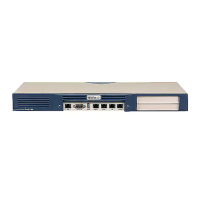
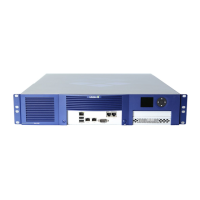
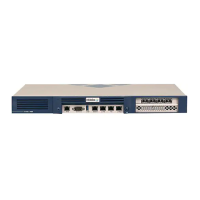
Details the components and indicators on the front panel of the Infoblox 805 Series appliances, including ports and buttons.
Explains compliance with CC and FIPS 140-2 security standards and the application of tamper-evident FIPS labels.
Describes the status conveyed by Activity and Link LEDs on Ethernet ports based on color and illumination.
Details the pin assignments for the DB-9 console port and RJ-45 Ethernet ports on the appliance's front panel.
Identifies components on the rear panel of the Infoblox 805 Series appliances, such as air vents and fans.
Outlines the physical characteristics of the Infoblox 805 Series appliances, including form factor, dimensions, and weight.
Lists the operating and storage temperature, humidity limits, and airflow requirements for the appliances.
Details the input voltage, frequency, current, power factor, and output power of the appliances.
Provides step-by-step instructions for mounting the Infoblox 805 Series appliances into standard equipment racks using various methods.
Guides on how to safely connect and turn on the power for the Infoblox 805 Series appliance.
Explains how to connect the Infoblox 805 Series appliance to a network using Ethernet cables for single units and HA pairs.
Details methods for accessing and configuring the appliance, including through a web browser and CLI.
The Infoblox 805 Series appliances are 1-U rack-mountable platforms designed to provide core network services and advanced network management capabilities. This series includes the Trinzic TE-805, TE-815, and TE-825 for core network services, the Network Insight ND-805 for expanded device discovery, and the Trinzic Reporting TR-805 for data collection and reporting. All appliances in the Infoblox Trinzic 805 series are Class A digital appliances, compliant with FCC regulations, RoHS, and WEEE.
The Trinzic TE-805, TE-815, and TE-825 network services appliances are designed to deliver essential core network services. These include DNS (Domain Name System), DHCP (Dynamic Host Configuration Protocol), IPAM (IP Address Management), and NTP (Network Time Protocol). These appliances can operate as Grid members and are capable of high availability (HA) mode when paired with a second appliance of the same model. They support Grid management and all administrative features for Infoblox IPAM, DNS, DDNS, and DHCP. The TE-825 and TE-V825 models can also be made compliant with CC (Common Criteria) and FIPS (Information Processing Standard) 140-2 security standards, offering enhanced security features.
The Network Insight ND-805 is a high-performance network appliance focused on expanded device discovery. It utilizes SNMP and other protocols to discover, query, and catalogue a wide range of network devices. This includes enterprise Ethernet switches, routers, firewalls, security devices, VoIP softswitches, load balancers, and end host devices. The ND-805 features three active 1GbE Ethernet interfaces: two dedicated for Device Discovery and one (MGMT) for device management. It integrates with the Infoblox Grid for management but does not support HA operation, functioning solely as a Grid member.
The Trinzic Reporting TR-805 is a specialized reporting appliance. Its primary function is to collect data from Infoblox Grid members, store this data in a dedicated reporting database, and generate statistical reports. These reports provide insights into IPAM, DNS, DHCP, and overall system activities and performance. Like the ND-805, the TR-805 features three active 1GbE Ethernet interfaces: two for event data collection and one (MGMT) for device management. It is managed through the Infoblox Grid and operates as a Grid member without HA support.
All Infoblox 805 Series appliances are managed through the Infoblox Grid Manager, a graphical user interface (GUI) accessible via standard web browsers in Windows, Linux, and Mac environments. This centralized management simplifies configuration and monitoring. Initial setup involves connecting the appliance to a network via the LAN1 port, which defaults to specific IP settings (192.168.1.2/24 with a gateway at 192.168.1.1). The HA, MGMT, and LAN2 ports do not have default network settings and must be configured.
The appliances support auto-provisioning by default, allowing a DHCP server to automatically assign an IP address. This feature simplifies initial deployment. If auto-provisioning is not desired, users can wait one minute before connecting the appliance to the network, or if an IP address has already been set via CLI, Grid Manager, or API, auto-provisioning is disabled. When auto-provisioning is enabled, services like DNS, DHCP, FTP, TFTP, HTTP, NTP, blox Tools, Captive Portal, and Reporting are disabled until a static IP address is configured.
For high availability, the Trinzic TE-815 and TE-825 appliances can be configured in an HA pair. This involves connecting both LAN1 and HA ports of each appliance to a network switch, ensuring the Virtual IP (VIP), LAN1, and HA port addresses are on the same subnet and unique. Proper configuration of switch port settings, such as disabling Spanning Tree Protocol, Trunking, EtherChannel, IGMP Snooping, and Port Channeling, is crucial for VRRP (Virtual Router Redundancy Protocol) to function correctly. Speed and Duplex settings should match between the appliance and the switch.
The Infoblox NIOS CLI (Command Line Interface) provides an alternative method for configuration and monitoring, especially for tasks like resetting the appliance. It can be accessed directly via a serial console connection or remotely via SSHv2. The CLI offers a small set of commands, categorized into set for configuration and show for displaying settings, with extensive help documentation available for each command.
The front panel of the appliance includes an On/Off Switch (hidden, requiring a small blunt object to push), a Power LED (green for power, red for error), an IPMI Port for Lights Out Management (LOM), a Console Port (male DB-9 serial), USB Ports (reserved for future use), and Gigabit Ethernet ports (MGMT, LAN1, LAN2, HA). The MGMT, LAN1, and LAN2 ports are 10/100/1000-Mbps auto-sensing. The LAN1 port is essential for initial setup, while LAN2 is disabled by default. The HA port is used for HA pairs and is inactive for ND-805 and TR-805 models. A UID Button illuminates a blue LED on the rear panel for easy identification in a rack.
The Infoblox 805 Series appliances are designed for ease of installation and maintenance. They are 1-U rack-mountable and come with accessory kits for various rack mounting procedures: two-post, four-post, and adjustable rail four-post. Rack mounting requires specific clearances for optimal airflow: 63.5 cm (25 in) in front, 76.2 cm (30 in) in the rear, and 121.9 cm (48 in) from the back of the rack to another rack. The appliance draws air from the front and expels it through the rear, necessitating unobstructed airflow.
Ethernet Port LEDs provide visual cues for link activity and connection speeds. A steady yellow Activity LED indicates the link is up but inactive, while blinking yellow signifies active link. Dark indicates the link is down. For Link status, steady amber means 1000 Mbps, steady green means 100 Mbps, and dark means 10 Mbps. These LEDs assist in quick troubleshooting of network connectivity.
The IPMI/LOM port supports 10/100/1000 Mbps operations and auto-negotiates up to Fast Ethernet 100BASE-TX. It is crucial to connect the IPMI port to the network properly and configure LOM through the Infoblox Grid Manager for remote management. Best practices advise against connecting the LOM port to general-use data center networks or 1 Gbps/10 Gbps switch interfaces.
For serial console connections, a male DB-9 port is available. Users can connect a management system using an RJ-45 rollover cable with two female RJ-45-to-female DB-9 adapters, or a female DB-9-to-female DB-9 null modem cable. It is important to use a properly grounded USB-to-Serial dongle if connecting to a laptop to prevent damage to the console port.
The appliance includes fans on the rear panel to maintain optimum operating temperature. An air vent allows warm air to flow out, and it should not be obstructed. The UID LED on the rear panel, activated by the UID button, helps locate the server in a rack environment.
For Trinzic TE-825 and TE-V825 appliances requiring FIPS compliance, tamper-evident FIPS labels must be affixed to the HDD cover and over the IPMI port. The chassis should be cleaned before applying these labels.
In cases of auto-negotiation failure for Ethernet ports, where the appliance connects at lower speeds or mismatched duplex settings, users should first check for firmware upgrades for the connecting switch. If this does not resolve the issue, manually setting the ports on both the Infoblox appliance and the switch to 1000-Mbps full-duplex connections is recommended.
The Infoblox Grid Manager and CLI provide tools for diagnosing and resolving network issues, allowing administrators to monitor system health and performance effectively.
 General
| Brand | Infoblox |
|---|---|
| Model | Trinzic TE-815 |
| Category | Network Hardware |
| Language | English |


 To Next Page