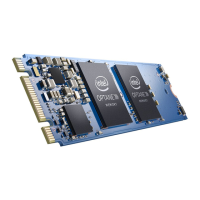
Intel® Optane™ Memory M Series
February 2021 Installation & User Guide
345866-002US 5
6. Drivers/Software
a. Intel® Rapid Storage Technology (Intel® RST) Windows Driver. See here for supported driver
versions per processor.
b. Intel® Optane™ Memory and Storage Management application, available here.
1.3 Intel® Volume Management Device (Intel® VMD) Support
The 11
th
Generation Intel® Core™ Processors enabled support for Intel® VMD. This changes the way these
platforms are configured for Intel® RST and the related Intel® Optane™ memory technology vs. earlier processor
generations.
Following is a summary of these changes, related sections in the document will specify the proper settings for
Non-Intel® VMD systems vs Intel® VMD capable systems.
For how to determine if your platform is Intel® VMD capable or not, contact your system/motherboard vendor.
• BIOS: The settings in the BIOS are different from earlier, non-Intel® VMD capable platforms.
• Operating System Installation:
o Intel® VMD support starts with driver version 18.0.x, this version is not included in current Windows
10 OS builds.
o Drives managed by Intel® VMD will not be detected during the OS installation process.
o The f6flpy Intel® RST driver must be loaded during the installation process to detect these drives.
• Windows Driver name:
o Intel® VMD Capable/Enabled Platform: ‘iastorVD’
o Non-Intel® VMD Capable Platform: ’iastorac’
• Device Manager: The listing will be under the ‘PCI Express Root Complex’ section.
1.4 Limitations/Things to Keep in Mind
The following items are important to keep in mind when configuring a system with Intel® Optane™ memory.
• The acceleration of the following “Slower media” is not supported:
o RAID volumes or other multiple disk/drive configurations
o PCIe NVMe drives that are not listed in Section 1.2
o Drives with more than one system partition, dual boot OS for example.
• Dynamic type drives are not supported, only Basic type.
• MBR Partition structure is not supported, any drives to be accelerated must have a GUID Partition Structure (GPT).
see Section 2.2 for options to check the partition structure and make changes if needed.
• Only one Intel® Optane™ memory volume is allowed per system. If more than one volume is detected during boot,
the second volume will be placed offline.
o When a drive is placed “offline” it means that the drive is put in a state where the operating system is
unable to detect the drive. The drive can still be detected in the Intel® Optane™ Memory and Storage
Management application and the System BIOS (Under the Intel® RST menu).



 To Next Page