ENGLISH
27
9 PUMP INSTALLATION
9.1 Installation
The pump must be xed horizontally using the M16x1.5
threaded support feet. Tighten the screws with a torque of 210
Nm.
The base must be perfectly at and rigid enough as not to
allow bending or misalignment on the pump coupling axis/
transmission due to torque transmitted during operation.
The unit cannot be xed rigidly to the oor but must
interposed with vibration dampers.
For special applications contact the Technical or Customer
Service Departments.
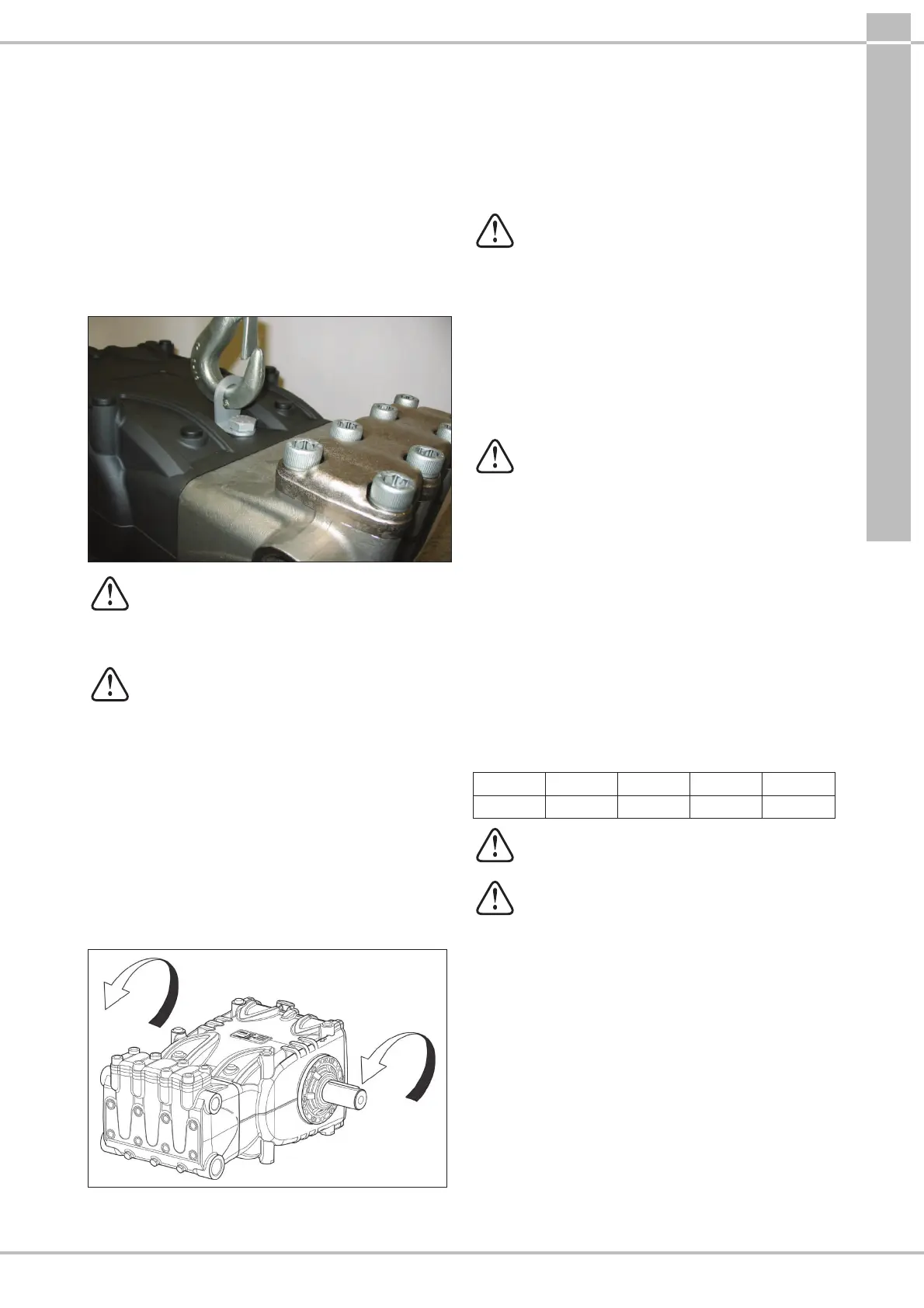
A lifting bracket is mounted on the pump for easy installation,
as per the gure below.
Replace the oil lling hole closing service plug
(red) positioned on the rear casing cover. Check
the correct quantity with the oil dipstick.
The oil dipstick must always be reachable, even
when the unit is assembled.
The pump shaft (PTO) should not be rigidly
connected to the propulsion unit.
The following types of transmission are
recommended:
- Hydraulics by ange, for proper application
consult with our Technical or Customer Service
Departments.
- V-belts.
- Cardan-shaft (comply with manufacturer's Max.
recommended working angles).
- Flexible joint.
9.2 Rotation direction
The rotation direction is indicated by an arrow located on the
casing near the drive shaft.
From a position facing the pump head, the rotation direction
will be as in Fig.5.
LH SIDE
clockwise
RH SIDE
anticlockwise
Fig.5
9.3 Version change
The pump version is dened as right when:
Observing the pump facing the head side, the pump shaft
must have a PTO shank on the right side.
The pump version is dened as left when:
Observing the pump facing the head side, the pump shaft
must have a PTO shank on the left side.
Note. The version shown in Fig.5 is right.
The version can only be modied by trained and
authorised personnel and carefully following the
instructions below:
1. Separate the hydraulic part from the mechanical
part as indicated in chapter2 par.2.2.1 of the
Repair manual.
2. Turn the mechanical part 180° and reposition
the rear casing cover in such a way that the
oil dipstick is turned upward. Reposition the
lifting bracket and relative hole closing plugs
in the upper part of the casing. Finally, properly
reposition the specication label in its housing
on the casing.
Make sure that the lower casing draining
holes in correspondence with the pistons are
open and not closed from the plastic plugs
provided for the previous version.
3. Unite the hydraulic part to the mechanical part
as indicated in chapter2 par.2.2.5 of the Repair
manual.
9.4 Hydraulic connections
In order to isolate the system from vibrations produced by
the pump, it is advisable to make the rst section of the duct
adjacent to the pump (both suction and outlet) with exible
piping. The consistency of the suction section must be such as
to prevent deformations caused by vacuums produced by the
pump.
9.5 Pump supply
To obtain the best volumetric eciency, feed the pumps with
a positive head (NPSHr).
The recommended value, measured on the head suction
ange, is given in the following table:
HF 18 HF 20 HF 22 HF 25
NPSH
r
(m) 2.5 4.0 4.0 4.5
The values given apply to the rated speed of
rotation; otherwise, contact our Technical or
Customer Service Departments.
For any supply conditions other than those
specied above, contact our Technical or
Customer Service Departments.


 To Next Page