
 To Next Page

J
Jennifer AlvarezAug 19, 2025
Why does my Invacare TDX SP2 have a short charging period?
- DDavid BrownAug 20, 2025
If your Invacare Wheelchair experiences a short charging period, one of the batteries could be defective and need replacement.

Why does my Invacare TDX SP2 have a short charging period?
If your Invacare Wheelchair experiences a short charging period, one of the batteries could be defective and need replacement.
How to troubleshoot Invacare Wheelchair that will not start?
If your Invacare Wheelchair won't start, there are several potential causes. First, ensure that the drive motors are engaged. If they are already engaged, the batteries may be defective and need replacement. Alternatively, the battery might be completely discharged, in which case you should pre-charge them.
Why does my Invacare Wheelchair run too slowly?
If your Invacare Wheelchair is running too slowly, the batteries may be defective and need replacing. Alternatively, the remote may be defective, requiring replacement.
What to do if Invacare Wheelchair motors stop and do not start again?
If the motors on your Invacare Wheelchair stop and don't restart, it could be due to a high motor load causing the power module to lower the voltage. Leave the mobility device switched on and let the power module operate. Charge the batteries overnight with the electronics turned on. Another possibility is a burnt-out fuse, so check the cabling and replace the fuse if necessary.
Why does my Invacare TDX SP2 Wheelchair pull to the left or right?
If your Invacare Wheelchair pulls to the left or right, it could be due to drive motors running asymmetrically. In this case, you should change the programming to synchronize the motors. Another possible cause is insufficient tire pressure. Check the tire pressure and replace the inner tube and/or valve if needed.
What causes Invacare TDX SP2 to judder in drive mode?
If your Invacare Wheelchair judders while driving, the batteries might be defective, resulting in unstable voltage, so you should replace them. Alternatively, the drive motor(s) could be defective, requiring their replacement. Another possible cause is worn carbon brushes, which should also be replaced.
What to do if Invacare TDX SP2 motors do not run?
If the motors on your Invacare Wheelchair do not run, begin by checking all cabling for bad connections. Also, inspect the fuse and replace it if it's burnt out. The batteries may be defective and need replacement. Check the cabling to the power module or remote for any defects. If the power module itself is defective, replace it. Lastly, check the cabling for defective contacts and replace them if necessary.
Why does the gearbox on my Invacare TDX SP2 Wheelchair make a clicking noise?
If the gearbox on your Invacare Wheelchair makes a clicking noise, the gearbox itself might be defective and need replacement. Another possibility is a loose drive wheel. Tighten the drive wheel and secure the bolts with thread-locking adhesive if necessary.
How to fix Invacare Wheelchair error message that does not disappear?
If the error message on your Invacare Wheelchair does not disappear, start by checking all connecting cables for bad connections. Another potential cause is a defective motor brake. Measure the internal resistance of the brakes and replace the motor if the brakes are indeed defective.
What to do if Invacare Wheelchair batteries are not being charged?
If your Invacare Wheelchair batteries are not being charged, the fuse may be burnt out, or the cable may be defective. Check the cabling and replace the fuse.
Manual provides important handling and safety information for the product.
Explains signal words and symbols used for hazards and unsafe practices.
Describes the intended user and purpose of the mobility device.
Recommends use of power wheelchair for specific mobility limitations.
Classifies the vehicle according to EN 12184 as a Class B mobility product.
Details testing standards and compliance with regulations.
Outlines situations where the device should not be used or requires immediate attention.
Explains manufacturer's warranty and claims process.
Estimates the product's service life and factors affecting it.
Details Invacare's liability for damages.
Provides crucial safety warnings regarding fire, injury, and misuse.
Covers risks of accidental motion, switching off while driving, and transfers.
Covers risks of falling out, exceeding load, lifting, moving parts, and hot surfaces.
Details hazards related to electrical system misuse, fire, oxygen, and shorts.
Discusses risks from water exposure, corrosion, and improper battery connections.
Warns about potential malfunctions due to EMI and precautions.
Addresses dangers of malfunctioning joysticks causing unintended movement.
Covers risks of tipping, load limits, and safe driving posture.
Details risks from weather, foot placement, narrow passages, legrest position, and antitippers.
Warns against incorrect repairs and highlights maintenance importance.
Warns about using incorrect parts and unapproved accessories.
Details risks associated with moving parts under a raised lifter.
Covers risks of tipping, module malfunction, loading, and speed reduction.
Explains various labels and symbols on the mobility device.
Details symbols, WEEE conformity, and specific warnings for operation.
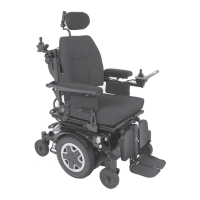
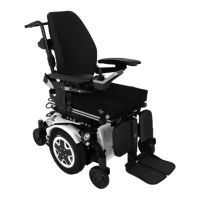
Identifies key components of the wheelchair with labels.
Refers to separate manuals for remote functions.
Explains lifter operation, including temperature effects.
Describes the purpose and function of posture belts.
Explains how to use the cane holder for safe transport.
Details how to attach and remove accessories using the KLICKfix system.
Covers initial setup warnings and requirements for safe configuration.
Provides a chart for converting imperial to metric measurements.
Introduces remote adjustment possibilities for various seating systems.
Details adjustments for height, orientation, and display.
Covers adjustments for depth and height of the midline holder.
Details how to adjust the pad position on the head array.
Explains how to adjust the swing-away mechanism's depth.
Covers adjustments for manual chin controls and extremity joysticks.
Details adjustments for powered chin controls and linkage.
Covers armrest and hip support adjustments.
Covers armrest and seat adjustments specific to the Max seat.
Warns about seat tilt affecting stability and describes manual adjustment.
Covers backrest height, width, angle, and bend adjustments.
Covers position, height, and cheek support adjustments for Rea headrests.
Covers Elan headrest installation and hardware adjustment.
Covers width, height, and depth adjustments for trunk supports.
Covers lateral, depth adjustments, and swinging the tray away.
Covers legrest removal, angle, and length adjustments.
Covers length, foot plate, footboard, and calf pad adjustments.
Covers swivel, angle, end stop, and length adjustments.
Covers swivel, angle, end stop, length, calf pad, foot plate adjustments.
Covers swivel, angle, length, calf pad, foot plate adjustments.
Covers swivel, angle, length, calf pad, foot plate adjustments.
Covers swivel/removal and length adjustments.
Covers calf pad height, width, and legrest length adjustments.
Details how to adjust the width of side-mounted legrests.
Warns about unexpected behavior due to locked castors.
Guides on familiarization, posture belt use, and pre-drive checks.
Instructions for parking and securing the mobility device.
Mentions armrest removal for side transfers and transfer guidance.
Covers SureStep technology, obstacle height, safety, and correct methods.
Warns about tipping and braking risks on slopes.
Information on using the device on public roads with lighting systems.
Explains freewheel mode, motor disengagement, and safety warnings.
Explains overload protection and error codes for the control system.
Covers battery information, charging, handling, storage, usage, and disposal.
General precautions for transporting the device, especially with a tray.
Safety warnings and procedures for transferring the device to a vehicle.
Discusses using the device as a seat and securing the user and device.
Instructions for transporting the device without the user, including battery removal.
Defines maintenance and recommends annual checks by a provider.
Guidelines for cleaning and disinfecting the mobility device.
Lists inspection checks for users and intervals.
Information on dealing with wheel damages and tyre pressure.
Instructions for storing the device when awaiting repair.
Guidelines for preparing the device and batteries for long-term storage.
Steps for reconditioning the product for a new user.
Environmental hazard warnings and procedures for product disposal.
Provides operating/storage conditions and electrical system details.
Details charging specs, tyre types, and driving characteristics.
Covers rated slopes, obstacle heights, drive range, and dimensions.
Details total width, length, stowage dimensions, and seat height.
Provides dimensions for seat width, depth, backrest height, and armrest adjustments.
Details seat angle adjustments and dimensions for various legrests.
Lists kerb weights for different configurations and component weights.
Specifies maximum payload and axle loads for the device.
Details inspection schedule and record-keeping for service.
 General
| Weight Capacity | 300 lbs |
|---|---|
| Seat Width | 16, 18, 20 inches |
| Seat Depth | 16, 18 inches |
| Battery | Group 22 batteries |
| Overall Length | 42 inches |
| Motor Type | DC motors |