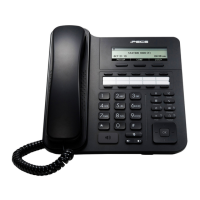
Need help?
Do you have a question about the iPECS 1010i and is the answer not in the manual?
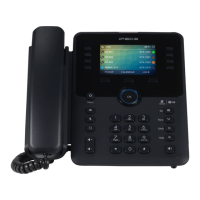
Diagram illustrating the physical buttons and components of the Ericsson-LG iPECS 1010i phone.
Detailed functions of the fixed buttons on the iPECS 1010i phone, such as MSG, Mute, Headset, Dir, Trans, DND, Menu, Volume, Speaker.
Explanation of programmable flexible buttons, the LCD display's role, and the interactive functions of soft keys.
Procedures for answering incoming calls, making external and internal calls, and picking up calls.
Instructions on how to reject an incoming call and place an active call on hold.
Guide to using speed dial and directory features for efficient call initiation.
Steps for redialing numbers and accessing the call log for recent calls.
Instructions on accessing voicemail, listening to messages, and managing greetings or passwords.
Procedures for parking active calls and using the camp-on feature for waiting calls.
Guidance on transferring calls to other extensions or numbers and returning from a transfer.
How to activate and deactivate the DND feature to make your extension unavailable for calls.
Instructions for setting up 3-way conference calls by adding parties to an active call.
Steps to program call forwarding rules (unconditional, busy, no answer) and disable forwarding.
The Ericsson-LG Enterprise iPECS 1010i Handset is a sophisticated communication device designed to enhance productivity and streamline call management for businesses. This guide outlines its key features, usage instructions, and maintenance considerations, ensuring users can fully leverage its capabilities for efficient communication.
The handset's layout is intuitively designed for ease of use, featuring a central LCD display that provides essential information at a glance. Surrounding the display are several interactive elements, including Soft Keys, which dynamically change their function based on the phone's status, offering context-sensitive options. A Ring/Message Indicator visually alerts users to incoming calls or new messages, ensuring important communications are not missed. Flexible Buttons, programmable to specific lines or features, allow for personalized customization, adapting the phone to individual workflow needs.
Navigation is made simple with the Navigation Key, enabling users to scroll through menus and lists, while the OK Key confirms selections. The Dial Pad Buttons are standard for entering numbers and text, facilitating quick dialing and data input. For audio control, the Volume Button adjusts the ring, headset, handset, and speaker volume, providing flexibility in different environments. The Speaker Button toggles the speakerphone on and off during a call, illuminating when the phone is in menu mode to indicate its active status.
Fixed Buttons offer direct access to frequently used functions. The MSG button provides access to message boxes, allowing users to retrieve voicemails and internal messages. The Mute button silences the microphone during a call, ensuring privacy. A dedicated Headset icon button allows users to toggle between headset and handset audio if a headset is connected. The Dir button is used to assign or access assigned station speed dial numbers, simplifying contact management. The Trans button facilitates call transfers and also provides access to the Program menu when the phone is idle. The DND (Do-Not-Disturb) button blocks incoming calls and can terminate a ringing call, sending a busy tone to the caller. The Hold button places a call on hold, playing on-hold music or comfort tones to the caller. The Menu button opens the phone's settings, where users can customize display options, font, and other configurations.
Answering an incoming call is straightforward: simply lift the handset. To answer a call on another extension, press the flashing flex key and then lift the handset. Making an external call involves lifting the handset and pressing a free flex key allocated to a line, or the '9' key to pick up an outside line, then dialing the desired number. For internal calls, lift the handset and dial the extension number or press the flex key assigned to the contact. To reject a call, press the DND button when a call comes in. Call Pick Up allows users to answer calls ringing on other handsets: lift the handset and dial '566' for any handset in your group, or '*77' followed by the station number for a handset not in your group. Placing a call on hold is done by pressing the HOLD button; to reconnect, press HOLD again.
The Speed Dial/Directory feature is accessed via the Directory button. Users can enter the first character(s) of a name (e.g., pressing '5' twice for 'K') to find contacts. Once found using the navigation key, pressing OK or 'Send' dials the number. The Redialling a number function is available through the LOG soft key, allowing users to scroll through recent calls and redial using the SEND soft key. The Call Log lists called and received numbers, with the DETAIL soft key providing more information on a call.
Accessing voicemail is initiated by pressing the Message button, followed by selecting options such as '1' for a call back to an internal user, '2' for missed calls, '3' for voicemail, or '4' for SMS. If the password is unknown, the system administrator should be contacted. Once in the voicemail inbox, options include '1' for new messages, '2' for saved messages, '3' for urgent messages, '4' to send messages or manage greetings, '5' for personal options, '8' to set greeting or password, and '0' to disconnect.
To park an active external call, press Transfer, dial the park code (e.g., #601 for Park 1), or press the assigned park key, then hang up. To retrieve a parked call, lift the handset and dial the park code or press the assigned park key.
When dialing an engaged extension, the Camp On feature notifies the station of a waiting call. Pressing the assigned flex key initiates camp on.
To transfer a call, press the Transfer button, dial the extension number, external number, or press the programmed flex key. Users can then either announce the call to the recipient or simply hang up. If unable to transfer, pressing the Transfer button again returns to the caller.
Do-Not-Disturb (DND) is activated by pressing the DND button and deactivated by pressing it again. This feature makes the extension unavailable for calls, though it is not available on the attendant handset. Ad Hoc Conference Calls, or 3-way calling, are initiated by calling the first party, then pressing the assigned flex key. Call the second party, and once connected, press the assigned flex key twice to connect the calls. To program a flex key for this, press Transfer, then the desired key, dial '91', and press OK.
Call Forward routes calls to another extension, group, or speed dial, overriding voicemail functions. Dial '501' (or assigned feature code) and select from options: '1' for Unconditional Forward (all calls instantly), '2' for Busy Call Forward (when on the phone), '3' for No Answer Call Forward (if not answered), or '4' for Busy/No Answer Call Forward (mix of 2 & 3). Then, dial the extension number. To disable all call forwarding, dial '502' (or assigned feature code).
The guide also provides instructions for quick access call tools and directory management. For speed dial/directory, press the Directory button, enter the first character(s) of the name, use the navigation key to scroll, and press OK or 'Send' to dial. For redialing, press the LOG soft key, scroll through the list, and press SEND. For call log details, press DETAIL and BACK to exit.
The Ericsson-LG Enterprise iPECS 1010i Handset is designed for robust performance and user-friendly operation, making it an essential tool for effective business communication. Its comprehensive features and intuitive interface ensure that users can manage calls, access voicemails, and utilize advanced telephony functions with ease.
 General
| Number of Programmable Keys | 8 |
|---|---|
| Speakerphone | Yes |
| Headset Port | Yes |
| Ring Tones | Multiple |
| Volume Control | Yes |
| Speed Dial | Yes |
| Call Log | Yes |
| Display | LCD |
| Ethernet Port | 1 |
| Power Supply | AC Adapter |

 To Next Page