EasyManua.ls Logo

iPECS ES-3024GP - User Manual

iPECS ES-3024GP
10 pages
Print Icon
To Next Page IconTo Next Page
Loading...
5. Conneting to the Switch
5.1 Using Console Port
Attach a VT100-compatible terminal, or a PC running a terminal emulation program to
the switch. You can use the console cable provided with this package.
To connect a terminal to the console port, complete the following steps :
Step 1 : Connect the console cable to the serial port on a terminal, or a PC running
terminal emulation software, and tighten the captive retaining screws on the
DB-9 connector.
Step 2 : Connect the other end of the cable to the RS-232 serial port on the switch.
Step 3 : Make sure the terminal emulation software is set as follows :
• Select the appropriate serial port (COM port 1, or COM port 2, …).
• Select the baud rates to 115200 bps.
• Select the data format to 8 data bits, 1 stop bit, and no parity.
• Set the emulation mode to VT100.
• When using HyperTerminal, select Terminal keys, not Windows keys.
5.2 Accessing the CLI
To access the switch through the console port, perform the following steps :
Step 1 : At the console prompt, enter the user name and password. (The default user
names are “admin” and “guest” with corresponding passwords of “admin”
and “guest”.) When the administrator user name and password is entered,
the CLI displays the “ES-3026#” prompt and enters privileged access mode.
But when the guest user name and password is entered, the CLI displays the
“ES-3026>” prompt and enters normal access mode.
Step 2 : Enter the necessary commands to complete your desired tasks.
Step 3 : When nished, exit the session with the “quit” or “exit” command.
After connecting to the system through the console port, the login screen displays :
User Access Verication
Username: admin
Password:
CLI session with the ES-3026 is opened.
To end the CLI session, enter [Exit]
ES-3026#
5.3 Setting IP Address
You must establish IP address information for the stack to obtain management access
through the network. This can be done in either of the following ways :
• Manual : You have to input the information, including IP address and subnet mask.
If your management station is not in the same IP subnet as the stack’s mas-
ter unit, you will also need to specify the default gateway router.
• Dynamic : The switch can send IPv4 conguration requests to BOOTP or DHCP ad-
dress allocation servers on the network.
To assign an IPv4 address to the switch, complete the following steps :
Step 1 : From the Global Conguration mode prompt, type “interface vlan 1” to access
the interface-conguration mode. Press <Enter>.
Step 2 : Type “ip address ip-address netmask”, where “ip-addressis the switch IP
address and “netmask” is the network mask for the network. Press <Enter>.
Step 3 : Type “exit” to return to the global conguration mode prompt. Press <Enter>.
Step 4 : To set the IP address of the default gateway for the network to which the
switch belongs, type “ip default-gateway gateway”, where “gateway” is the IP
address of the default gateway. Press <Enter>.
5.4 Setting Password
Passwords can consist of up to 8 alphanumeric characters and are case sensitive. To
prevent unauthorized access to the switch, set the passwords as follows :
Step 1 : Open the console interface with the default user name and password “admin”
to access the privileged access mode.
Step 2 : Type “congure” and press <Enter>.
Step 3 : Type “username guest password 0 password”, for the normal access mode,
where “password” is your new password. Press <Enter>.
Step 4 : Type “username admin password 0 password”, for the privileged access
mode, where “password” is your new password. Press <Enter>.
ES-3026(cong)#interface vlan 1
ES-3026(cong-if)#ip address 192.168.1.1 255.255.255.0
ES-3026(cong-if)#exit
ES-3026(cong)#ip default-gateway 192.168.1.254
Username: admin
Password:
CLI session with the ES-3026 is opened.
To end the CLI session, enter [Exit].
ES-3026#congure
ES-3026(cong)#username guest password 0 [password]
ES-3026(cong)#username admin password 0 [password]
ES-3026(cong)#
5.5 Connecting to the Web Interface
Prior to accessing the switch from a web browser, be sure you have rst performed
the following tasks :
Step 1 : Congure the switch with a valid IP address, subnet mask, and default gate-
way using an out-of-band serial connection, BOOTP, or DHCP protocol. (See
“5.3 Setting IP Address”)
Step 2 : Set user name and passwords using a serial connection. Access to the web
agent is controlled by the same user names and passwords as onboard con-
guration program. (See “5.4 Setting Password”)
Step 3 : After you enter a user name and password, you will have access to the sys-
tem conguration program.
When your web browser connects with the switch’s web agent, the home page is
displayed as shown below. The home page displays the Main Menu on the left side of
the screen and System Information on the right side. The Main Menu links are used to
navigate to other menus, and display conguration parameters and statistics.
Quick Installation Guide
iPECS Ethernet Switch
ES-3000/3000G Series
Package Contents
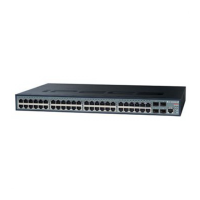
• Managed 26-Port FE Switch (ES-3026) or
Managed 26-Port FE PoE Switch (ES-3026P) or
Managed 24-Port GE Switch (ES-3024G) or
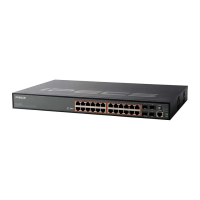
Managed 24-Port GE PoE Switch (ES-3024GP)
• RJ-45 to RS232 Console Cable
Four Adhesive Foot Pads
• Two Brackets and Eight Screws
• One Ground Screw
• Quick Installation Guide (QIG)
• Manual CD
Note : Power Cord is separately supplied for the product with the sufx of “*.STGDLN”
NOV/2012/ISSUE 2.2
150200000243A R02
Printed in China
Inquire and Technical Support
For further information, please refer to the Ericsson-LG Website at www.ericssonlg.com
Copyright
Information furnished by Ericsson-LG Co., Ltd. (Ericsson-LG) is believed to be accurate and reliable.
However, no responsibility is assumed by Ericsson-LG for its use, nor for any infringements of pat-
ents or other rights of third parties, which may result from its use. No license is granted by implication
or otherwise under any patent or patent rights of Ericsson-LG. Ericsson-LG reserves the right to
change specications at any time without notice.
Copyright Ericsson-LG Co., Ltd. 2011. All rights reserved. Ericsson-LG is a registered trademark.
Other product and company names are trademarks and registered trademarks of their respective-
holders.
iPECS is an Ericsson-LG Brand

Question and Answer IconNeed help?

Do you have a question about the iPECS ES-3024GP and is the answer not in the manual?

Summary

Package Contents

Overview

Installing the Switch

Selecting a Site

Guidelines for choosing a suitable location for the switch, considering temperature, airflow, and accessibility.

Rack Mounting

Instructions for mounting the switch in a standard 19-inch equipment rack, including grounding.

Desktop or Shelf Mounting

Steps for placing the switch on a flat surface, ensuring proper airflow and power connection.

Installing an Optional SFP Transceiver

Guide on how to select and insert SFP transceivers into the switch's SFP slots.

Powering Up

Port and System Status LEDs

Connecting to the Switch

Using Console Port

Instructions for connecting a terminal or PC to the switch's console port using the provided cable.

Accessing the CLI

Steps to access the Command Line Interface (CLI) using default or custom user credentials.

Setting IP Address

Procedure to configure the switch's IP address, subnet mask, and default gateway.

Setting Password

Steps to set or change user passwords for accessing the switch's CLI and web interface.

Connecting to the Web Interface

Guide to accessing the switch's management interface via a web browser after initial configuration.

Inquire and Technical Support

Copyright

Overview

The iPECS ES-3000/3000G Series is a family of fully managed Layer 2 Ethernet switches designed for enterprise-class networking. These switches offer advanced Quality of Service (QoS), robust security, and intuitive management features, enabling network administrators to build high-performing and reliable networks cost-effectively.

Function Description:

The iPECS ES-3000/3000G series provides Layer 2 switching capabilities, supporting various network configurations from Fast Ethernet to Gigabit Ethernet. The switches are designed to connect multiple network devices, facilitate data transfer, and manage network traffic efficiently. Specific models within the series also offer Power over Ethernet (PoE) capabilities, allowing them to power connected devices such as IP phones, wireless access points, and IP cameras directly through the Ethernet cable, simplifying deployment and reducing cabling requirements. The management features enable network administrators to configure, monitor, and troubleshoot the network, ensuring optimal performance and security.

Important Technical Specifications:

The series includes four main models:

  • ES-3026: A Managed 26-Port Fast Ethernet (FE) Switch. This model features 24 10/100 BASE-TX ports and two Small Form Factor Pluggable (SFP) transceiver slots (ports 25-26) that operate in combination with 10/100/1000 BASE-T ports.
  • ES-3026P: A Managed 26-Port Fast Ethernet (FE) PoE Switch. Similar to the ES-3026, it includes 24 10/100 BASE-TX ports and two SFP transceiver slots (ports 25-26) operating with 10/100/1000 BASE-T ports, with the added capability of providing PoE power to connected devices.
  • ES-3024G: A Managed 24-Port Gigabit Ethernet (GE) Switch. This model is equipped with 24 10/100/1000 BASE-T ports and four SFP transceiver slots (ports 21-24) that operate in combination with the BASE-T ports.
  • ES-3024GP: A Managed 24-Port Gigabit Ethernet (GE) PoE Switch. This model offers 24 10/100/1000 BASE-T ports and four SFP transceiver slots (ports 21-24) operating with the BASE-T ports, and it also provides PoE power to connected devices.

Environmental Specifications:

  • Operating Temperature: 0°C to 50°C (32°F to 122°F).
  • Humidity: 10% to 90%, non-condensing.
  • Power Supply: 100 to 240 VAC, 50 to 60 Hz. It is recommended to connect the unit to a separate grounded power outlet within 2 meters (6.6 feet) and powered from an independent circuit breaker. Using a filter or surge suppressor is also recommended.

SFP Transceiver Support:

The SFP slots support various optional SFP transceivers, including:

  • 1000BASE-SX
  • 1000BASE-LX
  • 1000BASE-LH
  • 100BASE-FX SFP transceivers are hot-swappable, meaning they can be installed or removed without powering off the switch, though network cables should always be disconnected first. SFP transceivers are not included in the switch package.

Usage Features:

  • Installation Flexibility: The switches can be deployed in various environments:
    • Rack Mounting: Standard 19-inch equipment rack mounting is supported. Proper grounding is essential, and attention should be paid to temperature, mechanical loading, and circuit overloading within the rack assembly. Brackets are provided for rack mounting.
    • Desktop or Shelf Mounting: The switches can be placed on a flat surface. Four adhesive foot pads are provided for stability. Adequate space (at least two inches) on all sides is required for proper airflow.
  • Console Port Access (CLI): The switch features an RS-232 console port for command-line interface (CLI) access. A RJ-45 to RS232 console cable is included. To access the CLI, a VT100-compatible terminal or a PC running terminal emulation software is required.
    • Console Settings: Baud rate: 115200 bps, Data format: 8 data bits, 1 stop bit, no parity, Emulation mode: VT100.
    • Login: Default usernames are "admin" and "guest" with corresponding passwords. "admin" provides privileged access mode (ES-3026# prompt), while "guest" provides normal access mode (ES-3026> prompt).
  • Web Interface Access: The switch can be managed via a web browser. Before accessing the web interface, the switch must be configured with a valid IP address, subnet mask, and default gateway (either manually or via BOOTP/DHCP), and user names and passwords must be set via the serial connection. The web interface displays a main menu for navigation and system information.
  • IP Address Configuration: IP address information can be set manually or dynamically via BOOTP/DHCP. Manual configuration involves setting the IP address, subnet mask, and default gateway through the CLI.
  • Password Setting: Passwords, consisting of up to 8 alphanumeric characters and case-sensitive, can be set for both "admin" (privileged access) and "guest" (normal access) users via the CLI to prevent unauthorized access.
  • LED Indicators: The switch includes a display panel with LEDs for system status and port indications, simplifying installation and network troubleshooting.
    • LNK/ACT LEDs (Fast Ethernet Ports 1-24):
      • Amber: Port operating at 10 Mbps. Flashes when active.
      • Green: Port operating at 100 Mbps. Flashes when active.
      • Off: No valid link.
    • LNK/ACT LEDs (SFP Gigabit Ethernet Ports 25-26 for ES-3026/P, or 21-24 for ES-3024G/GP):
      • Amber: Port operating at 10/100 Mbps. Flashes when active.
      • Green: Port operating at 1000 Mbps. Flashes when active.
      • Off: No valid link.
    • LNK LEDs (SFP Ethernet Ports 21-24 for ES-3024G/GP):
      • Green: SFP transceiver inserted.
      • Off: No SFP transceiver inserted.
    • System Status LEDs (PWR, Diag, PoE):
      • PWR:
  • Green: Internal power operates normally.
  • Off: No power supply plugged.
    • Diag:
  • Amber: System Diagnostic in progress.
  • Amber Flashing: System Diagnostic Fail.
  • Green: System Diagnostic test OK.
  • Green Flashing: Flashes while booting.
    • PoE (When Mode button pressed):
  • Amber: Port's LEDs display PoE status.
  • Amber Flashing: Power budget reached maximum value or power budget under and including 95% for the whole system.

Maintenance Features:

  • Quick Installation Guide (QIG): Provided for initial setup.
  • Manual CD: Contains comprehensive documentation for detailed configuration and troubleshooting.
  • Grounding: Rack-mounted equipment must be properly grounded. A ground screw is included for this purpose.
  • Cable Management: Twisted-pair cables should be routed away from power lines, fluorescent lighting, and other sources of electrical interference to ensure reliable network performance.
  • Troubleshooting: The LED indicators provide quick visual cues for system and port status, aiding in rapid identification of network issues. The console port and web interface offer detailed diagnostic and configuration options for advanced troubleshooting.
  • Power Cord Note: The power cord is supplied separately for products with the suffix "*.STGDLN".

The iPECS ES-3000/3000G series is designed for ease of use, robust performance, and flexible deployment, making it suitable for various enterprise networking needs.

iPECS ES-3024GP Specifications

General IconGeneral
BrandiPECS
ModelES-3024GP
CategorySwitch
LanguageEnglish

Related product manuals