
 Need help?
Do you have a question about the iRobot Roomba e5 and is the answer not in the manual?
Explains various safety alert symbols used in the manual.
Covers warnings and precautions for operating the robot.
Details safety advice specific to the Home Base charging station.
Provides essential warnings and precautions for battery use and care.
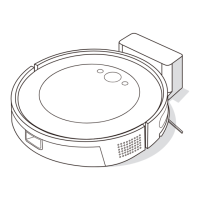
Identifies and labels the key parts of the robot and Home Base.
Instructions for correctly placing the Home Base charging station.
Guide to downloading and connecting the iRobot HOME app.
Covers initial robot activation and basic controls.
Details the function and modes of the Virtual Wall Barrier accessory.
Step-by-step instructions for emptying the robot's dustbin.
Guide on how to clean the robot's filter for optimal performance.
Instructions for washing the robot's dustbin.
How to clean the robot's front caster wheel.
Method for cleaning the edge-sweeping brush.
Steps to clean the robot's main brushes.
How to clean sensors and charging contacts.
Instructions for rebooting the robot to resolve issues.
Explanation of the robot's power-saving standby mode.
Guidelines for safely shipping the robot's battery.
Details on how to contact iRobot Customer Care and their hours.
Information on finding local support and resources globally.
Statements regarding FCC and Industry Canada regulatory compliance.
Information on RF exposure limits and battery recycling.
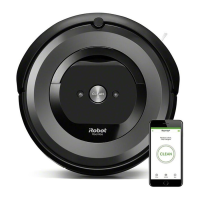
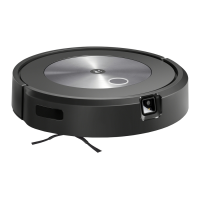
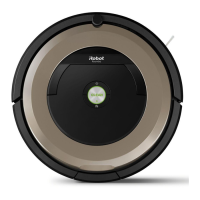
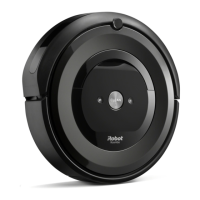
This document describes the Roomba® e5 Robot Vacuum, a device designed to autonomously clean dry floors. It is intended for indoor use and operates by navigating and cleaning various surfaces, including those with potential spills or high concentrations of dirt.
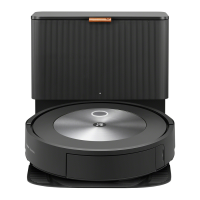
The Roomba® e5 Robot Vacuum is an intelligent cleaning appliance that operates automatically. It is equipped with sensors to detect its surroundings, including cliffs, and uses a multi-surface brush system along with an edge-sweeping brush to effectively pick up dirt and debris. The robot is powered by a Lithium Ion Battery, which is charged via a Home Base charging station. It can be controlled manually through buttons on the device or remotely via the iRobot HOME App, which also allows for scheduling and customization of cleaning preferences. The robot features a "Dirt Detect™" mode, where it automatically engages in a spiral motion to thoroughly clean areas with high concentrations of dirt. It also has a "Spot Clean" feature for targeting specific spills. The Dual Mode Virtual Wall® Barrier accessory can be used to define cleaning boundaries, either as a linear barrier (Virtual Wall Mode) or a circular protective zone (Halo Mode), preventing the robot from entering certain areas or approaching fragile objects.
To begin using the Roomba® e5, it should first be placed on its Home Base to activate the battery. While it comes with a partial charge, a full 3-hour charge is recommended before the first complete cleaning cycle. Before operation, it is advisable to remove excess clutter from floors, such as clothing or toys, to ensure efficient cleaning. The robot can be paused during a cleaning cycle by pressing the CLEAN button and resumed by pressing it again. To send the robot back to its Home Base during a cleaning cycle, the CLEAN button can be pressed, followed by the Home button on the robot or through the iRobot HOME App. The robot will play a series of tones to indicate successful completion of a cleaning job when it returns to recharge. The iRobot HOME App is a crucial tool for managing the robot, offering features like watching overview videos, setting up and using the robot, scheduling automatic cleaning, customizing preferences, enabling automatic software updates, and accessing tips, tricks, and answers to common questions. The Home Base charging station should be placed in an open, uncluttered area with specific clearance distances from walls and stairs (at least 1.5 feet on each side, 4 feet in front, and 4 feet from stairs). It is important to keep the Home Base plugged in and within consistent Wi-Fi® coverage for optimal performance and updates. The robot is designed for dry floor use only and should not be used to pick up spills or come into contact with water. It should also not be operated in areas with exposed electrical outlets on the floor or used to pick up sharp objects, glass, or anything burning or smoking. If the device passes over a power cord, there is a risk of pulling objects off tables or shelves, so loose cords and fragile items should be secured before cleaning. For long-term storage, the battery should be turned off by removing the robot from the Home Base and holding the Home button for 9 seconds until all indicators turn off and an audible tone is heard. The robot can be woken up by placing it back on the Home Base.
Regular maintenance is essential to keep the Roomba® e5 operating at peak performance. The bin should be emptied after each use, and the filter should be cleaned weekly (or twice a week if there are pets) and replaced every two months. The front caster wheel requires cleaning every two weeks, and the edge-sweeping brush and multi-surface brushes should be cleaned monthly (or twice a month if there are pets) and replaced every 12 months. The sensors and charging contacts should be cleaned once a month.
To empty the bin, press the bin release button, remove the bin, open its door, and shake out the debris. The filter should be removed from the bin by grasping both ends and pulling it out, then tapping it against a trash container to remove debris. The filter must be reinserted with the ridged grips facing out, and the bin placed back in the robot. It is crucial that the filter is installed correctly, as the robot will not run otherwise. The bin can be rinsed with warm water, but the filter should not be washed, and the bin is not dishwasher safe.
For cleaning the front caster wheel, pull it firmly to remove, clear any debris from inside the wheel cavity, and then reinstall all parts, ensuring the wheel clicks back into place. A clogged front wheel can damage floors, so if it doesn't spin freely after cleaning, customer care should be contacted.
To clean the edge-sweeping brush, use a coin or small screwdriver to remove the screw holding it in place. Remove the brush, clean both the brush and the brush post, and then reinstall it.
For the multi-surface brushes, pinch the brush frame release tab, lift the tab, and remove any obstructions. Remove the brushes from the robot, take off the brush caps from the ends, and clear any hair or debris that has collected beneath the caps. Reinstall the brush caps. Also, remove any hair or debris from the square and hexagonal pegs on the opposite side of the brushes. Remove the bin from the robot and clear any debris from the vacuum path. Finally, reinstall the brushes in the robot, matching the shape of the brush pegs with the brush icons in the cleaning head module.
The sensors and charging contacts should be wiped with a clean, dry cloth. It is important not to spray cleaning solution or water onto the sensors or sensor openings.
For battery maintenance, only the iRobot Lithium Ion Battery that comes with the robot should be used. Non-rechargeable batteries should not be used. If a replacement is needed, an identical iRobot battery should be purchased, or iRobot Customer Care should be contacted for alternative options. Batteries must be disposed of in accordance with local regulations. For long-term storage, the battery should always be charged and removed from the robot and accessories. If the product needs to be shipped, the battery must be turned off, and specific shipping instructions for Lithium Ion batteries must be followed, including packaging in original packaging and shipping via ground transportation only.
 General
| Shape | Round |
|---|---|
| Product color | Charcoal |
| Remotely operated | Yes |
| Dust container type | Bagless |
| Noise level | - dB |
| Wet mopping | No |
| Navigation type | Intelligent |
| Dust capacity (total) | 0.6 L |
| HEPA filtration system | - |
| Floor surfaces supported | Carpet, Hard floor, Laminate, Tiles |
| Threshold climbing (max) | 20 mm |
| Charging time | 3 h |
| Battery capacity | - mAh |
| Package depth | 510 mm |
| Package width | 410 mm |
| Package height | 129 mm |
| Package weight | 5200 g |




 To Next Page