DANGER: RAPID DESCENT HAZARD
Do not use the Rope Wrench to release the grip of the friction hitch. This will
cause very rapid descent resulting in serious injury or death.
CAUTION: DO NOT DESCEND TOO QUICKLY
Although the Rope Wrench is designed to act as a heat sink during descent, the climber
should not descend too quickly, as doing so can still damage the friction hitch.
Your rope must be tied to a secure anchor point. From this Tie in Point (TIP), the rope may pass through
redirects as the climber works the tree. Unlike DdRT, using the Rope Wrench allows consistent friction
regardless of the number of redirects the climber uses. Redirects help the climber to prevent dangerous
swings or bad rope angles. It is crucial that the climber never climb above his last redirect or be exposed
to an uncontrolled swing. Dynamic falls and uncontrolled swings can cause serious injury or death.
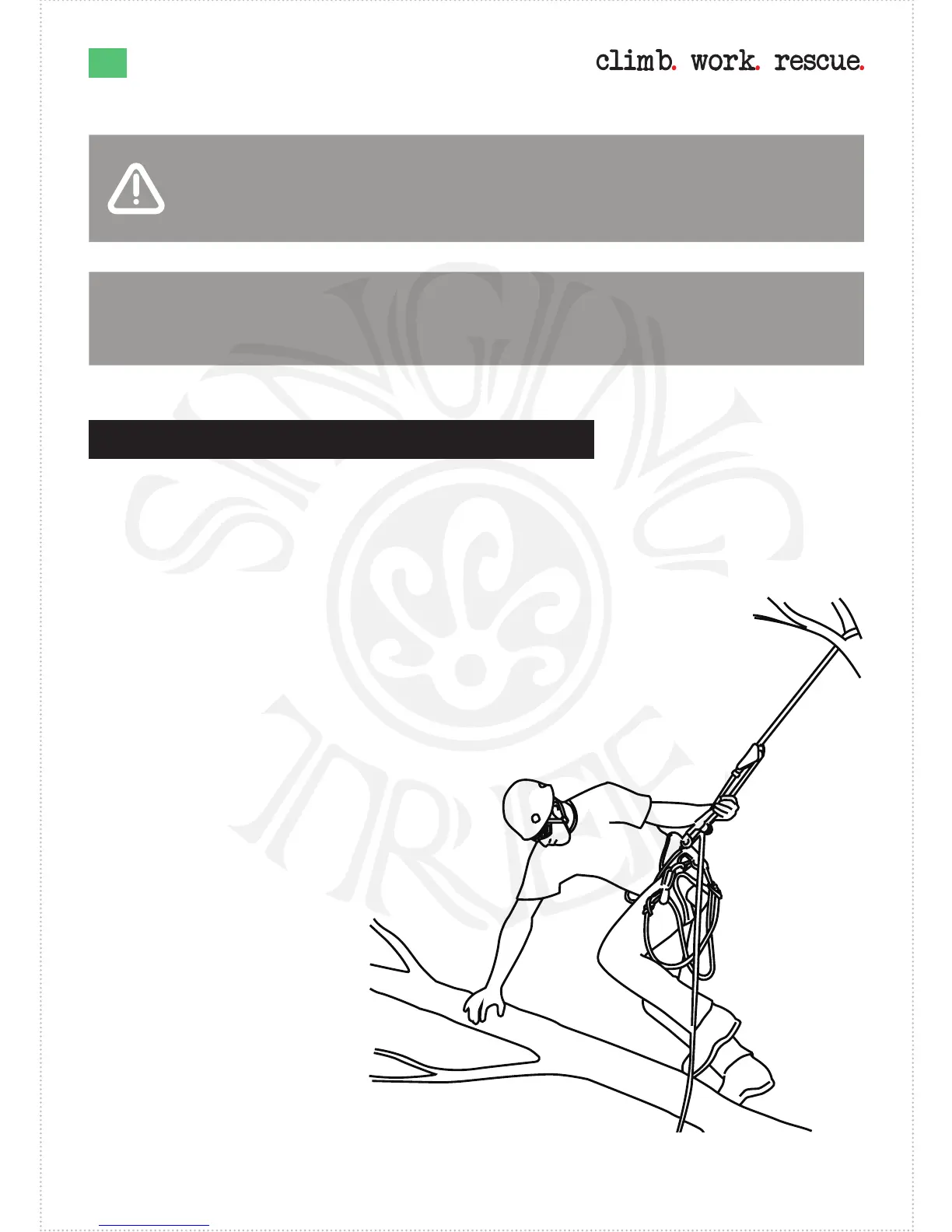
Limb Walking with the Rope Wrench
Halting Descent. To stop descending, simply let go of the friction hitch.
It is important to not allow slack in the system at any time and
always be aware of tripping hazards and stubs that can impale
during the course of a fall or swing.
To limit the exposure to dangerous swings, take advantage of
natural redirects in the tree. Select redirects with caution and
care. Being able to judge the health and strength of trees as
well as understanding the physics of fundamental tree rigging
are imperative to being a safe climber.
Understand that forces can be
multiplied on redirects depending on
the angle of the rope. Understand
that a redirect that is strong in one
direction may be weak when pulled
from another angle. Constantly
inspect the tree for spots of decay
and test the redirect before trusting
you full weight to it. TREES ARE NOT
RATED. Only good judgment can
prevent a climber from over
stressing a limb or tree.
If the climber clips the tail of their
climbing line through a pulley xed
to the working part of the line, the
system can be converted from a 1:1
climbing system to a 3:1 climbing
system.



 To Next Page