For Your Safe Flight Page 5
Section 1 - Introduction
Product Features
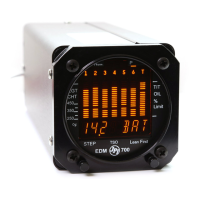
EDM 700/800 Standard Instrument:
• Hands-free, automatic scanning
• All programming done from the
Front Panel
• LeanFind finds the first and last
cylinder to peak with true peak
detect—eliminating a false peak
detection. Displays both leaned
temperature below peak and peak
• Battery voltage with alarm
• 24 Programmable alarm limits
• Normalize view
• DIF low to high EGT with alarm
• RS-232 Output for data logging in
real time
• Oil temperature option
• EGTs to stable 1°F resolution
• Shock cooling monitored on every
cylinder
• User selectable index rate
• Fast response probes
Fuel Flow Option:
• Solid-state pulse generating rotor
fuel flow transducer
• Fuel quantity measured in gallons,
kilograms, liters, or pounds
• Low fuel quantity alarm
• Low fuel time alarm
• GPS interface
• Instantaneous fuel flow rate
• Total amount of fuel consumed
• Total fuel remaining
• Time to empty at the current fuel
flow rate
Long Term Data Memory:
• Records and stores data up to 30
hours
• Non-volatile memory
• Post-flight data retrieval
• Download to Palm™ Computer
• Data retrieval software
EDM-800 %HP, MAP and RPM:
• Displays % horsepower and RPM
• Automatically calculates percent
horsepower
Engine Data Management
The EDM Engine Data Management system is the most advanced and
accurate piston engine-monitoring instrument on the market. Using the
latest microprocessor technology, the EDM will monitor up to twenty-
four critical parameters in your engine, four times a second, with a
linearized thermocouple accuracy of better than 0.1 percent or 2 F°.
As your built-in flight engineer, the EDM is constantly “red line”
checking: all critical parameters are automatically checked four times a
second, regardless of the current display status. Leaning is accomplished
quickly and automatically using the LeanFind procedure. With the


 To Next Page