79
Power Converter
The power converter converts 120-volt AC power to useable 12-volt DC power when the
shore power cord is connected to an external power source.
The converter has a built-in protective thermal breaker that will shut it down should over-
heating occur. Overheating can be caused by operating the converter above its maximum
power output for an extended period of time, or by an obstruction to its ventilation air ow.
To reduce converter heat build keep unnecessary 12-volt lights and motors turned “o”.
Keep the converters cooling ns and fan clear of obstructions.
. Car batteries (CCA
rating) are not designed for RV applications. If doing a lot of dry camping use a
deep cycle battery rated in amp hours only (NO CCA rating).
If using multiple batteries they must be the same brand and type. Adding more
batteries will provide longer use of DC appliances when not on shore power but
may reduce charging eciency.
The battery works in conjunction with the converter to supply DC power to the
RV. A battery is typically only necessary if you do a lot of dry camping or have
slideouts and/or a leveling system.
Reverse polarity fuse provides protection for the converter when a battery is used.
If the battery is connected backwards to the fuse board this fuse would blow pre-
venting damage to the converter.
If your lights are dimming or ickering that usually indicates an overloaded con-
verter. Remove some of the load by turning o DC lights or appliances.
Fan is controlled by load. It will begin running at 3 to 6 amp DC draw. It increases
in speed with a higher load until 14 to 15 amps. Fan is at maximum speed and
stays there even with more load. If load drops below 6 amps DC, the fan shuts o.
Before checking for converter output voltage, the battery cables must be disconnected at the
battery. Make sure the converter is plugged into an AC source (105-132 AC volts). Check
the converter output voltage at the battery with a voltmeter. Place the voltmeter probes on
the disconnected battery cables. If the voltage reads 13.6VDC with no load, the converter
is functioning properly.
It is important that the uid level of any connected batteries be checked on a
regular basis. All batteries will “gas” and lose some uid when continuously
connected to any charging source (does not apply to “gel-cell” batteries).
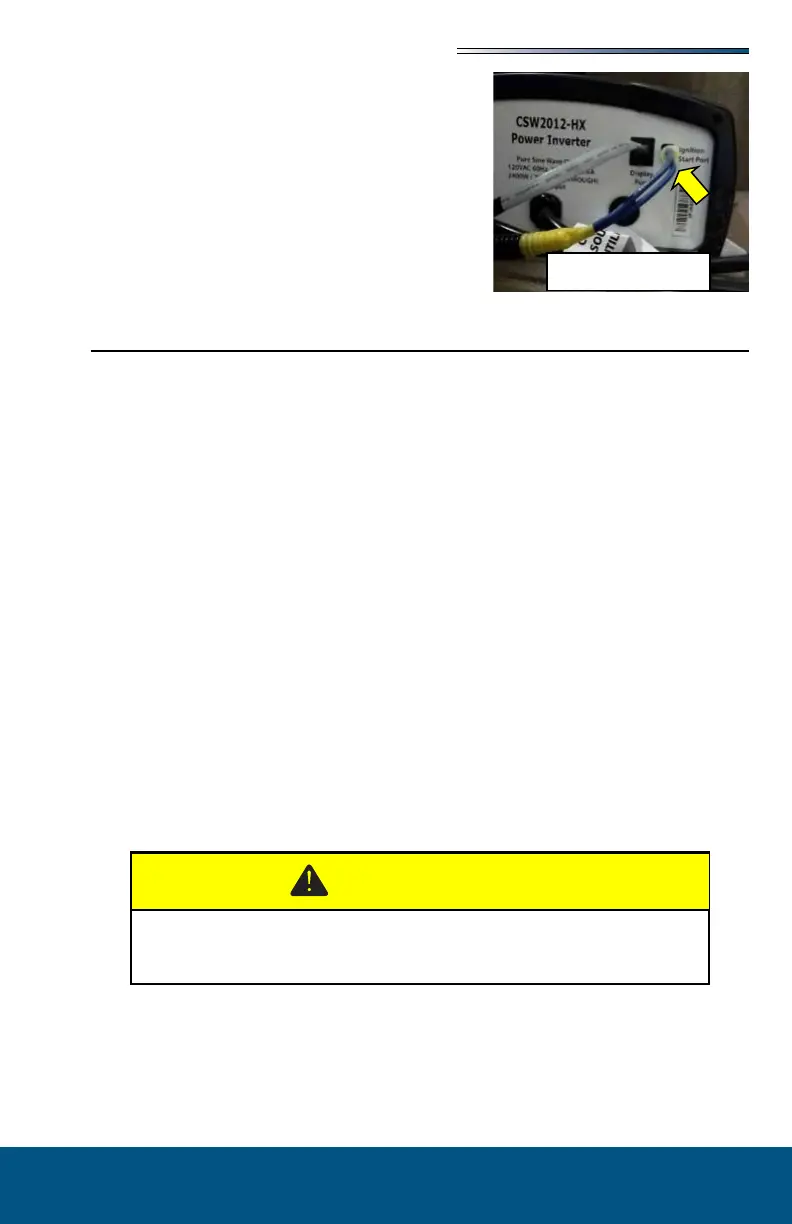
Pressing the SELECT button also cycles through in-
verter settings. Inverter settings can be changed, but
12VDC must be removed from the Ignition Start Port
on the back of the inverter. Unplug the 12VDC wire(s)
on the back of the inverter to make changes to invert-
er settings. Plug +12VDC back in after settings are
changed. (See photo)
Refer to the Inverter manufacturers’ manual in your
warranty packet for further operating instructions, er-
ror codes, changing inverter settings and safety infor-
mation.





 To Next Page