Model N611
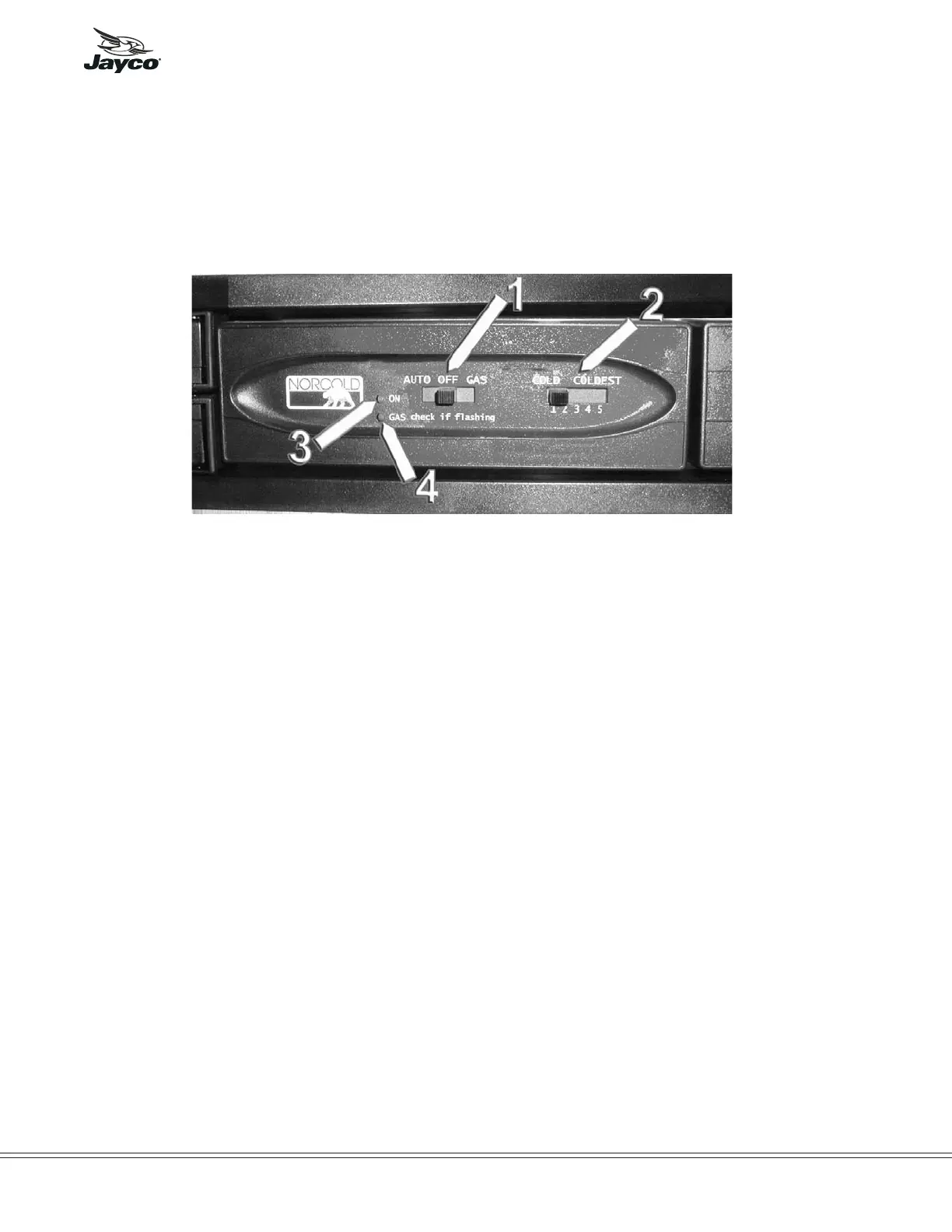
CONTROL PANEL
The refrigerator control panel is between the freezer compartment and the fresh food compartment.
To maintain the operating control functions of the refrigerator, a 12-volt DC power supply is
necessary. The refrigerator and any other DC components in the vehicle receive DC power from
the 12-volt system of the vehicle; either an auxiliary battery, a converter, or the vehicle engine
battery.
The selector switch starts (Fig. 5-5 - #1) and shuts down the refrigerator;
• Push the selector switch to the AUTO position to start the refrigerator in auto mode.
• Push the selector switch to the GAS position to start the refrigerator on propane gas.
The temperature switch (Fig. 5-5 - #2) controls the temperature adjustment of the freezer and the
fresh food compartment. The temperature adjustment that you select does not change if the mode
of operation of the refrigerator changes.
•
Push the temperature switch to the desired temperature setting.
•
The number “5” is the coldest temperature setting.
Refer to the “Display Codes” section of manufacturer’s owner’s manual.
AUTOMATIC MODE OPERATION:
When you select AUTO mode, the refrigerator controls automatically select the most efficient
energy source that is available for operation. If a more efficient energy source becomes available,
the refrigerator controls change from the current energy source to the more efficient energy source.
The controls select the energy source in this sequence:
•
When 120-volt AC is available to the refrigerator:
•
The ON light shows (Fig. 5-5 - #3) in the center display.
•
This means that the refrigerator is operating on AC electric.
•
If 120-volt AC is not available to the refrigerator:
•
The ON light and the GAS light (Fig. 5-5 - #3 & #4) show in the center display.
•
This means that the refrigerator is operating on propane gas.
GAS MODE OPERATION
•
The ON light and the GAS light (Fig. 5-5 - #3 & #4) show in the center display.
•
This means that the refrigerator is operating on propane gas.
60 Escapade Type C Owner’s Manual
Fig. 5-5





 To Next Page