Need help?
Do you have a question about the JBL 250Ti Jubilee and is the answer not in the manual?
Guidance on optimal positioning of speakers for best stereo imaging and acoustic performance.
Instructions for correctly connecting speaker wire, emphasizing polarity and safety.
Detailed steps for making a secure connection using bare speaker wire.
Using connectors for a reliable audio connection, emphasizing quality.
Explanation of bi-wiring for improved audio separation and amplifier flexibility.
Routine checks and cleaning of audio connections to ensure optimal performance.
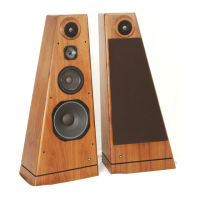
The JBL 250Ti Jubilee is an advanced home loudspeaker system designed for accurate sound reproduction. It represents a definitive expression of quality and craftsmanship, with no effort spared in its construction to achieve the most precise audio performance possible. The design encompasses every detail, from the unique shape of its enclosure to the meticulous engineering of its level controls. The woodworking of the 250Ti Jubilee is a key feature, with each enclosure being hand-detailed, crafted from dense fiberboard, and finished with a high-gloss lacquer that complements its sophisticated engineering.
This loudspeaker system is engineered to deliver sound quality that is limited only by the connected equipment and program source. It provides precise and stable imaging, ensuring that the soundstage is accurately rendered. The frequency response is nearly ruler-flat, both on and off axis, extending well beyond the audible bandwidth. Distortion levels are kept exceptionally low, more typical of fine electronic components than of loudspeakers, contributing to a clean and transparent sound.
Despite its sophisticated design, the 250Ti Jubilee is designed for straightforward setup. Users are advised to read the instruction manual thoroughly to ensure a trouble-free setup and to realize the full potential of their system.
For optimal performance, the speakers should be placed at least three feet from any walls. They should also be equidistant from the primary listening position, as there is no designated right or left speaker. The ideal listening area, formed by the loudspeakers and the listening position, should create a 40- to 60-degree angle. For example, if the loudspeakers are 2.4 meters (8 feet) apart, the listening position should be 2.4 to 3.65 meters (8 to 12 feet) from each speaker. To broaden the area where the best stereo image is perceived, the speakers can be angled to face the primary listening position.
Speaker wire and interconnecting cables are crucial components of an audio system. The 250Ti Jubilee system features internal wiring specifically designed by Monster Cable for JBL. The same care taken in selecting internal wiring should be applied to external cables. Dealers can recommend suitable interconnects and speaker wire to complement the system. The length of the wire depends on the loudspeaker and amplifier locations. It's recommended to temporarily arrange wiring to experiment with placement before making permanent connections with the shortest possible cable runs. Using the same length wires for both speakers is important. In some setups, placing the amplifier near the loudspeakers with short amplifier-to-loudspeaker connections, despite a longer preamplifier-to-amplifier cable, can often be beneficial.
Users are warned to turn off their amplifier before connecting or disconnecting loudspeakers to prevent damage and voiding the warranty. The amplifier must also be off when connecting or disconnecting cables at its inputs. Before starting, users should examine their speaker wire, noting that one conductor is solid and the other is differentiated by a ridge, marking, or color stripe. It's crucial to assign positive (+) and negative (-) polarity to conductors and connect them consistently (positive-to-positive, negative-to-negative) to ensure the loudspeakers work in phase. Out-of-phase connections won't cause damage but will reduce low-frequency output and stereo effect.
The 250Ti Jubilee loudspeakers are designed to produce a positive pulse when a positive voltage is applied to the positive (red) terminal. Some audio amplifiers may invert polarity. Users should audition the system with both normal (+ amp to + speaker) and reversed (+ amp to – speaker) connections to determine the best audible results, ensuring both left and right connections are reversed to maintain phase. Connections are made at two terminals on the back of the enclosure, designed for various methods. Experimentation and dealer advice can help choose the best method.
For bare wire connections, clean, bare wire is used. Each wire should be separated into three equal bundles. The terminal knob is turned counterclockwise, the center bundle passed through the exposed hole, and the remaining bundles wrapped around the post and twisted with the center strands. The knob is then securely tightened for a snug, positive connection over a maximum area, without excessive force. Excess wire not in contact with the binding post should be trimmed to prevent short circuits.
Spade or banana-type connectors can also be used, where wire ends are fastened to these connectors, which are then attached to the binding posts. However, keeping the number of contacts to a minimum is advantageous, so high-quality terminals expertly connected to selected cables are recommended if this method is chosen.
The "Bi-Wire" connecting method is also supported. The system's internal dividing network is electrically separated at the low-frequency to midrange transition. Strapping bars connect the networks for single-wire connections (shipped from the factory in place). Removing these bars allows connections to individual network sections using two wires (four conductors). Using the same type of wires for both low-frequency and high-frequency sections can reduce wire effects and avoid intermodulation. In some systems, specialized wires for low-frequency and high-frequency sections may yield excellent results. Low-frequency cables should be as short as possible, and left and right cables for each section must be the same length. A critical caution: never connect two amplifier channels to the same loudspeaker without first removing the strapping bars, as this will seriously damage amplifiers and void the warranty.
The bi-wire option also allows powering the system with two amplifiers. Four identical amplifiers (or two dual-channel units) can be used, though specialized low- and high-frequency amplifiers offer advantages. Dealers can recommend suitable amplification. Left and right amplifiers for each section must be identical, and input sensitivity must be equal, or level controls must maintain proper low-to-mid/high balance. If using two identical stereo amplifiers, one can be placed near each loudspeaker for short wire runs. Input polarity must be the same for both low- and high-frequency sections. If polarity is reversed to one section, a discontinuity in the crossover region will be apparent. If suspected, reverse the polarity to either low- or high-frequency sections of both loudspeakers. Amplifier polarity markings may not ensure correct connections.
All connections should be periodically inspected, cleaned, or remade. Maintenance frequency depends on the metals, atmospheric conditions, and other factors.
The 250Ti Jubilee can handle 200 watts continuous (based on an 8-hour broadband noise test simulating music power distribution) with peaks up to 800 watts, indicating its ability to handle transient peaks well above average power levels. Amplifier power ratings typically refer to continuous, steady-state power levels measured with a test signal and only indicate how loud the system will play without distortion. The quality of sound and dynamic power capability are more important than the power rating. An amplifier should be chosen after careful listening. If it can achieve the desired volume level without distortion, it has sufficient power, regardless of its rating. Dealers can help select suitable amplification.
If four amplifier channels are used, the high-frequency amplifier can be up to 6dB less powerful than the low-frequency amplifier. This is because the low-frequency section requires approximately four times the power of the high-frequency section due to music's power versus frequency distribution. For example, a 200-watt low-frequency amplifier would pair with a 50-watt high-frequency amplifier. Users should not use fuses or circuit breakers between the amplifier and loudspeakers, as these degrade sound quality and do not protect against loudspeaker damage. Adequate amplifier power to avoid distortion at the highest required sound levels is key to safe operation.
The crossover network in the 250Ti Jubilee uses a 9V battery to maintain a charge on capacitors in the midrange, high-frequency, and ultrahigh-frequency circuits. This charge allows capacitors to operate in a "class A" mode, enhancing detail and spatial properties beyond traditional networks. The battery's current drain is minimal, resulting in an average life of 3 to 4 years. For replacement, remove the two top center screws on the network cup, carefully lift off the curved battery cover, and replace the old battery held in a clip on the left side of the network. Then reinstall the cover and screws.
Loudspeaker grilles protect transducers and enhance appearance. However, even the most acoustically transparent grille affects sound. On the 250Ti Jubilee, this effect is minor, particularly for casual listening or background music, but noticeable. For serious listening, when damage is unlikely (e.g., no small children), removing the grille is recommended.
The 250Ti Jubilee features a high-gloss lacquer finish, achieved through a meticulous multistep painting and polishing process. The surface should be treated carefully to avoid scratching. Only lint-free cotton cloths should be used for dusting. For fingerprints and smudges, an ammonia-free window cleaner can be applied sparingly to a lint-free cotton cloth to gently clean the surface. Abrasive cleaners or strong chemicals should never be used. For deep scratches or damage, a qualified furniture repair shop should be consulted. The grille can be gently vacuumed when removed. Stains can be removed with an aerosol cleaner according to its instructions, but solvents should not be used on the grille.
JBL 250Ti Jubilee loudspeakers are designed for years of trouble-free service without required maintenance. If a problem is suspected, first check that all connections are properly made and clean. If a problem exists in one loudspeaker, reverse the speaker wires to the left and right system. If the problem remains in the same system, the fault is in the loudspeaker. If the problem appears in the opposite system, the cause is in another component or cable. Users should not move loudspeaker cones or diaphragms by hand, as the voice coil assembly is aligned with extreme precision, and any attempt to move it can force the coil out of alignment, causing distortion or failure.
Should service be needed, contact the JBL dealer or distributor from whom the system was purchased. If this is not possible, write directly to the JBL Customer Service Department, fully describing the problem and waiting for return authorization. Products should not be returned to the JBL factory without prior authorization. Correspondence can be sent to JBL Customer Service, 80 Crossways Park West, Woodbury, NY 11797. Telephone support is available at (516) 496-3400 or (800) 645-7292. Outside the United States, contact a local JBL distributor.
 Speaker Components
| low frequency | 360 mm (14 in.) |
|---|---|
| midrange | 200 mm (8 in.) |
| high frequency | 25 mm (1 in.) |
Frequency and Sensitivity| frequency response | ±2dB, 50Hz – 21kHz |
|---|---|
| usable response | 30Hz – 25kHz |
| sensitivity | 89dB, 2.83 volts @ 1m |
Power and Impedance| power-handling capability | 200 watts continuous |
|---|---|
| peak power | 800 watts |
| nominal impedance | 8 ohms |

 To Next Page