He went on to describe the process
behind his creation: “Most people who
own and appreciate fine sound repro-
duction equipment look forward to the
day when they will be able to assemble
a system without limitation in just
exactly the way they think it should be
done. Periodically a manufacturer gets
this same feeling ... The science of
acoustics has provided us with basic
principles-available to all for achieving
precision reproduction. It is only a mat-
ter of incorporating these methods into a
system design, and then taking every bit
of trouble necessary to build a system
precisely to the design.”
"It isn't easy, but that's the way it is
d o n e . "
The R a n ge r- Pa rag o n , JBL's second
P ro j e c t system, was the first serious
attempt at a reflecting speaker system,
and broke ground in the new concept of
stereo imaging. Essentially two inde-
pendent full-range speaker systems
installed in a handsome curved cabinet
nearly 9 feet long, the Pa r ag o n ' s e n c l o-
sure was treated as an extension of its
transducers. In essence, the system had
its own "built-in acoustics." In many
respects the Pa r ag o n anticipated loud-
speaker developments that would occur
years-and even decades-later.
For nearly 30 years, the Pa r ag o n r e -
mained the most acoustically viable
sound system for the home. To d a y,
along with the H a r t s fi e l d, it is still the
most sought-after speaker in the world.
In 1986, JBL introduced a new P ro j e c t
system that retained the Pa rag o n ' s o v e r -
all sense of musicality while upgrading
its character by incorporating three
decades' worth of continuous develop-
ment in every facet of its design. Its
name reflected the pinnacle of achieve-
ment it represented: P roject Evere s t .
For the first time, the rest of the sound
reproduction chain-and not the loud-
speaker or its transducers-would impose
limits on overall system performance.
Like the Pa rag o n and H a r t s fi e l d ,
P roject Evere s t was built around com-
pression driver technology and
addressed a more refined stereo image
than was previously considered techni-
cally feasible.
Since P roject Evere s t was introduced,
sound recording and playback technolo-
gy has undergone a revolution of its
own. With the advent of CD, extremely
demanding recorded signals had
become the rule rather than the excep-
tion-the average source material used by
the typical audio enthusiast had become
superior to the best demonstration mate-
rial of even just a few years ago. In
overall dynamics and transient response,
transducers are once again a potential
weak link in the high-end audio repro-
duction chain.
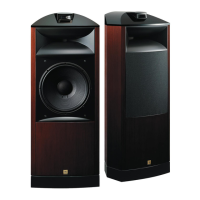
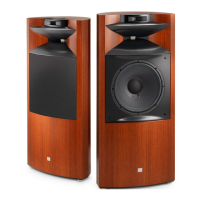
It was in this environment that JBL s e t
out to create its fourth and fifth P ro j e c t
loudspeakers, K2 S9500 and K2 S5500.
As with H a r t s fi e l d, the puritan simplici-
ty of a two-way system was considered
the most promising design track.
Advances in transducer design and low
frequency alignment would make the
construction of a two-way system of
3
K2 manual v11 approved 12/4/01 12:10 PM Page 3


 To Next Page
 Loading...