Need help?
Do you have a question about the jcb 516-40 and is the answer not in the manual?
Overview of the manual's purpose, structure, and general usage guidelines.
Details on machine and engine identification plates and serial numbers.
Procedures and safety precautions for towing a disabled machine.
Guidelines for safely loading and securing the machine onto a transporter.
Instructions and safety warnings for lifting the machine.
Provides torque specifications for fasteners and hydraulic connections.
This document serves as a comprehensive Service Manual for the JCB 516-40 machine, covering models from serial number 2415604 to 2416000. It is designed for JCB Distributor Service Engineers who have received training from the JCB Technical Training Department, ensuring they possess a sound knowledge of workshop practice, safety procedures, and general techniques for maintaining and repairing hydraulic earthmoving equipment.
The manual is structured into several sections, with the initial three providing general information, care and safety guidelines, and maintenance schedules. Subsequent sections are alphabetically coded and detail specific components such as attachments, body and framework, electrics, controls, hydraulics, transmissions, brakes, steering, and the engine. Each section includes technical data, circuit descriptions, and operational descriptions pertinent to the component.
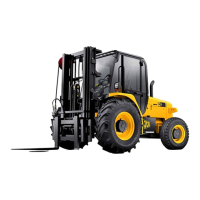
The JCB 516-40 is a robust machine designed for earthmoving and material handling tasks. Its primary function involves lifting, moving, and placing various loads, making it suitable for applications in construction, agriculture, and other industries requiring versatile material handling capabilities. The machine's design incorporates a boom and carriage system, allowing for precise control over attachments like shovels or forks. The hydraulic system is central to its operation, enabling the powerful movement of the boom, carriage, and attachments. The machine is also equipped with a ROPS/FOPS (Roll Over Protection Structure/Falling Objects Protection Structure) to ensure operator safety during operations, especially in environments where there is a risk of rollover or falling objects.
The manual emphasizes safe and correct usage procedures. For instance, when transporting the machine, it is crucial to secure all movable parts and attachments to prevent movement during transit. The document provides detailed instructions for loading the machine onto a trailer, distinguishing between serviceable and disabled machines. For disabled machines, specific steps are outlined for preparing the transmission pump for towing, including opening bypass valves to prevent damage. The manual also highlights the importance of using appropriate towing equipment, such as a rigid draw-bar, and adhering to speed limits during towing to avoid transmission damage.
Lifting the machine requires specialized procedures and equipment. The manual explicitly states that the machine should only be lifted using the Lifting Point Option (333/R3798) installed by a JCB Dealer, as other anchor points are not designed to support the machine's weight and could lead to instability. Instructions for preparing the machine for lifting include stopping it on level ground, engaging the park brake, retracting and lowering the boom, tilting the carriage, and isolating the battery. D-shackles must be attached to designated sling-points on the chassis, and a spreader-frame is required to prevent damage during lifting. Safety warnings are prominently featured, cautioning against standing under a raised load and ensuring the lifting-eye is directly above the machine's center.
Maintenance is a critical aspect covered extensively in the manual. It includes service schedules and recommended lubricants for all machine components. The document stresses the importance of regular safety statements and general warnings, which are repeated throughout the manual. When performing repairs, it is expected that oil seals, gaskets, and any worn or damaged components will be renewed. Components should be cleaned and lubricated as appropriate, and open hose or pipe connections must be blanked to prevent hydraulic fluid loss and dirt ingress.
The manual provides detailed information on standard torque settings for various fasteners, including zinc-plated, Dacromet, and metric grade fasteners. It differentiates between dry and lubricated threads, noting that torque figures for lubricated threads may be reduced. Dacromet fasteners, identifiable by their mottled silver finish and 'D' suffix in part numbers, have lower torque settings than zinc and yellow plated fasteners and should not be lubricated. The manual also warns against mixing Dacromet and zinc/yellow plated nuts and bolts due to potential changes in torque characteristics. All bolts used on JCB machines are high tensile and must only be replaced with bolts of an equivalent or higher tensile specification.
Hydraulic connections, including adaptors screwed into valve blocks and hoses, also have specific torque settings to ensure proper sealing and prevent damage. The 'O' ring face seal system and 'Torque Stop' hose system are described, with instructions on how to correctly tighten these connections to avoid damaging the 'O' rings. The manual also includes torque settings for BSP adaptors with bonded washers, ensuring a secure and leak-free connection. The manufacturer's policy of continuous improvement means that specifications may change without notice, and the manual reflects the most current information available at the time of publication.
 General
| Maximum Lift Capacity | 1600 kg |
|---|---|
| Maximum Lift Height | 4.0 m |
| Engine Power | 36.4 kW |
| Transmission | Hydrostatic |
| Engine Type | Diesel |
| Tyre Type | Pneumatic |
| Width | 1.56 m |

 To Next Page