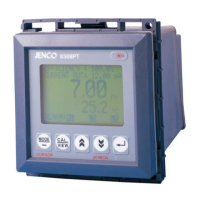
The Jenco Model 6308PT is a robust, microprocessor-based pH and Temperature System, designed for use in laboratories and process control applications. Housed in a watertight 1/4 DIN case, this instrument offers comprehensive monitoring and control capabilities for pH and temperature measurements.
Function Description
The primary function of the 6308PT is to simultaneously display pH, temperature, alarm status, and current output on a single LCD graphic screen. It utilizes a glass electrode for pH measurement and a precise thermistor for temperature readings, ensuring accuracy across all measurements. The system is equipped with a backlight for enhanced visibility in dark environments.
A key feature of the 6308PT is its advanced control capabilities, facilitated by five relays. These include two active Low and two active High relays for pH control, and one programmable high or low relay for temperature. All relays are hysteresis-driven and can be configured in either CENTER or EDGE mode, offering flexible control over process parameters.
The instrument also provides an isolated 4-20mA analog output, which is configurable for offset and span, allowing for precise integration into various control systems. Furthermore, the 6308PT includes an RS485 interface, enabling users to easily log data from multiple 6308 units to an IBM® PC/AT compatible computer, facilitating comprehensive data acquisition and analysis.
Usage Features
The 6308PT is designed for user-friendly operation with its intuitive front panel and clear display. Upon power-on, the unit performs a self-diagnostic routine, providing basic information about its stability. The main display mode shows real-time pH, temperature, efficiency of the pH electrode, and the actual output of the 4-20mA circuit.
Calibration and Setting Mode:
Accessing the Calibration/Setting mode is done by pressing the [CAL/VIEW] key for about 2 seconds from the main display. This mode provides access to several pages for configuring the instrument:
- Check Password Page: This page appears if the unit is password-locked. Users can view settings without a password or enter the correct 4-digit password to unlock the system for calibration and setting changes. If unlocked, entering this mode will freeze relays and analog output as a warning.
- User Setting Page: A warning page indicating that relays and analog output are frozen when the unit is not password-locked, allowing for calibration and setting changes.
- pH Calibration Page: This is crucial for maintaining measurement accuracy.
- ATC Temp: Displays the current temperature of the solution.
- Buffer 1: Allows selection of the first buffer (7.00 pH or 6.86 pH) for standardization calibration.
- Buffer 2: After selecting Buffer 1, this option allows selection of the second buffer (4.00 pH, 4.01 pH, 9.18 pH, or 10.01 pH) for slope calibration.
- Stand (Offset) Calibration: The actual pH calibration process for the offset. Users immerse the pH and ATC probes into the standard buffer solution and press [ENTER]. The unit displays the pH of the buffer at the current temperature and waits for stabilization. Error messages like "OVER" or "UNDER" indicate issues with the offset mV, suggesting probe cleaning or buffer change. If stable, a "SAVE" message appears, and pressing [ENTER] saves the new offset. The efficiency defaults to 100% if only offset is calibrated.
- Slope Calibration: This option becomes available after successful STAND calibration. Users immerse the probes into the second standard buffer solution and press [ENTER]. The unit displays the pH of the buffer at the current temperature and waits for stabilization. An error occurs if the mV input is not within ±30% of the ideal mV slope. If stable, a "SAVE" message appears, and pressing [ENTER] saves the new slope. The efficiency is then calculated as (new slope / ideal slope) x 100%. An efficiency below 80% suggests replacing the electrode.
- pH Control Setting Page: Configures the pH relays.
- HI Relay 1 & 2: Fixed to HIGH action. Relays turn ON if pH is greater than or equal to the set value, modified by hysteresis.
- LO Relay 3 & 4: Fixed to LOW action. Relays turn ON if pH is less than or equal to the set value, modified by hysteresis.
- Hysteresis (mode): Selects CENTER or EDGE mode for pH relays.
- Hysteresis (value): Sets the hysteresis value from 0.00 pH to 3.99 pH.
- Current Setting Page: Configures the 4-20mA output.
- 4mA Out & 20mA Out: Sets the pH values corresponding to 4mA and 20mA output. The range for these settings is 0.00 to 14.00 pH, with a minimum absolute difference of 0.10 pH required to enable the analog output.
- Transmitter Output: Selects between pH LINEAR or pH LOGARITHMIC output types.
- Temp. Control Setting Page: Configures the temperature relay.
- Relay 5: Sets the action to HIGH or LOW. In HIGH-action, the relay turns ON if temperature is greater than or equal to the set point. In LOW-action, the relay turns OFF if temperature is less than or equal to the set point.
- Set Point: User-changeable value for the temperature alarm relay.
- Hysteresis (mode): Selects CENTER or EDGE mode for temperature alarm.
- Hysteresis (value): Sets the hysteresis value from 0.0 to 19.9°C.
- RS 485 ID: Unique ID/Address for the unit, essential for multiple units connected via RS485.
- Password Set: Security code for locking the unit.
Relay Control:
The relays operate based on set points, action types (HIGH/LOW), hysteresis mode (Center/Edge), and hysteresis value. For example, in HI action with CENTER mode, the relay turns ON at [(RELAY SETPOINT) + (0.5 * hysteresis value)] and OFF at [(RELAY SET POINT) - (0.5 * hysteresis value)].
4-20mA Output:
The analog output can be linear or antilogarithmic, depending on user selection. The linear output is calculated based on the current pH display and the pH values set for 4mA and 20mA. The antilog output uses a similar calculation involving powers of 10.
RS485 Interface:
The 6308PT features a 2-wire RS485 interface for data communication. Users can connect the meter to a PC and program a routine to read data, with sample programs provided to assist in integration.
Maintenance Features
Initial Inspection and Assembly:
Upon receipt, users should carefully unpack and inspect the instrument for any shipping damages. All packing materials should be retained until satisfactory operation is confirmed. The mounting procedure involves making a panel cutout, inserting the controller, and securing it with a mounting bracket.
Cleaning the Instrument:
Before cleaning, the power must be removed. The instrument should be wiped with a lint-free cloth and clean water or a neutral detergent. Only the outer surface should be cleaned, and it must be thoroughly dried before reapplying power.
Error Displays and Troubleshooting:
The instrument provides various error messages to assist in troubleshooting:
- "OVER" (Temperature): Indicates temperature > 120.0°C or no temperature sensor. Actions include bringing the buffer/solution to a lower temperature or replacing the temperature probe.
- "UNDR" (Temperature): Indicates temperature < -10.0°C. Action involves bringing the buffer/solution to a higher temperature.
- "OVER" (pH): Indicates pH > 16.00. Suggests recalibration or being out of range.
- "OVER" (pH-Cal-STAND): Indicates offset mV is outside the acceptable range (e.g., >100mV at pH 7.00).
- "OVER" (pH-Cal-SLOPE): Indicates new slope is > ideal slope by 30%. Actions include using a new buffer solution or replacing the electrode.
- "UNDR" (pH): Indicates pH < -2.00. Suggests recalibration or being out of range.
- "UNDR" (pH-Cal-STAND): Indicates offset mV is outside the acceptable range (e.g., <-100mV at pH 7.00).
- "UNDR" (pH-Cal-SLOPE): Indicates new slope is < ideal slope by 30%. Actions include using a new buffer solution or replacing the electrode.
- EEPROM/ROM/RAM BAD: These errors during power-on indicate internal hardware failures. The recommended action is to turn the instrument OFF and ON again. If the message persists, the unit may require service.
pH Buffers:
The instrument stores temperature characteristics for common pH calibration buffers (4.00, 4.01, 6.86, 7.00, 9.18, and 10.01). It is crucial that the buffers used for calibration exhibit the same temperature characteristics as the stored values for accurate calibration. A table is provided showing the pH values of these buffers at various temperatures from 0°C to 60°C. The actual reading may differ by ±0.01 pH from these values.
The Jenco Model 6308PT is designed for reliable and precise pH and temperature control, with features that support both routine measurements and complex process management.


 To Next Page
 General