
 Need help?
Do you have a question about the JL Audio Slash v2 1000/1V2 and is the answer not in the manual?
Emphasis on safe listening levels to prevent permanent hearing loss and maintain awareness of vehicle noises.
Details the R.I.P.S. power supply and guidance on speaker load recommendations.
Step-by-step guide to setting input sensitivity for maximum, low-distortion output.
Technical specifications for the amplifier, including power, frequency response, and dimensions.
Addresses amplifiers that do not turn on or shut off unexpectedly, and issues with no sound output.
Addresses distorted, attenuated, or fluctuating audio output from the amplifier.
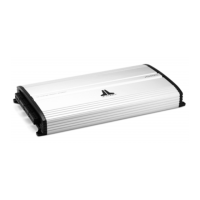
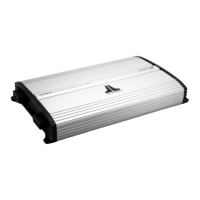
The JL Audio 1000/1v2 is a monoblock subwoofer amplifier meticulously engineered for automotive sound systems. Its primary function is to amplify low-frequency audio signals, specifically those below 250 Hz, to power subwoofers with exceptional clarity and power. This amplifier is not designed for driving midrange speakers or tweeters, as its operation is optimized exclusively for bass reproduction.
The 1000/1v2 utilizes proprietary and patented Class D technology, ensuring efficient power delivery and superior sound quality for subwoofer applications. It features a sophisticated, state-variable, low-pass active filter for its internal channel, designed to attenuate frequencies above its selected filter frequency. This prevents the subwoofers from reproducing audible midrange content, allowing for a cleaner and more focused bass response. The low-pass filter is fully variable between 40 Hz and 200 Hz, offering flexibility in tuning. Users can select between a moderate 12 dB/octave slope or a steeper 24 dB/octave slope, depending on the subwoofer system and vehicle acoustics, to achieve a smooth transition to mid-bass speakers. The amplifier's internal crossover can also be completely defeated, which is useful when an external active crossover is employed in the system.
Beyond its core amplification and filtering capabilities, the 1000/1v2 incorporates a versatile Advanced Bass Control section. This section comprises a fully variable 24 dB/octave infrasonic filter and a parametric, single-band equalizer. The infrasonic filter, adjustable between 15 Hz and 60 Hz, helps conserve amplifier power by attenuating frequencies below its cutoff, particularly beneficial for protecting speakers in ported enclosures from excessive excursion below box tuning. The parametric equalizer allows users to precisely shape the bass response by selecting the center frequency of the boost band (20-80 Hz), its bandwidth ("Q" adjustment from 0.5-4.0), and the amount of boost (0-15 dB). An optional remote bass control knob (RBC-1) can be connected to the amplifier, taking the place of the on-board boost knob and allowing for convenient bass level adjustments from the front of the vehicle.
The amplifier also features a flexible preamp output section, enabling easy setup of multiple amplifier systems. This preamp output can operate in three modes: "Full-Range" (pass-through of the input signal), "Amp Filter" (delivering the same signal as the amplifier's internal section, including all processing), and "Out Filter" (filtered by an independent, fully variable active filter with selectable high-pass or low-pass modes, 12 dB/octave or 24 dB/octave slopes, and a cutoff frequency between 40-200 Hz). This independent output filter allows for precise control and optimized mid-bass performance, even when matching, staggering, or overlapping with the amplifier's internal crossover.
The 1000/1v2 is designed for operation in vehicles with 12V, negative-ground electrical systems. Its differential-balanced input topology provides high input flexibility (200mV – 8V) and superior noise rejection, allowing it to accept high-voltage inputs from factory source units without distortion. The input sensitivity can be adjusted via a rotary control, with a switch to select between "Low" (200mV-2V) and "High" (800mV-8V) input voltage ranges. Proper adjustment of input sensitivity is crucial for achieving maximum clean output and preventing audible distortion.
The amplifier's unique Regulated, Intelligent Power Supply (R.I.P.S.) design allows it to deliver its optimum power (1000 watts x 1) across a wide range of speaker impedances (1.5Ω – 4Ω nominal). This automatic impedance optimization eliminates the need for user configuration, simplifying speaker wiring choices. However, loads below 1.5Ω nominal are not recommended due to potential excessive distortion.
For multi-amplifier systems, the 1000/1v2 supports "Master/Slave" configurations, where one "Master" amplifier controls the processing and filtering for multiple "Slave" amplifiers. This is particularly useful for driving multiple subwoofers with dedicated amplifiers while maintaining unified control over bass processing.
The amplifier includes a status indicator light system: a green "Power" light for normal operation, a red "Thermal" light indicating excessive operating temperature (which triggers a power reduction mode), an amber "Low Ω" light for impedance issues or short-circuits (also reducing power output), and a blue "Low V" light for supply voltage dips below 8 volts (leading to amplifier shutdown). These indicators provide crucial feedback on the amplifier's operational status and potential issues.
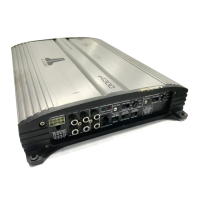
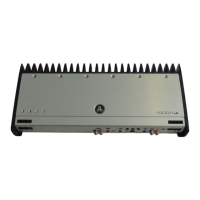
The 1000/1v2 employs an advanced heat management system called RealSink™. For optimal cooling performance, the vertical heat sinks located at the back of the amplifier should be exposed to as much air as possible. While fan-cooling is generally not necessary in normal applications, proper ventilation is essential to prevent excessive heat build-up and degraded performance. If the amplifier is enclosed, ventilation with a fan is recommended. When mounting, ensuring at least 1 inch (2.5 cm) of space above the amplifier's outer shell is advised for proper cooling.
Installation requires careful planning, including proper routing of power, signal, and speaker wires to protect them from sharp edges and wear. All system wires should be protected with grommets and loom where appropriate. Secure mounting of the amplifier with appropriate hardware is essential to prevent it from coming loose during vehicle movement.
For power connections, the amplifier's +12VDC and Ground terminals are designed for 4 AWG power wire, which is the only recommended size for this amplifier. If multiple amplifiers are used, a larger main power wire (2 AWG or 1/0 AWG) connected to a distribution block is recommended. The ground connection should be kept as short as possible, using 4 AWG wire, and connected to a solid, sanded metal point on the vehicle chassis. It is vital to fuse the main power lead within 18 inches (45 cm) of the positive battery post connection, with a 100A ANL fuse recommended for a single 1000/1v2.
The remote turn-on connection accepts 12 AWG - 8 AWG wire, typically controlled by the source unit's remote turn-on output.
The manual emphasizes that there are no user-serviceable parts or fuses inside the amplifier. Any service or repair should be performed by an authorized JL Audio dealer to avoid voiding the warranty and to ensure proper repair. Troubleshooting guidance is provided for common issues such as the amplifier not turning on, distorted/attenuated sound, output fluctuations, and intermittent shutdowns, often pointing to wiring, power, or grounding problems.
 General
| Amplifier Type | Class D |
|---|---|
| Crossover Slope | 12 dB/octave |
| Damping Factor | >500 |
| Fuse Rating | 100A |
| Input Sensitivity | 200 mV - 4 V |
| Input Voltage | 14.4V |




 To Next Page