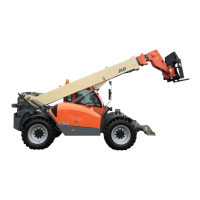
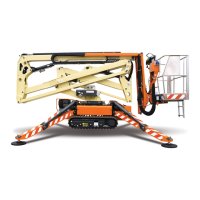
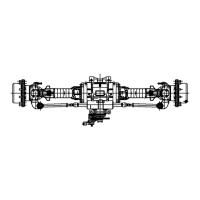
This document is an Operation & Safety Manual for JLG telehandlers, specifically models 3614RS and 4017RS. It provides essential information for owners, users, operators, lessors, and lessees to ensure safe and proper machine operation. The manual emphasizes the importance of reading and understanding its contents, along with other safety materials, before operating the equipment.
Function Description:
The JLG telehandlers (models 3614RS and 4017RS) are designed for lifting, transporting, and placing loads. They feature a boom that can be extended, retracted, lifted, and lowered, and can be equipped with various attachments such as forks, buckets, and truss booms. The machines are capable of operating with both non-suspended and suspended loads. Key operational aspects include engine starting and shutdown, steer modes (2-wheel front steer, 4-wheel circle steer, 4-wheel crab steer), and a Load Stability Indicator (LSI) system to monitor forward stability.
Important Technical Specifications:
The manual provides detailed specifications across various categories:
Usage Features:
- Operator Qualifications: Operators must read and understand the manual, complete training, possess a valid driver's license, be in good physical and mental condition, and comply with all applicable regulations.
- Controls and Indicators: The cab features an instrument cluster, ignition, park brake, transmission control lever, Load Stability Indicator (LSI), steering column adjuster, joystick for boom and attachment functions, console switches, and an accessory control lever.
- Steer Modes: Three modes are available: 2-wheel front steer (required for public roads), 4-wheel circle steer, and 4-wheel crab steer. Steer modes must be changed while stationary.
- Anti-Theft: Machines can be equipped with an anti-theft feature requiring a numeric code for operation.
- Operator Presence System: The operator seat is equipped with a system that prohibits engine start and hydraulic functions if the operator is not present, and disables hydraulic controls if the operator leaves the seat during operation.
- Attachments: The manual details installation and operation for various JLG-supplied attachments including standard quick attach, Manitou quick attach, JCB quick attach, carriages with forks, side shift carriages, fork positioning carriages, buckets, multi-purpose buckets, carriages with lift lugs, adjustable truss booms, fork-mounted hooks, quick attach mounted hooks, and truss booms.
- Road Operation (CE): Specific procedures for preparing the telehandler for road travel, including removing loads, cleaning, checking lights and mirrors, and selecting front wheel steering.
- Emergency Procedures: Instructions for towing a disabled product, emergency lowering of the boom, and cab emergency exit.
Maintenance Features:
- Pre-Operation and Inspection: Daily checks include cleanliness, structural integrity, safety decals, manuals, walk-around inspection, fluid levels, and attachment verification.
- Warm-Up and Operational Checks: Before operation, check heater, A/C, wipers, lighting, mirrors, brakes, travel, gears, steering, horn, back-up alarm, and joystick functions.
- Service and Maintenance Schedules: Detailed schedules are provided for 10 hours, 50 hours, 1st 50 hours, 250 hours, 500 hours, 1000 hours, 3000 hours, and 6000 hours/4 years. These include checks for fuel level, engine oil, hydraulic oil, tire condition, coolant, transmission oil, axle differential oil, wheel end oil, boom chain & tension, boom wear pads, battery, air filter, cab air filters, and windshield washer fluid.
- Fuel System Maintenance: Includes checking fuel level and draining the fuel/water separator.
- Tire Maintenance: Covers air pressure checks, damage inspection criteria for pneumatic and foam-filled tires, and guidelines for tire and wheel replacement.
- Engine Cooling System Maintenance: Instructions for checking and adding engine coolant.
- Hydraulic Oil Maintenance: Procedures for checking hydraulic oil level.
- Transmission Oil Maintenance: Steps for checking transmission oil level.
- Air Intake System Maintenance: Includes checking and changing air filters.
- Battery Maintenance: Instructions for checking the battery.
- Windshield Washer System Maintenance: Checking and refilling washer fluid.
- Load Stability Indicator (LSI) System Test: A procedure to verify the proper functioning of the LSI system.
- Boom Interlock System Test: A test to ensure the boom interlock system operates correctly in different boom positions.
- Inspection, Maintenance and Repair Log: A dedicated section for recording maintenance activities.

 Need help?
 General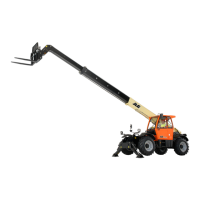

 To Next Page