VC2 5
Even with the needle hitting the end stop, the signal will not be distorted;
although the overload margin will be reduced. (The VU meter is connected before the
output gain control)
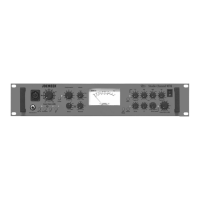
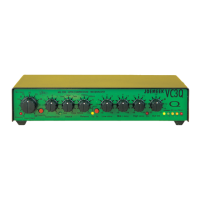
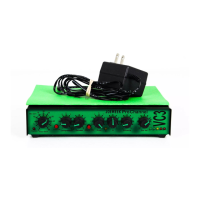
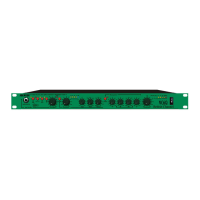
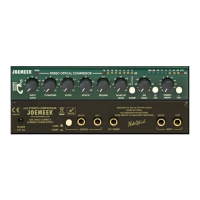
THE JOEMEEK Tube Channel COMPRESSOR.
And now for the part of the JOEMEEK Tube Channel that gives it character;
THE COMPRESSOR.
The compressor is a photoelectric device where the sound triggers light emitting diodes
which in turn control the resistance of a photo sensitive resistor. This form of
compression used to be common in the 60's and 70's but has been superseded by so
called 'improved' voltage controlled amplifiers.
The advantages of the older system are that distortion is virtually nil, noise is extremely
low while overload margin is extremely good. The disadvantages are that the design is
more difficult to produce cheaply and, according to those who judge equipment by
specifications and not by listening, the older design is less flexible in operation and
more difficult to use (!)
Using 1990's electronics for the control circuitry, Ted Fletcher has recreated the
compressed sound of the 60's; a sound that was unlikely ever to be heard again.
Totally unlike a modern compressor, it can pull voices forward, help with internal mix
balance, and add 'presence' to the sound as well as controlling recording volume levels.
But its main and unique attribute is its ability to produce the characteristic 60's
compressed exciting sound without losing the transient sparkles that are such a feature
of good digital recording.
THE COMPRESSOR; TECHNICALLY.
To get the best use out of the compressor it is necessary to understand the
basic physics and what it is designed to do.
A LIMITER is a device which stops the output of a signal path going above
a predetermined level.



 To Next Page