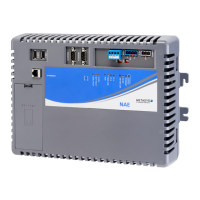
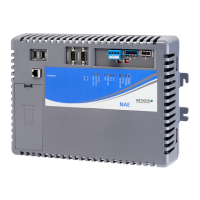
• Mount the network engine in the panel following the
guidelines in the Location considerations and Mounting
sections of this document.
Wiring Overview
Power supply, network, and
communication connections
See Figure 2 and Figure 3 for the location of the power
supply terminal, network communication terminals,
Ethernet jack, and modem jack.
Depending on the model, the network engine can
connect to an MS/TP field bus trunk, an N2 Bus trunk,
or a LonWorks network trunk. Also, all network engines
support multiple vendor integrations, including Modbus,
M-Bus, and KNX. See Table 21 for a list of all supported
trunk applications. The rules, guidelines, and wiring
considerations for each type of network or field bus
application are provided in tables of this document.
Power supply
Important: Install the data protection battery before
applying 24 VAC power to the network engine. See
the Installing the data protection battery section.
In North America, use a Class 2, 24 VAC power supply with
a 50 VA minimum output. Outside North America, use a
24 VAC SELV transformer at the appropriate rating. The
minimum input voltage for the network engine to operate
properly is 20 VAC. See the Technical specifications section.
Use a dedicated power supply to the network engine
only. Do not connect any other loads to the power supply.
Additional loads may cause noise interference.
Ethernet port
The Ethernet port, labeled ETHERNET, is an 8-pin RJ-45
network port for connecting the network engine to
Ethernet IP networks. Network engine can connect to
Ethernet networks at 10 Mbps, 100 Mbps, or 1 Gbps.
This Ethernet port provides IP communications over the
building network and to any third-party integration that
uses Ethernet communication. The devices that you can
connect to the ETHERNET port on the network engine
include the following:
• BACnet/IP
• Ethernet TCP/IP
• Modbus TCP/IP
• KNX
• Tyco C•CURE 9000 and Tyco victor Video Management
• Simplex FACU
• Cree SmartCast Lighting Control
• Molex Lighting Control
• OPC Unified Architecture (UA)
FC Bus terminal block
The two Field Controller (FC) Bus connections on a
network engine are 4-pin removable, keyed terminal
blocks labeled FC-A and FC-B. The FC bus connections are
optically isolated RS-485 ports that communicate at 9600,
19,200, 38,400, or 76,800 baud. You can use the FC Bus port
to integrate the following field controller networks into the
Metasys system:
• BACnet MS/TP FC Bus
• N2 Bus
• Modbus RTU
• M-Bus
Note: Each field controller integration has different
protocols and network requirements. Do not
intermix N2, MS/TP, Modbus, or M-Bus devices on
the same FC Bus port.
The SHD connections on the FC terminal blocks are not
connected to any earth ground connection. The FC A and
FC B terminal blocks are not interchangeable.
LonWorks network terminal block
The LonWorks TP/FT-10 network connection, available
only on the network engine LonWorks model, is a 3-wire
removable, keyed terminal block. The Shield connection
on the LonWorks network terminal block is an isolated
terminal and is not connected in the network engine.
Use the LonWorks terminal block to connect LonWorks
networks to the network engine.
Computer serial ports
The network engine has two RS-232-C serial ports labeled
RS232C A and RS232C B (Figure 3). Use either port to
connect a Modbus RTU or Zettler MXSpeak third-party
integration. For more information on how to use the
serial port for third-party vendor integration, refer to the
application note for the particular vendor integration you
are installing. Lastly, these RS-232-C serial ports do not
support external modems.
Universal Serial Bus (USB) ports
The two USB ports labeled USB A and USB B are both
configured as masters and are independent of each other.
At Release 10.0 or later, the use of a USB port to connect
an optional external modem is no longer supported.
Optional Internal Modem
MS-NAE55x1-x models with Release 9.0 have an internal
modem and a 6-pin RJ-12 modular jack labeled MODEM.
Connect a standard phone line into the MODEM jack to
use the internal modem.
Note: Modem functionality is no longer available for
NAE55s upgraded to Release 10.0 or later.
For information on commissioning an internal modem
on older models, refer to the NAE Commissioning Guide
(LIT-1201519).
Wiring the Network Engine
Mount the network engine securely before wiring it. For
details, see Mounting.
NAE55 Installation Guide6


 To Next Page
 Loading...