8
Original instructions
> English
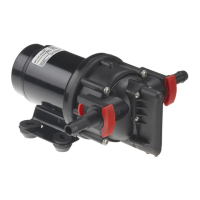
Typical applications
TheWDpumpsarevechamberpositive
displacement diaphragm pumps.
Thesepumpsaretheidealchoicefor
wash down applications as they provide
2.8 bar pressure (WD 2.9) or 5 bar/ 70psi
pressure (WD 3.5 and WD 5.2), making
clean-up faster and easier.
Features
• Quietoperation
• Smoothowing
• Selfpriming
• Integratedpressureswitchturnspump
on and off automatically when the
spray nozzle is opened and closed
• Dryrunningwithoutdamage
• Lowpowerconsumption
• Quickdisconnectttings
Working principle
As the pump runs, pressure is increased
until it reaches the pre-defined pressure
level, see page 40. When the pre-defined
pressure level is reached the integrated
pressure switch automatically shuts the
pump off.
Thepumpisequippedwithpositively
checking outlet valves which ensure that
the pressure is maintained after the pump
shuts off.
When water is demanded the pres-
sure decreases. After a moderate drop in
pressure, the integrated pressure switch
automatically turns the pump back on.
Due to their durable construction and
thoughtful design, the WD-pumps will
provide many years of service.
Important!Thepressuresettingofthis
pump is made at the factory. Warranty
invalidated by pressure switch inter-
ference.
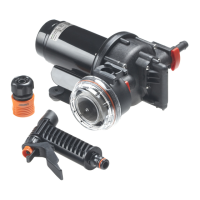
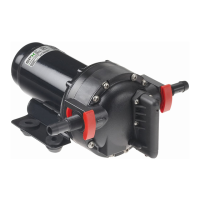
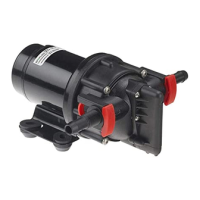
Wash Down Systems WD 2.9, WD 3.5 and WD 5.2
mounted to DC motor 12/24 V
Technical description
Body: Nylon/Polyamide
Valve housing: Polypropylene/Polya-
mide
Valves: Nitrile
Diaphragm: Santoprene
Connection: 3/8" BSP, 1/2" hose
(Ø 13 mm) or
US:1/2"NPT,3/4"hose
(Ø 13 mm) 3/4" Garden
hosethread(GHT)
Max. liquid
temperature: Max +50°C/+120°F
Fasteners: Stainless steel
Max. suction lift: WD 2.9 2 m/
WD 3.5 – 2.5 m/8.2 ft
WD 5.2 – 3 m/9.8 ft
Cut in pressure: See page 40
Cut-off pressure: See page 40
Duty cycle: Intermittent, max 20 min
Motor: WD 2.9 – 85 W
WD 3.5 – 120 W
WD 5.2 – 185 W
12/24 V DC
with built in thermal
protection
Themotorisignitionprotectedaccording
to ISO 8846 (Small craft – Electrical
devices – Protection against ignition of
surrounding flammable gases).
Type designation
See page 40



 To Next Page