This document describes the Jumbuck Outdoor Patio Heater, a portable gas-powered appliance designed to provide warmth in outdoor settings. The heater is intended for domestic use and comes with a 12-month warranty.
Function Description
The Jumbuck Outdoor Patio Heater functions by burning propane gas to generate radiant heat, effectively warming outdoor areas. It is designed to be portable, allowing for easy relocation as needed. The heater incorporates safety features such as a flame failure device and a tip-over safety switch, which automatically shut off the gas supply in the event of a flame extinguishing or the unit tipping over.
Usage Features
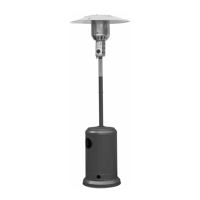
The heater is designed for ease of use and mobility. It features a gas bottle housing that accommodates a 9kg gas bottle, making it self-contained and eliminating the need for external gas lines. Wheels are integrated into the base for easy mobility, allowing users to move the heater to different locations within an outdoor space. The burner head is made of stainless steel, ensuring durability and efficient heat distribution. The unit operates on propane gas and has a substantial heat output of 38.5 MJ/h, suitable for heating patio areas. The steel body is powder-coated in charcoal, providing a durable and aesthetically pleasing finish.
To operate the heater, users must first ensure the gas bottle is turned on. The control knob is then pressed and turned to the "HI" position. Simultaneously, the igniter button is repeatedly pressed until the burner ignites. After ignition, the control knob should be held down for 10 seconds to ensure the burner remains lit. The heat output can be adjusted by turning the control knob to the desired temperature setting, starting with "LO" for at least 5 minutes before further adjustment. If the burner fails to light or goes out, the control knob should be turned to "OFF," and a 5-minute waiting period is recommended before attempting to re-ignite. If ignition issues persist, the gas cylinder should be disconnected, and the heater returned to the place of purchase.
Turning off the heater involves a simple three-step process: first, turn the control knob to the "HI" position, then press and turn it to the "OFF" position, and finally, turn off the valve on the gas cylinder.
The manual provides clear guidelines for the heater's placement and operation. It emphasizes that the heater is for outdoor use only and must be placed on level, firm ground. Adequate fresh air ventilation is crucial, and specific clearance distances to combustible materials (460mm top, 610mm sides) must be maintained. The heater should never be operated in explosive atmospheres or near flammable materials. It is not intended for installation in recreational vehicles or boats. The manual also details requirements for operating the heater within various types of partial enclosures, ensuring sufficient open wall area for ventilation and dispersion of combustion products.
Maintenance Features
Regular maintenance is essential to ensure the safe and efficient operation of the Jumbuck Outdoor Patio Heater. The manual outlines several key maintenance procedures:
A crucial initial step is a gas leak test, which should be performed before the first use and whenever the gas cylinder is changed or connections are disturbed. Although the heater is leak-tested at the factory, mishandling during shipment or excessive pressure can cause leaks. The leak test involves making a soap solution (one part liquid detergent to one part water) and applying it to all gas connections with a soft bristle brush. Before applying the solution, the heater's control knob and the gas cylinder valve must be in the "OFF" position. After applying the solution, the gas supply is turned "ON." The appearance of soap bubbles indicates a gas leak. In such cases, the gas supply must be turned off, leaking fittings tightened, and the test re-checked. If a leak is detected on the gas cylinder itself, it should not be used and must be disposed of outdoors, away from ignition sources, by contacting a local gas authority or cylinder exchange provider. It is explicitly stated not to operate the appliance until all gas leaks have been rectified and never to leak test while smoking.
For general cleaning and care, powder-coated surfaces should be wiped with a soft, moist rag. Combustible or corrosive cleaners should be avoided. Debris must be removed from the burner to maintain cleanliness and safety. When the heater is not in use, covering the burner unit with an optional protective cover is recommended.
Storage instructions emphasize safety: the gas valve of the cylinder should always be closed after use or in case of disturbance, and the regulator disconnected from the gas cylinder valve. The gas valve's tightness should be checked for damage, and any damaged valves should be replaced by a gas dealer. Liquid gas cylinders should never be stored in sub-terrain areas or places without adequate air ventilation. If the cylinder is removed, the appliance can be stored indoors. However, if the cylinder remains attached, indoor storage is only permitted if the cylinder size complies with AS/NZS 1596; otherwise, cylinders must be stored outdoors in a well-ventilated area, out of reach of children.
The manual also includes a troubleshooting guide to address common operational issues, such as the burner not lighting, not staying on, having a low flame, uneven emitter glow, thick black smoke, or carbon build-up. For many issues, it provides user-actionable steps like checking gas valve positions, tightening connections, replacing the cylinder, or cleaning components. For more complex problems, it advises contacting an authorized service technician.


 To Next Page
 General