EasyManua.ls Logo

JVC RM-G810U - Manual Editing

JVC RM-G810U
10 pages
Print Icon
To Next Page IconTo Next Page
To Previous Page IconTo Previous Page
Loading...
MANUAL
EDITING
®
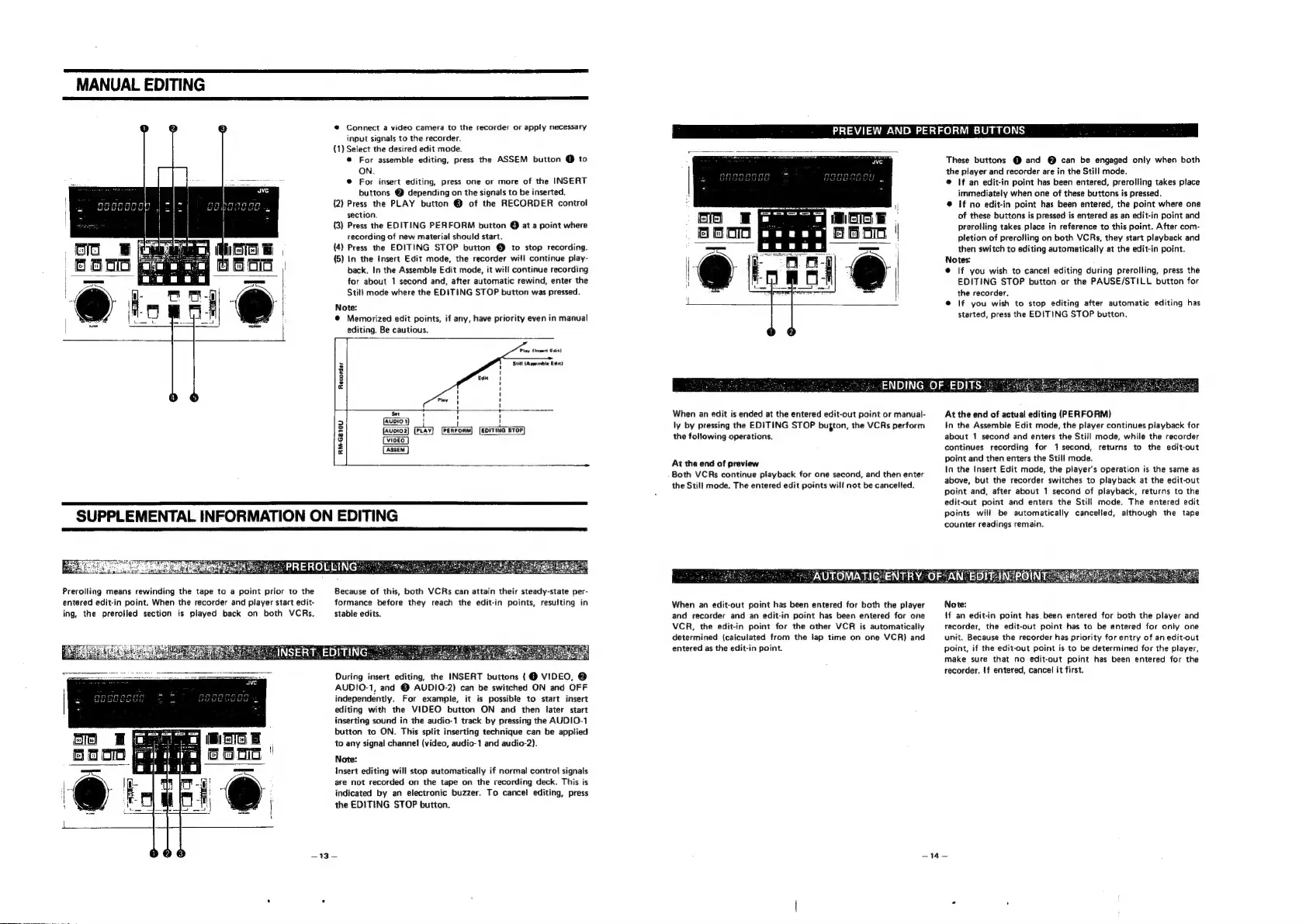
Connect
a
video
camera
to
the
recorder
or
apply
necessary
input
signals
to
the
recorder.
(1)
Select
the
desired
edit
mode.
®
For
assemble
editing,
press
the
ASSEM
button
@
to
ON.
©
For
insert
editing,
press
one
or
more
of
the
INSERT
buttons
@
depending
on
the
signals
to
be
inserted.
{2)
Press
the
PLAY
button
@
of
the
RECORDER
control
section.
{3)
Press
the
EDITING
PERFORM
button
@
at
a
point
where
recording
of
new
material
should
start.
{4)
Press
the
EDITING
STOP
button
©
to
stop
recording.
(5)
in
the
insert
Edit
mode,
the
recorder
will
continue
play-
back.
In
the
Assemble
Edit
mode,
it
will
continue
recording
for
about
1
second
and,
after
automatic
rewind,
enter
the
Stitt
mode
where
the
EDITING
STOP
button
was
pressed.
Note:
@
Memorized
edit
points,
if
any,
have
priority
even
in
manual
editing.
Be
cautious.
act
Ploy
{insert
Edit!
Still
(Assemble
Edit)
Recorder
'
'
'
T
'
!
Set
4
f
i
[Avo
a]
[Fearon]
[EoITING
STOP
RMG8I0U
SUPPLEMENTAL
INFORMATION
ON
EDITING
Prerolling
means
rewinding
the
tape
to
a
point
prior
to
the
entered
edit-in
point.
When
the
recorder
and
player
start
edit-
ing,
the
prerotled
section
is
played
back
on
both
VCRs.
Because
of
this,
both
VCRs
can
attain
their
steady-state
per-
formance
before
they
reach
the
edit-in
points,
resulting
in
stable
edits.
During
insert
editing,
the
INSERT
buttons
{@
VIDEO,
@
AUDIO-1,
and
@
AUDIO-2)
can
be
switched
ON
and
OFF
independently.
For
example,
it is
possible
to
start
insert
editing
with
the
VIDEO
button
ON
and
then
later
start
inserting
sound
in
the
audio-1
track
by
pressing
the
AUDIO-1
button
to
ON.
This
split
inserting
technique
can
be
applied
to
any
signal
channel
(video,
audio-1
and
audio-2).
Note:
Insert
editing
will
stop
automatically
if
normal
contro!
signals
are
not
recorded
on
the
tape
on
the
recording
deck.
This
is
indicated
by
an
electronic
buzzer.
To
cancel
editing,
press
the
EDITING
STOP
button.
—13-—
PREVIEW
AND
PERFORM
BUTTONS
When
an
edit
is
ended
at
the
entered
edit-out
point
or
manual-
ly
by
pressing
the
EDITING
STOP
bugton,
the
VCRs
perform
the
following
operations.
At
the
end
of
preview
Both
VCRs
continue
playback
for
one
second,
and
then
enter
the
Still
mode.
The
entered
edit
points
will
not
be
cancelled.
When
an
edit-out
point
has
been
entered
for
both
the
player
and
recorder
and
an
edit-in
point
has
been
entered
for
one
VCR,
the
edit-in
point
for
the
other
VCR
is
automatically
determined
(calculated
from
the
fap
time
on
one
VCR)
and
entered
as
the
edit-in
point.
These
buttons
@
and
@
can
be
engaged
only
when
both
the
player
and
recorder
are
in
the
Still
mode.
®
If
an
edit-in
point
has
been
entered,
prerolling
takes
place
immediately
when
one
of
these
buttons
is
pressed.
@
If
no
edit-in
point
has
been
entered,
the
point
where
one
of
these
buttons
is
pressed
is
entered
as
an
edit-in
point
and
prerotling
takes
place
in
reference
to
this
point.
After
com-
pletion
of
prerolling
on
both
VCRs,
they
start
playback
and
then
switch
to
editing
automatically
at
the
edit-in
point.
Notes:
®@
If
you
wish
to
cancel
editing
during
prerolling,
press
the
EDITING
STOP
button
or
the
PAUSE/STILL
button
for
the
recorder.
@
If
you
wish
to
stop
editing
after
automatic
editing
has
started,
press
the
EDITING
STOP
button.
At
the
end
of
actual
editing
(PERFORM)
In
the
Assemble
Edit
mode,
the
player
continues
playback
for
about
1
second
and
enters
the
Still
mode,
while
the
recorder
continues
recording
for
1
second,
returns
to
the
edit-out
point
and
then
enters
the
Still
mode.
In
the
Insert
Edit
mode,
the
player's
operation
is
the
same
as
above,
but
the
recorder
switches
to
playback
at
the
edit-out
point
and,
after
about
1
second
of
playback,
returns
to
the
edit-out
point
and
enters
the
Still
mode.
The
entered
edit
points
will
be
automatically
cancetled,
although
the
tape
counter
readings
remain.
Note:
{f
an
edit-in
point
has.
been
entered
for
both
the
player
and
recorder,
the
edit-out
point
has
to
be
entered
for
only
one
unit.
Because
the
recorder
has
priority
for
entry
of
an
edit-out
point,
if
the
edit-out
point
is
to
be
determined
for
the
player,
make
sure
that
no
edit-out
point
has
been
entered
for
the
recorder,
If
entered,
cancel
it
first.
-14-—