
 To Next Page
A
AliSep 9, 2025
How does the oil separator tank do

How does the oil separator tank do
Details on the machine's designation and important technical information found on the nameplate.
Overview of all possible options that can be fitted to the machine.
Technical specifications of the machine when no optional equipment is fitted.
Technical details related to the machine's chassis, including weights and tyre specifications.
Technical data for the compressor, including working pressure, FAD, and temperature specifications.
Technical specifications for the engine, including data, oil, and coolant recommendations.
Details on various optional equipment available for the machine.
General safety regulations and potential dangers associated with machine operation.
Defines the intended use of the machine and liabilities for incorrect applications.
Lists prohibited uses of the machine and compressed air.
Outlines user obligations regarding regulations, personnel, and inspections.
Details various dangers during operation, including exhaust fumes, fire, and forces of compression.
Information on safety devices and their importance for safe operation.
Illustrates and explains the meaning of various safety signs used on the machine.
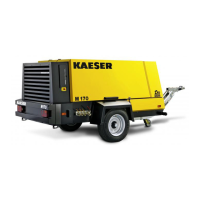
Description of the machine's exterior and its functional aspects.
Diagrams identifying key components of the machine.
Explanation of the machine's core functionality without options.
Details on how the machine operates and its control modes.
Description of safety devices like monitoring functions and quick stop buttons.
Overview of the keys and displays on the SIGMA CONTROL MOBIL instrument panel.
Explanation of the SIGMA CONTROL MOBIL's display and operating sequences.
Navigation through the SIGMA CONTROL MOBIL menus and options.
Description of possible air treatment options fitted to the machine.
Details on special equipment for operation in extremely low temperatures.
Configuration of automatic engine start/stop and battery trickle charging.
Description of various transport chassis and stationary frame options.
Safety precautions to be observed during installation and operation.
Requirements for the installation site, including ground stability and ventilation.
Instructions for safe installation and information on authorized personnel.
Procedure for checking and reporting any transport damage.
Instructions for fitting and re-assembling the towbar.
Procedures for adjusting the chassis, including towbar height and towing eye.
Safety instructions for commissioning and recommissioning the machine.
Procedures to follow before initial start-up or recommissioning.
Checklist for confirming installation and operating conditions before starting.
How to set the units for temperature and pressure display.
Procedure for entering passwords to access settings and functions.
Configuration of engine parameters like starter time and cool-down period.
Adjusting parameters for automatic start/stop operation.
Measures for recommissioning the machine after prolonged storage.
Guidelines for operating the machine in low ambient temperatures.
Instructions for activating the battery trickle charging system.
Safety instructions for ensuring safe operation of the machine.
Procedures for starting, running, and stopping the machine.
How to adjust the output pressure via the instrument panel.
Procedure for shutting down the machine, including cool-down phase.
Overview of parameter settings within the controller's settings menu.
How to acknowledge and manage messages displayed by the controller.
How to view engine and compressor operating data via the display.
Instructions for operating the external fuel pump via the controller.
General guidelines for fault rectification and contacting service.
Explanation of alarm, warning, and maintenance messages from the controller.
Troubleshooting engine-related faults and alarms.
Troubleshooting compressor-related faults and alarms.
Safety precautions for performing maintenance work on the machine.
Understanding and acknowledging maintenance messages from the controller.
Overview of scheduled maintenance tasks and intervals.
Detailed maintenance procedures for the engine components.
Detailed maintenance procedures for the compressor components.
Maintenance procedures related to the machine's chassis and running gear.
Maintenance procedures specific to various optional equipment.
Importance of the nameplate for identification and ordering spares.
Information on genuine KAESER parts and the risks of using unsuitable ones.
Benefits and offerings of the KAESER AIR SERVICE maintenance agreement.
Procedures for temporary and long-term decommissioning of the machine.
Guidelines for safely transporting the machine by road, crane, or forklift.
Recommendations for storing the machine to prevent damage from moisture and frost.
Procedures for safely disposing of the machine and its fluids.
Identification markings on the machine, including nameplates and VIN.
Schematic diagrams illustrating the machine's fluid and instrument lines.
Technical drawings showing the dimensions of the machine for various options.
Electrical diagrams showing the machine's wiring connections.
Diagram illustrating the fuel flow within the engine system.
List and explanation of all message codes generated by the SIGMA CONTROL MOBIL.
Detailed instructions for the operation and maintenance of combination filters.
Detailed instructions for the operation and maintenance of fresh air filters.
 General
| Brand | KAESER KOMPRESSOREN |
|---|---|
| Model | M170 |
| Category | Air Compressor |
| Language | English |