Need help?
Do you have a question about the Kaiweets HT106E and is the answer not in the manual?
Details wiring problems detectable by the tester, including correct wiring, open ground, reverse polarity, open hot, and hot/ground reversed.
Lists wiring issues not detectable by the tester, such as ground quality, multiple hot wires, and complex defect combinations.
Instructions for measuring socket voltage using the tester, specifying the measuring range and accuracy.
Guidance on how to clean the tester using a dry, lint-free cloth, advising against abrasive cleaners or solvents.
Lists operational parameters including voltage, temperature, humidity, altitude, and RCD test current.
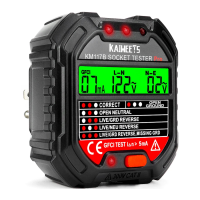
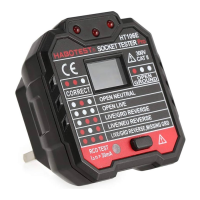
The KAIWEETS HT106E is a receptacle tester designed to identify common wiring problems in standard and RCD (Residual Current Device) receptacles. This device is a valuable tool for ensuring electrical safety and proper wiring in residential and commercial settings. Its primary function is to quickly diagnose various wiring faults, providing clear indications through a combination of illuminated lights and an LCD screen.
The core function of the HT106E is to detect and indicate specific wiring conditions within an electrical receptacle. It can identify if a receptacle is wired correctly, or if there are common faults such as an open ground, open neutral, open hot, hot/ground reverse, or hot/neutral reverse. The tester also features an RCD test function, which is crucial for verifying the proper operation of RCD-protected circuits. The integrated LCD screen enhances its functionality by providing a voltage measurement of the socket, adding another layer of diagnostic capability. This allows users to not only check for wiring faults but also to confirm the presence and approximate level of voltage.
The diagnostic chart provided with the tester clearly maps specific light patterns to corresponding wiring conditions. For instance, a "CORRECT" indication signifies that the receptacle is wired properly. An "OPEN GROUND" indication means the ground contact or wire is not connected. "OPEN NEUTRAL" and "OPEN HOT" indicate that the neutral or hot contact, respectively, is not connected. "HOT/GRD REVERSE" and "HOT/NEU REVERSE" point to reversed connections between hot and ground, or hot and neutral wires. A more complex indication, "HOT/GRD REVERSE, OPEN GRD," suggests a reverse connection between the hot and ground lines, with the ground line also being unconnected. These clear indicators help users quickly understand the nature of any detected wiring issue.
The RCD test function is a critical safety feature. When activated, it simulates a fault condition to check if the RCD trips as expected. This ensures that the RCD is functioning correctly to protect against electric shock. The tester guides the user through the RCD test process, instructing them to press the RCD button only when the wiring is indicated as "CORRECT." If the RCD trips and all lights on the tester go dark, it confirms the RCD is operating properly. If the RCD does not trip, it suggests a malfunction of the RCD or a miswired receptacle, prompting the user to consult a qualified electrician.
The KAIWEETS HT106E is designed for ease of use, making it accessible for both professionals and informed homeowners. Before each use, it is crucial to verify the tester's operation by testing it on a known live and correctly wired receptacle. This step ensures the tester itself is functioning accurately before diagnosing other circuits. The device is intended for indoor use only, and users are advised to clear the circuit of other equipment or devices before testing, as they could interfere with the tester's readings.
For standard receptacles, the usage involves plugging the tester into the receptacle and comparing the illuminated lights on the tester to the key code printed on the device. If the tester indicates incorrect wiring, a qualified electrician should be consulted. It's important to note that the test time should not exceed 5 minutes to prevent potential issues. When performing tests, users should be careful not to accidentally touch the RCD button unless specifically performing an RCD test, as this could trigger the leakage protection switch and cause unnecessary interruptions.
For RCD receptacles, the process begins by checking the RCD receptacle's user manual for specific operational details. After inserting the tester and confirming correct wiring (indicated by the "CORRECT" light pattern), the RCD button on the tester is pressed. The RCD light on the tester should illuminate, and ideally, the RCD on the circuit should trip, causing all lights on the tester to go dark. If the RCD does not trip, further investigation by an electrician is required.
The integrated LCD screen provides real-time voltage measurements, which is a significant advantage. After inserting the tester into a standard socket, the voltage value is displayed on the screen in volts. This allows users to quickly ascertain if voltage is present and its approximate level, adding to the diagnostic capabilities beyond just wiring fault detection.
The tester's design focuses on indicating specific wiring conditions: wiring correct, open ground, reverse polarity, open hot, open neutral, and hot/ground reversed. However, it's important to understand its limitations. The tester does NOT indicate the quality of the ground, the presence of multiple hot wires, combinations of defects not explicitly listed, or the reversal of grounded and grounding conductors. Users are strongly advised to unplug all appliances or equipment from the circuit being tested to help reduce the possibility of erroneous readings.
Maintaining the KAIWEETS HT106E is straightforward and primarily involves proper handling and cleaning. The device should be wiped with a clean, dry, lint-free cloth to remove any dust or debris. It is crucial to avoid using abrasive cleaners or solvents, as these can damage the device's casing or internal components.
Beyond physical cleaning, the most important aspect of maintenance is adhering to the safety warnings and operational guidelines provided in the manual. This includes verifying the tester's operation on a known good circuit before each use and not using the tester if it appears damaged in any way. Following these guidelines ensures the longevity and continued accuracy of the device, as well as the safety of the user.
The manual also emphasizes that while the tester detects common wiring problems, it is not a substitute for professional electrical expertise. If the tester indicates any wiring issues, or if there are any doubts about the electrical system, a qualified electrician should always be consulted to resolve the problems. This highlights that the device is a diagnostic tool, and professional intervention is necessary for repairs and complex issues. For any product-related concerns or warranty inquiries, users are directed to contact customer support, ensuring ongoing assistance and product reliability.
 General
| Auto Power Off | Yes |
|---|---|
| Alarm Mode | Yes |
| Operating Temperature | 0°C to 40°C |
| Safety Rating | CAT III 600V |
| Type | Clamp Meter |
| Display | LCD |
| Measurement Functions | AC/DC Voltage, AC/DC Current, Resistance, Capacitance, Frequency, Temperature, NCV |
| AC Voltage Range | 0-600V |
| DC Voltage Range | 0-600V |
| AC Current Range | 0.1A to 600A |
| DC Current Range | 0.1A to 600A |
| Frequency Range | 10Hz to 1MHz |
| Capacitance Range | 0-100µF |
| Temperature Range | -20°C to 1000°C |
| Battery | 2 x AAA |
| NCV Sensitivity | High |

 To Next Page