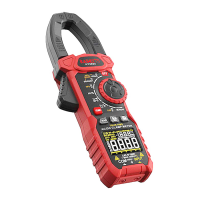
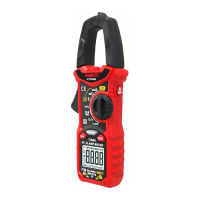
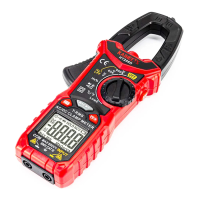
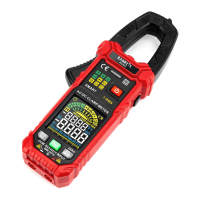
The KAIWEETS HT208A is a TRUE-RMS 1000A AC Digital Clamp Meter with integrated VFD Mode and Inrush Current capture, designed for electrical measurements in various applications.
Function Description
The HT208A clamp meter offers a comprehensive range of measurement functions, including AC/DC voltage, AC current, frequency, duty cycle, resistance, continuity, diode test, capacitance, and temperature. It also features advanced functions such as Inrush current measurement, Variable Frequency Drive (VFD) measurement for both AC current and AC voltage, High-Impedance voltage measurement, Low-Impedance voltage measurement (LoZ), Non-contact AC voltage detection (NCV), and Live detection. The Inrush current function captures the instantaneous high input current drawn by a power supply or electrical equipment at turn-on, which is crucial for analyzing the initial currents required to charge capacitors and inductors or transformers. The VFD mode eliminates high-frequency noise in voltage and current measurements by means of a low-pass filter, making it suitable for variable frequency drive applications. The LoZ mode allows for AC/DC voltage measurements with a low impedance, which helps prevent "phantom" voltage readings by lowering the meter's internal resistance, thus loading the circuit more heavily than in standard measuring mode.
Important Technical Specifications
The HT208A features a 6000-count True RMS display with an update frequency of approximately 3 Hz. It operates on 3 x AAA (1.5V) batteries and weighs approximately 700g, with dimensions of 285mm × 135mm × 60mm. The device conforms to IEC 61010-1, IEC 61010-2-032, and IEC 61010-2-033 security standards, rated for CAT III 1000V / CAT IV 600V. Its pollution level is 2.
Operating temperature ranges from 0 to +40 °C with an operating humidity of <80%, and an operating height of 0 to max. 2000 m. Storage temperature is -10 to +60 °C with an air humidity in storage of <70%.
Accuracy Specifications:
- DC Volts:
- 600mV/6V/60V/600V: ±(0.5%+5) with 0.1mV/0.001V/0.01V/0.1V resolution.
- 1000V: ±(0.8%+5) with 1V resolution.
- AC Volts:
- 600mV/6V/60V/600V: ±(0.8%+5) with 0.1mV/0.001V/0.01V/0.1V resolution.
- 750V: ±(1.0%+5) with 1V resolution.
- VFD(750V): ±(2.0%+5) with 0.1V resolution.
- AC Amps:
- 60A/600A/1000A: ±(2.5%+8) with 0.01A/0.1A/1A resolution.
- VFD: ±(5.0%+10).
- INRUSH: ±(5.0%+10).
- Resistance:
- 600Ω/6kΩ/60kΩ/600kΩ/6MΩ/60MΩ: ±(1.0%+5) with 0.1Ω/0.001kΩ/0.01kΩ/0.1kΩ/0.001MΩ/0.01MΩ resolution.
- Capacitance:
- 10nf/100nf/1000nf/10uf/100uf/1000uf/10mf: ±(4.0%+5) with 0.001nf/0.01nf/0.1nf/0.001uf/0.01uf/0.1uf/0.001mf resolution.
- 100mf: ±(5.0%+10) with 0.01mf resolution.
- Frequency:
- 10Hz/100Hz/1000Hz/10kHz/100kHz/1000kHz: ±(1.0%+3) with 0.001Hz/0.01Hz/0.1Hz/0.001kHz/0.01kHz/0.1kHz resolution.
- 10MHz: ±(3.0%+3) with 0.001MHz resolution.
- Duty Cycle: 1%~99%: ±(3.0%+3) with 0.1% resolution.
- Temperature:
- -20°C ~ 0°C: ±3°C.
- 0°C ~ 400°C: ±1.0% or ± 2°C.
- 400°C ~ 1000°C: ±2.0%.
- -4°F ~ 32°F: ±6°F.
- 32°F ~ 752°F: ±1.0% or ± 4°F.
- 752°F ~ 1832°F: ±2.0%.
Usage Features
The HT208A is designed for ease of use with a rotary function switch for selecting measurement modes and dedicated function buttons.
- Rotary Function Switch: Used to select the primary measurement function (e.g., AC current, AC/DC voltage, resistance, temperature).
- FUNC Button: Switches between secondary functions within a selected mode (e.g., AC and DC, or different sub-functions like continuity, diode, capacitance within the resistance mode).
- RAN Button: Enables auto-ranging by default. Pressing it switches to manual mode and cycles through all available ranges. Holding it for two seconds restores auto-ranging.
- MAX/MIN Button: Switches between maximum and minimum values. Holding it for more than 2 seconds exits this mode. When entering this mode, the meter automatically enters manual range mode.
- REL Button: Activates the Relative (REL) mode, storing the existing reading (a delta) and resetting the display to zero, setting a relative reference point for subsequent measurements.
- HOLD / Work Light Button: Captures and holds a stable measurement. It is important to deactivate this function at the start of a test to avoid incorrect results. Pressing and holding this button for more than 2 seconds switches the work light on or off.
- Auto-ranging: Automatically selects the best-suited measurement range and adjusts the measurement unit and resolution.
- Automatic Shutdown: The meter automatically shuts down after 15 minutes of no operation, with three beeps before turning off. Any key press restores the meter to operation. Holding the "FUNC" key for more than 2 seconds and switching on the clamp meter at the same time can deactivate the automatic switch-off.
- Connecting Test Leads: Proper connection of test leads is crucial. The black test lead connects to the COM terminal and the red test lead to the INPUT terminal.
- AC Current Measurement: Involves turning the rotary switch to the correct current setting, opening the jaw, inserting the conductor, closing the jaw, and reading the display. It is critical to surround only one conductor for accurate measurement; if multiple supply conductors (L and N) are measured, currents will cancel out. A cable separator is required for measuring with the current probe if household appliances contain L and N conductors.
- AC/DC Voltage Measurement: Requires setting the rotary switch to the appropriate voltage mode, plugging in test leads, and contacting the test probes with the points to be measured. Voltage above 750 V (AC) / 1000V (DC) cannot be measured.
- Frequency or Duty Cycle Measurements: Involves setting the rotary switch to Hz%, plugging in test leads, and connecting probes to the measuring points.
- Resistance Measurement: Requires setting the rotary switch to Ω, turning off the circuit under test, plugging in test leads, placing probes in contact with the points, and reading the display.
- Continuity Test: Involves setting the rotary switch to the continuity mode, pressing FUNC until the continuity symbol appears, plugging in test leads, and connecting probes to the circuit. An LED indicator light turns on if resistance is <30 Ω.
- Diode Test: Requires setting the rotary switch to the diode test mode, pressing FUNC twice until the diode symbol appears, removing power from the circuit, connecting test leads to the diode, and reading the forward bias voltage value.
- Capacitance Measurement: Involves removing power from the circuit, setting the rotary switch to capacitance mode, pressing FUNC three times until "nf" appears, connecting test leads to the component, and reading the display. For small capacitors, the REL function can be used to subtract residual capacitance.
- Temperature Measurement: Requires setting the rotary switch to °C / °F, inserting the K-type thermocouple into the INPUT and COM inputs, contacting the probe with the measurement object, and reading the display.
- Non-contact AC Voltage Detection (NCV): Involves turning the knob to NCV/LIVE. The meter detects electromagnetic fields, indicating weak fields with a slow beep and green LED, and strong fields with a quick beep and red LED.
- Live Detection: Similar to NCV, but specifically for live wire detection. It requires removing the black test lead and connecting the red test lead to the conductor.
Maintenance Features
- Safety First: Always disconnect test leads from the meter before removing its back cover to avoid electrical shock. Repairs or servicing should only be performed by qualified personnel.
- Battery Replacement: Replace batteries when the low battery symbol appears on the display. Disconnect the meter from the power source and remove test leads before loosening screws on the back and replacing batteries.
- Cleaning: To avoid damaging the meter, do not use abrasives or solvents. Periodically clean the meter by wiping it with a damp cloth and mild detergent. Do not get water inside the case. Wipe the contacts in the socket with a clean cotton swab soaked in alcohol.
- Storage: If the meter is not used for a long time, remove the battery. Do not store the meter in a high temperature or high humidity environment.

 Need help?
 General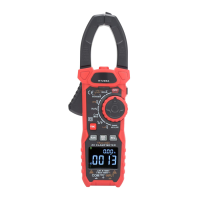

 To Next Page