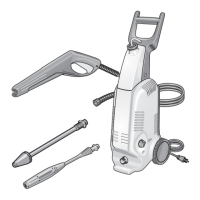
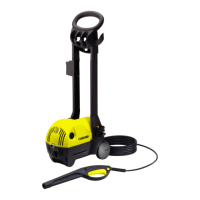
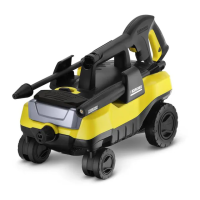
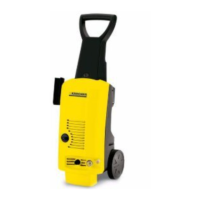
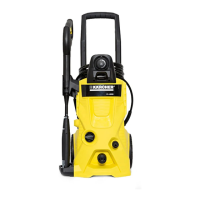
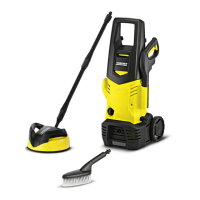
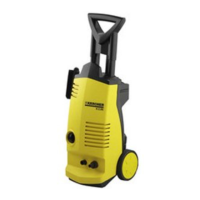
This document is the operating manual for the Kärcher K 3.70 Pressure Washer, a device designed for domestic cleaning tasks.
Function Description:
The Kärcher K 3.70 Pressure Washer is essentially a powerful electric motor that drives a set of pistons, forcing water through a small nozzle to create a pressurized jet. This high-pressure jet provides efficient, economical, and labor-saving cleaning power for a wide range of applications around the home and garden. It is capable of cleaning cars, motorbikes, caravans, boats, bicycles, patios, fences, garden walls, pathways, driveways, house facades (especially block driveways), and removing algae and moss from roofs, brickwork, and guttering. It can also clean garden tools, machinery, furniture, barbecues, and provide hygienic cleaning for animal pens and their surroundings. With additional Kärcher accessories, its capabilities extend to clearing blocked drains and pipes, removing old paint and rust from garden furniture and gates, and spraying insecticide onto trees, plants, and lawns. The pressure washer is environmentally friendly, reducing water consumption compared to a normal garden hose, which is particularly advantageous with a metered water supply. It also offers a suction mode, allowing water to be drawn from an open container like a water butt, providing flexibility in water sourcing.
Important Technical Specifications:
- Power Connection:
- Voltage: 230-240 V-AC
- Current: 1~50 Hz
- Connected/Load: 1.7 KW
- Mains Fuse: 13 AMP
- Water Connection:
- Supply Temperature (Max): 40 °C
- Supply Rate (Min): 10 litres per minute
- Supply Pressure (Max): 1.2 MPa (12 bar)
- Supply Hose: Length 7.5 metres, Diameter 1/2 inch
- Performance Data:
- Pump Pressure (Max): 12 MPa (120 bar)
- Operating Pressure: 11 MPa (110 bar)
- Flow Rate: 6.3 litres per minute (380 L/h)
- Detergent Intake: 0.3 litres per minute
- Recoil Force of Hand Held Spray Gun at Operating Pressure (Max): 15 N
- Unit vibrations: 0.8 m/s²
- Noise level LPA (EN 60704-1): 74.5 dB(A)
- Noise level LWA (2000/14/EEC): 90 dB(A)
- Optimum Working Distance on High Pressure: 30 cm
- Dimensions:
- Length: 395 mm
- Width: 205 mm
- Height: 295 mm
- Weight: 11 Kg
- Electrical Connection Requirements: An RCD plug and socket are recommended for emergency electrical supply interruption. A typical garden hose (minimum length 7.5 meters) with a suitable hose connection (Hoselock/Gardena type) is required. Extension lines must be fully unwound and have sufficient cross-sectional area. Recommended cross-sections for extension lines are: 1 to 10 m: 1.5 mm², 10 to 30 m: 2.5 mm². The plug and coupling of an extension line must be waterproof.
- Detergent Compatibility: Only cleaning agents recommended by Kärcher (UK) Ltd. should be used to avoid damage. Recommended detergents include Profi RM 555 ASF (Universal Cleaner), Profi RM 555 ULTRA (Universal Cleaner), Profi RM 565 ULTRA (Automotive Cleaner), Profi RM 570 ULTRA (House & Garden Cleaner), and Profi RM 575 ULTRA (Boat Cleaner). Detergent tablets (Kärcher Clean Tabs) are also available, providing 5 litres of cleaning detergent per 10 tablets dissolved in clean water.
Usage Features:
- High Pressure Operation: The spray lance with Vario Power Nozzle (No. 6) is attached to the spray gun (No. 8). The Vario Power Nozzle is set to high pressure mode ("+"). The safety ratchet on the spray gun is released, and the trigger is squeezed to operate. The pressurized water jet alone is effective for most cleaning tasks, but detergent and a wash brush are advantageous for vehicles or other paint finishes.
- Low Pressure Operation with Detergent: Detergent is diluted in a suitable container, and the detergent suction tube (No. 1) is placed into the container. The Vario Power Nozzle is set to low pressure mode ("-"). The safety ratchet is released, and the trigger is squeezed to apply detergent. Detergent is not used in high-pressure mode.
- Low Pressure Operation with Brush: For surfaces with grease contamination (e.g., car paintwork with traffic film), loose dirt is first washed away with a clean water high-pressure spray. Then, the bayonet fit spray lance is removed, and the wash brush is fitted to the spray gun to apply detergent in low-pressure mode. The detergent should be left for 2-4 minutes to maximize effect. After detergent application, the surface is brushed while the pressure washer is switched on, followed by a high-pressure rinse with the spray lance to remove traffic film.
- Suction Mode: To draw water from an open container, the high-pressure hose is disconnected from the machine. The water connection/hosepipe with coupling (No. 5) is replaced with a suction hose and filter (Part No. 4.440-238, purchased as an accessory). The pressure washer is operated without the high-pressure hose until water flows from the high-pressure outlet without bubbles, then the high-pressure hose is re-connected. A filter (Part No. 4.730-097) is recommended to prevent damage from dirt in drawn water.
- Safety Features: The appliance is not intended for use by young children or infirm persons without supervision. Young children must be supervised. The operator must use the appliance properly, considering local conditions and paying attention to third persons, especially children. The appliance should not be used if third persons are within reach unless they wear protective clothes. High-pressure jets can be dangerous if used improperly and must not be directed at people, animals, active electrical equipment, or the appliance itself. The jet should never be directed at oneself or others to clean clothes or shoes. The appliance should not be used to spray objects containing hazardous substances (e.g., asbestos). Vehicle tyres/tyre valves can be damaged and burst by the high-pressure jet; cleaning should be performed with a minimum distance of 30 cm. Cleaning operations generating oil-saturated wastewater (e.g., engine cleaning) must only be performed in locations with an oil separator. When cleaning varnished surfaces, a minimum distance of 30 cm should be maintained to avoid damage. Solvent-containing liquids or undiluted acids and solvents (e.g., benzene, paint thinner, heating oil, acetone) must never be used as they are highly inflammable, explosive, toxic, and can affect appliance materials. Appropriate protective clothes and glasses should be worn if required. The appliance should not be left unattended while turned on. Only manufacturer-supplied or recommended detergents should be used.
Maintenance Features:
- General Care: The inlet filter should be checked for dirt or debris before each use. If the nozzle is blocked by dirt or grit, it should be removed with a needle and rinsed with water from the front.
- Hose Maintenance: The water supply hose should be connected, and with the lance attached, the spray gun trigger should be squeezed to run water through the pressure washer until the water flow is constant, then plugged into the electrical supply.
- Water Sourcing: When drawing water from an open water source (e.g., a water butt), a minimum of 10 metres (25 feet) of uncoiled hose between the water tap and the machine is required. The internal diameter of the feed water hose should be 12 mm (1/2"). Water Regulations require the use of a back-flow preventer valve at the tap end of the supply hose. A full flow connector should be used to connect the hose to the machine.
- Electrical Maintenance: If using an electrical extension lead, it must be rated at a minimum of 13 amps and fully uncoiled.
- Chemicals: Only Kärcher-recommended chemicals should be used to avoid damage. After using chemicals, always run fresh water through the machine. The high-pressure hose should not be mistreated, as it is designed to withstand high-pressure operation; vehicles should not run over it, and it should not be pulled across sharp or abrasive edges to prevent ballooning.
- End of Operation: Always rinse the pressure washer after using detergent by hanging the detergent suction tube in a container with clean water and running the pump for approximately one minute in low-pressure setting. In case of a break of 5 minutes or more, or to avoid overheating, the pressure washer should always be switched off. This involves switching off the power switch (No. 2), unplugging the mains electric lead (No. 9) from the socket, closing the water inlet, disconnecting the hosepipe, and releasing the trigger to remove all pressure from the machine, then securing the trigger with the safety locking device. Always remove the plug from the socket before cleaning the pressure washer.
- Frost Protection: Remember that frost will damage the Kärcher pressure washer if it is not completely emptied of water after use. Always store the unit in a frost-free area.
- Troubleshooting: A checklist is provided for common problems and their solutions, including issues with the machine not starting (plug not connected, defective socket, fuse blown, defective extension cable, wrong mains voltage), pump stops (fuse blown, overheating due to poor water supply), strong pressure fluctuations (nozzle partly blocked), machine not reaching operating pressure (nozzle blocked/worn out, inadequate mains water, inlet hose squeezed, water filter clogged, inlet hose blocked), and no detergent suction (wrong pressure, blocked detergent filter). For further assistance, the Kärcher (UK) Ltd. help-line can be contacted.

 Need help?
 General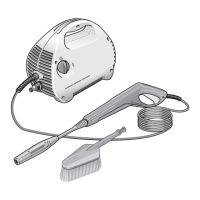

 To Next Page