The Chariot 3 iScrub 26 is a battery-powered, stand-on, hard floor scrubber designed for commercial use. It applies cleaning solution, scrubs the floor with brushes or pads, and then vacuums the soiled water into a recovery tank.
Function Description:
The machine operates through four primary systems: solution, scrub, recovery, and operator control.
The solution system stores cleaning solution and delivers it to the scrub system. It includes a solution tank, strainer, and valve, with an optional chemical metering pump and reservoir. The solution tank holds 25 gallons (95 liters) of cleaning solution (water and detergent, not hotter than 140°F/60°C). The strainer protects the valve from debris, and the valve automatically controls solution flow, activating only when scrub brushes are on and the machine is propelling.
The scrub system cleans the floor. For disk models, it features two rotary disk scrub brushes, motors, a scrub deck skirt, and a lift actuator. The brushes, driven by motors, follow floor irregularities. The scrub deck skirt contains the cleaning solution for efficient squeegee pickup. For cylindrical models, the scrub deck includes a debris hopper and a lift actuator.
The recovery system vacuums soiled water into a recovery tank. It comprises a squeegee, vacuum motor, float ball filter, and recovery tank. The squeegee wipes dirty solution from the floor as the machine moves forward. The vacuum motor draws the dirty solution into the recovery tank. The float ball filter prevents debris from reaching the vacuum fan and shuts off suction when the tank is full. The recovery tank has a capacity of 27 gallons (102 liters).
The operator control system manages the machine's direction and speed. It includes a directional control drive reset switch, throttle pedal, emergency stop/brake switch, steering wheel, propel controller, and drive wheel. The directional control drive reset switch ensures the operator is on the platform and signals forward or reverse direction. The controller translates throttle pedal input into drive wheel propulsion or deceleration. The steering wheel directs the drive wheel. The parking brake engages automatically when the operator steps off the platform or the emergency stop is activated, and can also be used to hold the machine on slopes.
Important Technical Specifications:
- Nominal Power: 1800 W
- Rated Voltage: 36 Volts DC
- Rated Amperage: 50 amps
- Batteries (Wet Cell): 3 x 12 Volt 205-234 AH @ 20 hr. rate. Compartment dimensions: 21 in. x 16 in. x 17 in. tall (533mm x 406mm x 432mm).
- Battery (Lithium - Optional): 38.4 Volts. Dimensions: (375mm x 347.5 x 471.5 mm).
- Scrub Brush Motors (Disk Machine): 2 x 0.5 HP (350 W)
- Scrub Brush Motors (Cylindrical Machine): 2 x 0.75 HP (560 W)
- Vacuum Motor(s): 0.63 HP (470 W)
- Maximum Flow Rate of Vacuum Motor: 72 cfm (33.98 liters per second)
- Maximum Suction of Vacuum Motor: 47.3 inches of water (11.7 kPa)
- Propelling Motor: 0.8 HP (600 W) 36V DC motor
- Mass (GVW): 1274 lbs (578 kg)
- Weight Empty (without batteries): 420 lbs (191 kg)
- Solution Capacity: 25 gal (95 L)
- Recovery Capacity: 27 gal (102 L)
- Scrub Brush Diameter (Disk Machine): 13 inch (330 mm)
- Scrub Brush Diameter (Cylindrical Machine): 4.1 inch (105 mm)
- Scrub Brush Pressure: 0 - 150 lbs (0-667 N) for Disk, 0 - 44 lbs for Cylindrical
- Scrub Brush Speed: 300 rpm for Disk, 720 - 950 rpm for Cylindrical
- Tires: 10 in. (254mm) Solid scrubber compound rear, urethane front
- Foundation Pressure: 135 psi (928 Kpa)
- Maximum Speed: 4.1 miles/hour (6.5 Km/hour)
- Frame Construction: Powder coated steel
- Brake: Electrical parking brake, sets automatically when operator steps off platform or engages emergency stop.
- Minimum Aisle U-Turn Width: 60 in. (1524 mm)
- Maximum Rated Climb and Descent Angle: 10% (6 degrees)
- Sound Pressure Level: 66 dBA
- Dimensions (Height): 50.0 inches (1270 mm)
- Dimensions (Length): 56.1 inches (1425 mm)
- Dimensions (Width without squeegee): 29.5 inches (749 mm)
- Dimensions (Width of squeegee - Disk Machine): 32.7 inches (830 mm)
- Dimensions (Width of squeegee - Cylindrical Machine): 33.5 inches (850 mm)
- Width of Scrub Path: 26 inches (660mm)
Usage Features:
The Chariot 3 iScrub 26 offers various operating modes controlled by a Function Mode Dial:
- Transport Only: Two positions for machine transportation.
- Daytime Cleaning / Light Cleaning: For light cleaning, machine propels at medium speed, scrub deck lowers to a low down pressure, water flows at a low rate (shuts off in neutral, restarts with pressure), squeegee lowers, and vacuum runs at a slow rate (squeegee remains down and vacuum on in neutral).
- Daytime Plus Cleaning / Light Cleaning: Similar to daytime cleaning, but vacuum flows at a medium rate.
- Medium Scrub Level Cleaning: For medium cleaning, machine propels at medium speed, scrub deck lowers to medium down pressure, water flows at a medium rate, and vacuum flows at a medium rate.
- Heavy Scrub Level Cleaning: For heavy cleaning, machine propels at slow speed, scrub deck lowers to heavy down pressure, water flows at a high rate, and vacuum flows at a high rate.
- Vacuum Only Mode: For picking up solution only. Brushes and water are off and up. Machine propels at slow speed, squeegee lowers, and vacuum flows at a high rate (squeegee and vacuum remain down and on in neutral).
- Double Scrub Cleaning: For applying solution and scrubbing without immediate pickup. Machine propels at slow speed, scrub deck lowers to heavy scrub level, and solution flows at a high rate (brushes and water shut off and raise in neutral, resume when propelling). This mode is ideal for heavily soiled floors or thick accumulations of floor finish, allowing solution to dwell and loosen soil before a second scrubbing pass.
A Solution Button and Indicator enables/disables solution flow, with a green indicator when active. The solution flow can be adjusted by approximately 10% using dip switches on the lower control panel.
The machine features an optional chemical metering system, allowing for precise dilution of chemicals. The chemical container is placed in a console recess, and dilution is set via a chemical selection knob. A prime button fills the line to the scrub deck.
Safety features include a Key Switch to control power, an Emergency Stop/Brake Switch to cut all power and apply the parking brake, and a Directional Control / Drive Reset Switch to ensure safe propel drive engagement.
Maintenance Features:
The manual outlines a comprehensive service schedule, including daily, 50-hour, 100-hour, and 200-hour checks.
- Batteries (Wet Cell Only): Regular maintenance is crucial. Batteries should be charged when their level reaches 25% of a full charge (specific gravity below 1.155). Electrolyte levels must be checked before and after charging, adding distilled water as needed. Battery tops should be wiped clean weekly, and battery condition tested with a hydrometer. Connections must be tight and corrosion-free. Every 4-6 months, batteries should be removed for cleaning of cases and compartment. AGM batteries are maintenance-free and do not require electrolyte checks.
- Lithium Battery (Optional): This product must be recycled. Lithium batteries pose a chemical risk if mishandled. Users must wear insulated gloves, eye protection, and safety toe boots, and use insulated tools. Batteries should be handled carefully, secured safely, and terminals protected from short circuits. They should not be lifted by terminals, vibrated, punctured, exposed to flames/incineration, opened, dropped, crushed, or exposed to water/fluids or direct sunlight. They should not be connected in series, with other battery types/brands, or exposed to high temperatures. Storage should be in direct sunlight at -20°C to 45°C (-4°F to 113°F), at 80% State of Charge (SOC), and checked monthly to ensure SOC does not fall below 20%.
- Onboard Charger (Optional): If equipped, charger programming may need adjustment when replacing batteries with a different type. The circuit breaker must be off before unplugging batteries.
- Squeegee Blades: Both front and rear squeegee blades should be checked daily for damage and wear. The front blade has four wear surfaces and can be rotated for extended life. The rear blade should be replaced if less than half its original thickness. The squeegee assembly can be removed for inspection or repair by loosening a retainer knob and disconnecting the vacuum hose.
- Scrub Deck: For disk models, the scrub deck Aqua-mizer™ and skirt should be inspected. Scrub brushes/pads are replaced by pressing a release lever and turning clockwise until locked. For cylindrical models, brush and skirt releases are turned counter-clockwise, brushes are slid out, and end caps removed.
- Actuator Scrub Deck: The actuator may need adjustment when replaced, ensuring it is fully extended and retracted without binding.
- Circuit Protection: A main circuit breaker interrupts power in case of electrical overload and can be reset.
- Solution System: The solution strainer should be cleaned, and the solution tank flushed with clean water (not hotter than 140°F/60°C). The solenoid valve, chemical bottle (optional), chemical pump (optional), and flow meter (optional) should be checked for proper function and obstructions.
- Vacuum System: The recovery tank float shut-off screen should be cleaned, and the ball checked for free movement. The vacuum motor carbon brushes should be checked periodically and replaced if less than 3/8" (9.5mm) long.
- Drive Motor: Carbon brushes should be replaced when worn.
- Electric Parking Brake: The brake engages automatically but has a mechanical override for pushing/towing (not to exceed 5 mph).
- Transporting: Before loading/unloading, the squeegee, scrub deck, side skirts, Aqua-Mizers, and scrub brushes/pads should be removed to prevent interference. The scrub head must be in the up position. When transporting, the parking brake should be set, and tires blocked.
- Troubleshooting: A detailed troubleshooting guide is provided for common issues like no power, little/no propel, machine not changing speeds, poor water pickup, vacuum motor issues, squeegee movement problems, poor scrubbing, solution flow issues, brush motor issues, scrub deck movement problems, and chemical metering system malfunctions. Controller fault codes are also listed to aid diagnosis.

 Need help?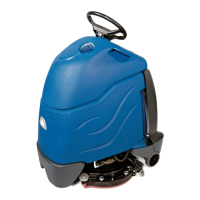




 To Next Page
 General