Need help?
Do you have a question about the Kavan V20 and is the answer not in the manual?
Lists key technical specifications of the KAVAN V20 RC set, including protocol, dimensions, weight, and operating voltage.
Details the primary capabilities of the KAVAN V20, such as its touchscreen, flight modes, telemetry, and model memory.
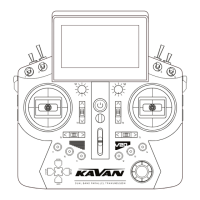
Identifies and labels the physical controls, buttons, gimbals, and ports on the KAVAN V20 transmitter.
Explains how to change the transmitter's gimbal mode and adjust centering springs or ratchet strength.
Provides instructions for charging the transmitter's 2S LiPo battery via USB-C and interpreting the LED status.
Covers navigation controllers and using the ETHOS Suite for firmware updates and management.
Guides users through creating new model profiles and configuring the internal RF module and antennas.
Details the procedure for registering and pairing receivers with the transmitter using ACCESS and Twin 2.4GHz protocols.
Explains how to configure the receiver's fail-safe modes (No signal, Hold, Custom) for safety.
Outlines the steps for performing a pre-flight range check to verify communication distance.
Details essential pre-flight checks and the correct sequence for powering the transmitter and receiver on/off.
Provides information on electrical equipment recycling and the EU Declaration of Conformity.
The KAVAN V20 is an advanced 24-channel RC set designed for both advanced and sport pilots, suitable for controlling various aircraft models, heli/multicopters, boats, or land models. It utilizes a 2.4GHz simultaneous dual-frequency transmission system (Twin 2.4GHz) with full telemetry support, offering a superior response time of up to 4ms and a range of up to tens of kilometers. The V20 is compatible with ACCST D16 or ACCESS transmission systems, allowing it to be paired with a wide range of KAVAN or FrSky receivers, with or without telemetry, and supporting classic PWM and S.BUS outputs. Its operation is managed by the ETHOS™ operating system, which provides a wide range of functions and mixes, adjustable via a large color touchscreen.
The KAVAN V20 offers extensive features for precise control and customization. It includes a 4.3" LCD touchscreen with 800x480 px resolution. Users can configure up to 20 flight modes, enabling perfect control in all conditions. Full telemetry is supported, with data transmission from a wide range of sensors and the ability to write data to an SD card. The device has memory for 64 models, expandable via an SD card. Voice telemetry output is available from the speaker or via a 3.5mm Jack connector. Up to 2 external antennas can be connected for enhanced signal reliability.
The transmitter is equipped with a comprehensive set of controls: 6 three-position switches, 2 two-position (1 momentary) switches, 2 rotary side dials, 2 momentary buttons on the rear, 6 user-programmable buttons on the front, 2 programmable mixer rotary knobs, and 4 digital trims. It also features a programmable slider (sliding potentiometer) and a 6-axis gyro sensor for advanced control. Precision gimbals are housed in 10 ball bearings, ensuring smooth and accurate input.
Trainer mode is available via cable or wirelessly via Bluetooth®. An F.BUS port is included for programming servos. Model names can be up to 15 characters long. Other configurable settings include subtrims, reversing servo operation, setting end points and rate limiting, and servo speed adjustment. The device supports data resetting, fail-safe emergency rates, dual rates, and rate progression setting along 2 exponential curves or 21-point curves. Freely programmable mixes, engine shutdown, safe idle, and logically linked switches are also available. The intuitive user menu features customizable widgets, and a servo monitor and tester are integrated.
For timing, three timers (stopwatch or timer) are available, along with model run time and transmitter run time tracking. The transmitter indicates preset controller positions upon startup. Display backlight intensity is adjustable, and gimbals can be calibrated. Sound and vibration warning alerts provide important feedback. A range check function is included, and operation with up to 3 receivers can be set.
Gimbal settings can be adjusted by unscrewing the 4 screws on the back cover. This allows for adjustment of the cross controller rotation up to 8°, tuning of the return spring force, and locking mechanisms. The centering springs and ratchet strength can also be adjusted.
Mode changing (e.g., from mode 2) is performed via the gimbal menu. After selecting the desired mode, the transmitter must be turned off, the battery removed, and the back cover unscrewed to physically adjust the self-centering arm mechanism on the gimbals.
The KAVAN V20 includes a 2S (7.4V) LiPo battery with a capacity of 4000 mAh and a balancer for charging via a USB-C interface. The battery case size is 84×41.5×20mm (L×W×H). An LED indicates charging status: ON for charging in progress, OFF for charging complete, and FLASHING for a charging error. When using the USB charging function, a suitable USB adapter with a voltage of 5±0.2 V and current >2.0 A is required.
The ETHOS Suite software can be used to update the transmitter's bootloader, firmware, SD card, and flash, as well as convert image and audio formats. It is recommended to keep the transmitter bootloader updated and to back up the current version before upgrading.
For registration and pairing, the process involves selecting [Register], holding down the pairing button on the receiver while turning it on, and then setting the RID (transmitter identifier), RX name, and UID (receiver identifier for multiple receivers). For ACCST D16 protocol, only pairing is required, without a registration system.
Fail-safe emergency rates can be set to "No signal," "Hold," or "Custom." In "No signal" mode, the receiver stops sending control signals. In "Hold" mode, it maintains the last known rates. In "Custom" mode, specific rate values can be preselected for each channel. A pre-flight range check is recommended before each flight, which reduces the transmitter's effective range to 1/30.
The device is designed with safety in mind, with warnings against flying in adverse conditions, turning off power in flight, starting engines with the neck strap on, flying in range check mode, or flying while impaired. It also advises against placing the transmitter upright on the ground, touching hot components, and emphasizes maintaining line of sight. Always check battery levels and control surface operation before flight. The recommended power-on sequence is transmitter first, then receiver, and power-off sequence is receiver first, then transmitter.
KAVAN electronic products come with a 2-year warranty covering manufacturing defects. Warranty claims should be made at the point of purchase or directly with KAVAN Europe s.r.o. The warranty does not cover misuse, improper maintenance, unauthorized service, incorrect wiring, use of unapproved accessories, modifications, deliberate damage, normal wear and tear, or operation outside specified limits.
For environmental responsibility, the device bears the crossed-out bin symbol, indicating it must not be disposed of with normal household waste but taken to a specialized collection and recycling facility in accordance with EU Directive 2012/19/EU (WEEE). The KAVAN V20 complies with Directive 2014/53/EU, and its EU Declaration of Conformity is available online.
 General
| Brand | Kavan |
|---|---|
| Model | V20 |
| Category | Controller |
| Language | English |

 To Next Page