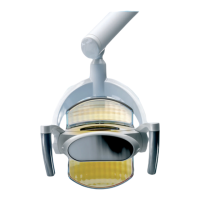
The KAVOLUX 1410 C is an operating light designed for illuminating the oral cavity during dental treatment. It is specifically suitable for installation on KaVo treatment centers, including the ESTETICA E50, E70, and E80 models. The device is intended for use by dentists, dental office personnel, and service technicians, with proper use emphasizing adherence to all instructions and regular inspections and service tasks.
Function Description
The KAVOLUX 1410 C provides illumination for dental procedures. It consists of a mounting pole, a swivel arm, a spring arm, a reflector, handles, a protective shield, and a lamp head. The light head can be adjusted for vertical swinging, and the swinging arm allows for rotational movement, both controlled by adjustable brakes. The device operates on an AC voltage supply and includes a halogen lamp as its light source.
Important Technical Specifications
- Input Voltage: 24 V AC
- Frequency: 50/60 Hertz
- Power Consumption: Max. 150 VA
- Illumination Intensity: Approx. 8,000 to 30,000 Lux
- Colour Temperature: Approx. 4,300 to 5,000 Kelvin
- Lamp Type: Halogen lamp (Mat. no. 0.740.4211)
- Dimensions (approximate):
- Length: 1,100 mm
- Width: 600 mm
- Height: 470 mm
- Weight (approximate):
- Gross weight: 23 kg
- Net weight: 16 kg
- Swing Ranges:
- Swivel arm: 260°
- Spring arm: 220°
- Lamp head: 180° (vertical), 320° (horizontal)
- Operating Environment:
- Temperature: +10 °C to +40 °C
- Relative humidity: 30% to 75%
- Air pressure: 700 to 1060 hPa
- Transportation and Storage Conditions:
- Ambient temperature: -20 °C to +55 °C
- Relative humidity: 5% to 95% (non-condensing)
- Air pressure: 700 to 1060 hPa
- Electromagnetic Compatibility (EMC): Complies with EN 60601-1-2. The device is suitable for use in all equipment, including devices in living areas, and for equipment directly connected to a public power supply. Special measures are in place regarding EMC, and further details on the technical EMC description can be provided upon request. KaVo does not guarantee EMC compliance for accessories or components not supplied by KaVo.
Usage Features
- Installation: The KAVOLUX 1410 C is installed on KaVo treatment units. The installation process involves mounting the pole, installing the swivel arm, and connecting the electrical lines. Specific instructions are provided for ESTETICA E50 and ESTETICA E70/E80 models.
- Safety: The device must not be operated in areas with explosion hazards. A protective shield must always be pre-mounted to protect against contact and chips. Users are advised to move and swivel the operating light with great care to avoid collisions.
- Lamp Voltage Setting: After installation, the lamp voltage must be set in service mode. This adjustment should only be performed by a service technician to ensure optimal life of the halogen lamp. The standard lamp voltage is 12.5 +/- 0.5 V AC (normal voltmeter) or 16.5 +/- 0.5 V AC (RMS voltmeter).
- Mechanical Adjustments:
- Swinging Arm Brake: This brake controls the ease of rotation of the swinging arm. It can be tightened or loosened by adjusting a screw visible under a hole in the arm.
- Light Head Brake: This brake determines the ease of vertical swinging of the glass reflector. Adjustment involves removing nuts and tightening a setscrew to allow the light head to move freely and remain in position.
- Operation: The general operation of the KAVOLUX 1410 C is described in the Instructions for Use of the respective treatment unit it is installed on.
Maintenance Features
- General Care: When using detergents or disinfectants, users must adhere to the manufacturer's instructions. The product should not be immersed in water or other fluids. Solvents or aggressive chemicals should not be used.
- Cleaning and Disinfecting:
- Lamp, Reflector, and Protective Shield: These components should only be cleaned when the light is turned off and cold. The protective shield should be removed by grasping its plastic frame, not the windows. The dental reflector should not be touched with fingers. Cleaning is done with lukewarm water and a lint-free soft cloth, followed by wipe disinfection using approved disinfectants such as FD 322 (Dürr) or Mikrozid AF (Schülke & Mayr).
- Handles: The handles can be removed by pressing spring-loaded catches and cleaned under running water. White handles (Mat. no. 1.001.4472) and grey handles (Mat. no. 1.002.4489) can be disinfected with a disinfectant wipe or by thermodisinfection (slight discoloration possible for grey handles). Approved disinfectants include Incidin Liquid (Ecolab), FD 322 (Dürr), and Microcide AF Liquid (Schülke & Mayr).
- Sterilization: Only the grey handles (Mat. no. 1.002.4489) can be sterilized for 4 minutes at 134 °C ± 1 °C, packed with a B cycle. White handles cannot be sterilized.
- Safety Checks: Comprehensive safety checks must be performed every 24 months. These include checking the cover/chip protection of the halogen lamp, fastening of the reflectors, mechanical strength and damage of the support arm system, joints, gas spring, and handles, and protective conductor connections. These checks are typically part of the treatment unit's safety check.
- Repair and Component Exchange:
- Exchanging the Dental Reflector: The dental reflector consists of two halves (Plastic dental reflector Mat. no. 0.740.4772). If only one half is defective, it can be replaced. The protective shield must be removed, setscrews loosened, and the defective half removed. New halves must be firmly positioned on the rubber base bead for a correct light field.
- Exchanging the Halogen Lamp: To prolong lamp life, the light should be turned off during breaks. The protective shield must be removed when the lamp is cold. Wires are removed from the luster terminal, and the retention spring is disengaged to remove the old lamp. The glass bulb of the new halogen lamp should not be touched with fingers. Wires of the new lamp must be tightly screwed to the terminal, and the protective sheath removed before inserting the lamp into the guide and locking the retention spring.
- Exchanging the Gas Spring: This procedure should only be performed by trained technicians.
- Troubleshooting: A troubleshooting guide is provided for common malfunctions such as the treatment unit and operating light not functioning, the light turning off and on sporadically, or the operating light not working. If issues persist, a KaVo-authorized technician should be contacted.

 Need help?
 General



 To Next Page