This document describes the Kenmore Microwave Oven, models 721.62342 and 721.62349, providing detailed instructions for its use, maintenance, and troubleshooting.
Function Description:
The Kenmore Microwave Oven is a kitchen appliance designed for heating and cooking food using microwave energy. It features various cooking modes, including Sensor Cook, Auto Defrost, Timed Cooking, and Multi-Stage Cooking, to accommodate a wide range of food items and cooking preferences. The Sensor Cook feature automatically determines cooking times and power levels based on detected vapor, simplifying the cooking process for popular food choices like potatoes, rice, popcorn, and various vegetables and entrees. Auto Defrost provides preset defrosting sequences for meat, poultry, and fish, with a built-in beep mechanism to remind users to check, turn over, separate, or rearrange food for optimal results. Timed Cooking allows users to program specific cook times and power levels, offering 10 power settings in addition to HIGH (100%) power. Multi-Stage Cooking enables programming up to two stages with different power levels for recipes requiring varied cooking intensities. The oven also includes convenience features such as an "Add Minute" function for quick cooking at 100% power and a child lock for safety.
Important Technical Specifications:
- Power Supply: 120 V AC, 60 Hz
- Rated Power Consumption: 1,650 W
- Microwave Output: *1,200 W (based on IEC 60705 RATING STANDARD)
- Rated Current: 13.8 A
- Overall Dimensions (WxHxD): 22 19/32 x 13 17/32 x 17 5/16 inches
- Oven Cavity Dimensions (WxHxD): 16 9/16 x 10 9/32 x 16 11/16 inches
- Capacity of Oven Cavity: 1.6 Cu. Ft.
- Weight for Auto Defrost: 0.1~6.0 lbs.
Usage Features:
Installation:
- Remove all packing materials.
- Place the oven on a level surface, ensuring at least 4 inches of space at the left, right, top, and rear for proper ventilation.
- Place the turntable roller rest in the circle on the oven floor, then place the glass turntable on top of the roller rest. Never place the glass turntable upside down, as blocking inlet/outlet openings can damage the oven.
Control Panel:
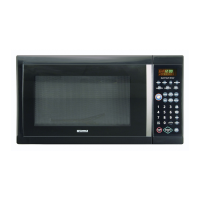
The control panel includes:
- DISPLAY: Shows time, cooking parameters, and selected functions.
- SENSOR COOK: Automatically cooks popular foods.
- AUTO DEFROST: Defrosts frozen foods (Meat, Poultry, Fish).
- NUMBER PADS: Enter cooking time, power level, quantities, or weights.
- COOK TIME: Sets cooking time.
- STOP/CLEAR: Stops cooking or clears entries.
- KITCHEN TIMER: Functions as a kitchen timer.
- CLOCK: Sets the time of day.
- POWER: Sets microwave power levels (1-10).
- ADD MINUTE: Adds 1 minute to cooking time (up to 99 min 59 seconds).
- START: Starts cooking.
- CHILD LOCK: Locks the control panel to prevent unsupervised use.
Cooking Tips:
- Browning: Meat and poultry with high fat content brown lightly after 10-15 minutes. Shorter cooks can use browning agents.
- Covering: Covers trap heat and steam, speeding up cooking. Use lids or microwave-safe plastic wrap (vented). Waxed paper prevents splattering and retains heat for bread.
- Spacing: Arrange individual foods (e.g., potatoes, cupcakes) in a circle, at least 1 inch apart, for even cooking.
- Stirring: Stir from outside to center to blend flavors and redistribute heat.
- Turning: Turn large foods (roasts, whole poultry, chicken pieces) for even cooking.
- Arrangement: Do not stack food. Arrange in a single layer. Place thicker portions of dense foods toward the outside of the dish.
- Doneness: Test frequently due to quick cooking times.
- Standing Time: Allow 2-15 minutes for food to stand after cooking, covered, to complete cooking and retain heat. Internal temperature rises about 10°F during this time.
- Shielding: Use small strips of aluminum foil to prevent overcooking rectangular/square dishes or poultry legs/wing tips. Keep foil at least 1 inch from oven walls to prevent arcing.
- Piercing: Pierce shells, skin, or membranes of foods (eggs, hot dogs, clams, potatoes) before cooking to prevent bursting.
Cookware Guide (USE):
- Ovenproof Glass: Utility dishes, bread dishes, pie plates, cake plates, liquid measuring cups, casseroles, and bowls without metallic trim.
- China: Bowls, cups, serving plates, and platters without metallic trim.
- Plastic: Plastic wrap (ensure it doesn't touch food, vent one corner), plastic dishes, cups, semi-rigid freezer containers, and plastic bags for short-time cooking (may soften).
- Paper: Microwave-safe paper towels, waxed paper, paper napkins, and paper plates without metallic trim.
Cookware Guide (DO NOT USE):
- Metal Utensil: Metal skewers, thermometers, foil trays (cause uneven cooking, arcing).
- Metal Decoration: Metal-trimmed or metal-banded dinnerware.
- Centura™ Tableware: Corning Company recommends not using Centura tableware and some Corelle™ closed-handle cups.
- Aluminum Foil: Large sheets (hinder cooking, arcing). Small pieces can shield, but keep 1 inch from walls/door.
- Wood: Wooden bowls, boards, baskets (dry out, split, crack).
- Tightly Closed Containers: Can explode (ensure opening for steam).
- Brown Paper: Absorbs heat, can burn.
- Metal Twist Ties: Can become hot, cause fire.
Microwave Power Levels:
10 power levels (1-10, with 10 being High/100%) are available for various tasks:
- 10 (High): Boiling water, making candy, cooking poultry/fish/vegetables, tender meat, whole poultry.
- 9: Reheating rice/pasta/vegetables, prepared foods, sandwiches.
- 8: Cooking eggs/milk/cheese dishes, cakes/breads, melting chocolate.
- 7: Cooking veal, whole fish, puddings/custard.
- 6: Cooking ham, whole poultry/lamb, rib roast, sirloin tip.
- 5: Thawing meat/poultry/seafood, less tender cuts of meat, pork chops, roast.
- 4: Chilling out fruit.
- 3: Softening butter.
- 2: Keeping casseroles/main dishes warm, softening butter/cream cheese.
- 1: Maintaining stews/main dishes warm, softening butter/cream cheese.
- 0: Standing time.
Maintenance Features:
Cleaning:
- Wipe oven interior and exterior with a soft cloth and mild detergent solution, then rinse and wipe dry. Do this weekly or more often.
- Never use cleaning powders or rough pads.
- Promptly wipe excessive oil splatters, especially after cooking chicken or bacon, with a wet paper towel.
- Removable Parts: The turntable and turntable roller rest are removable. Hand-wash them in warm (not hot) water with mild detergent and a soft cloth. Rinse well and dry. Do not use cleaning powders, steel wool, or rough pads.
- Turntable: Can be cleaned in the sink. Be careful not to chip or scratch edges.
- Turntable Roller Rest: Clean regularly.
- Special Care: Keep inner door panel and oven front frame free of food/grease buildup. Wipe often with mild detergent, rinse, and dry.
- After cleaning the control panel, touch STOP/CLEAR to clear accidental entries.
Troubleshooting (Common Issues):
- Oven does not start: Check if power cord is plugged in, door is closed, and cooking time is set.
- Arcing or Sparking: Ensure approved cookware is used and oven is not empty.
- Incorrect time of day: Reset the time.
- Unevenly Cooked Foods: Use approved cookware, ensure glass turntable is in place, stir/turn food, ensure food is defrosted, verify correct time/power level.
- Overcooked Foods: Verify correct time/power level.
- Undercooked Foods: Use approved cookware, ensure food is defrosted, verify correct time/power level, check ventilation ports.
- Improper Defrosting: Use approved cookware, verify correct time/power level, stir/turn food during defrosting.
- Oven light not on: Check if cooking time is set and START is touched.
- Steam from exhaust vent: Normal during cooking.
- Operating empty: Never operate empty or without the glass turntable.
- Microwave energy through viewing screen: No, metal screen bounces energy back; holes only allow light.
- Tone when pad touched: Confirms setting entry.
- Damage from overcooking: Possible, stay near oven.
- Improper function after first plug-in/power interruption: Unplug oven from 120V outlet, then plug back in to reset microcomputer.
- Light reflection around outer case: From oven light between cavity and outer wall.
- Operating sounds (clicking/hum/clunk): Caused by mechanical switch turning magnetron ON/OFF, power changes, and blower speed changes due to line voltage.
- Hard, dry, brown spots on baked foods: Overcooking; shorten time.
- Eggs popping: Steam buildup in yolk membrane; pierce yolk with toothpick. Never microwave eggs in shell.
- Scrambled eggs dry: Overcooked; cooking time varies by egg size, temperature, and standing time.
- Popping popcorn: Use microwave-specific devices or prepackaged commercial popcorn. Follow manufacturer directions exactly. Do not leave unattended. Do not use brown paper bags or attempt to pop leftover kernels. Place popcorn bag on a plate, not directly on turntable, to avoid overheating.
- Baked apples bursting: Peel not removed from top half, preventing expansion.
- Baked potatoes burning: Overcooking; do not overcook.
- Standing time recommended: Allows even cooking after microwave cycle.
- Additional time for refrigerated food: Initial temperature affects total cooking time.
Warranty:
- Full One-Year Warranty on Microwave Oven: Free repair for defects in material or workmanship.
- Full Five-Year Warranty on the Magnetron: Free repair for defects in material or workmanship of the magnetron.
- Warranty Service: Return to nearest Sears Parts & Repair Center in the United States. Call 1-800-4-MY-HOME®. Applies only while product is in use in the United States.
FCC Radio Frequency Interference Statement:
This equipment generates and uses ISM frequency energy. If not installed/used properly, it may cause interference to radio/TV reception. To correct interference: reorient receiving antenna, relocate microwave oven, move oven away from receiver, or plug oven into different outlet. Manufacturer is not responsible for interference caused by unauthorized modification.

 Need help?
 General

 To Next Page