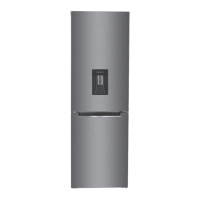
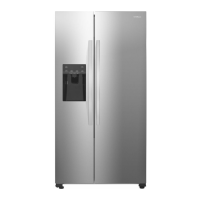
This document provides installation and instruction details for the Kenwood 60cm Total Frost Free Fridge Freezer, model KNF60HX18.
Function Description
The Kenwood KNF60HX18 is a 60cm total frost-free fridge freezer designed for indoor household use and similar applications. It features separate compartments for refrigeration and freezing, both controlled by an electronic panel. The unit is designed to keep food chilled and frozen efficiently, with various modes to optimize performance and energy consumption.
Important Technical Specifications
- Model: KNF60HX18
- Dimensions (H x W x D): 1854 x 600 x 665 mm
- Rated Voltage: 220-240V~, 50 Hz
- Rated Current: 0.9 A
- Rated Power: 110 W (Defrost: 160 W)
- Household Appliance Category: 7
- Energy Efficiency Class: A+
- Energy Consumption: 317 kWh per year (based on standard test results for 24 hours)
- Fridge Storage Volume: 193 L
- Freezer Storage Volume: 114 L (4-star)
- Frost-free: Yes, for the freezer compartment
- Temperature Rise Time: 13 hours
- Freezing Capacity: 12 kg / 24 hours
- Climate Class: SN, N, ST, T (intended for use at ambient temperatures between 10°C and 43°C)
- Airborne Acoustical Noise: 43 dB(A) re 1 pW
Usage Features
The fridge freezer offers several features to enhance usability and food preservation:
Operation Modes:
- User Defined Temperature: Users can set specific temperatures for both the fridge (2 to 8°C) and freezer (-16 to -22°C) compartments using dedicated buttons.
- ECO Mode: To save energy, this mode automatically sets the fridge to 5°C and the freezer to -18°C, minimizing energy consumption. An ECO indicator flashes and then remains on when activated.
- Holiday Mode: Ideal for periods of absence, this mode sets the fridge temperature to 17°C. It is recommended not to store food in the fridge during holiday mode. An indicator flashes and then remains on when activated.
- Super Freeze Mode: This mode is designed for rapid freezing, with an indicator flashing on the display. It automatically switches off after 26 hours.
- Lock/Unlock Function: The keypad can be locked or unlocked by pressing and holding a button for 3 seconds, preventing accidental changes to settings.
Food Storage Tips:
- Fridge Compartment: Cooked meats/fishes should be stored on a shelf above raw meats/fishes. Raw meats/fishes should be kept in a container on the lowest shelf.
- Air Circulation: Leave space around food to allow air to circulate inside the compartments.
- Food Separation: Prevent transfer of flavours and drying out by packing or covering food separately. Fruits and vegetables do not need to be wrapped.
- Cooling Hot Food: Always let pre-cooked food cool down before putting it in the unit to maintain internal temperature.
- Door Opening: Limit the number of times you open the doors to prevent warm air from entering.
Freezing Preparations:
- Quality and Speed: Freeze food in small quantities as it freezes faster, leading to better quality.
- Cooling Before Freezing: Cool cooked food completely before freezing.
- Packaging: Do not freeze food in metal containers. Use special freezer bags, film, polythene bags, plastic containers, or aluminium foil. Ensure packaging is airtight to prevent drying or freezer burn.
- Air Removal: Exclude as much air from the container as possible. A special vacuum pump can be used.
- Liquid Freezing: Freeze liquids (e.g., stew) in square blocks using polythene bags inside square-sided containers for efficient space usage.
- Labelling: Label frozen foods with contents, date, weight, and cooking notes using special freezer tapes, labels, and pens to organize and track storage times.
Defrosting Frozen Food:
- Room Temperature Defrosting: Remove frozen food from the freezer and uncover it to defrost at room temperature.
- Drainage: Drain off and discard any liquid lost during defrosting.
- Ice Crystals: Ensure no ice crystals remain in the food before cooking, especially meat.
- Prompt Cooking: Cook food as soon as possible after defrosting.
- Microwave Defrosting: Use microwave defrost settings only if cooking immediately afterwards.
- Re-freezing: Never re-freeze defrosted food unless it has been cooked again to kill harmful bacteria. Never re-freeze defrosted shellfish.
Internal Components:
- LED Light: Provides illumination inside the unit.
- Fridge Shelves: Glass shelves for organizing food.
- Salad Bins: Small and large salad bins with covers for fresh produce.
- Fridge Door Shelves: For storing bottles and smaller items.
- Freezer Drawers: For organizing frozen items.
- Freezer Glass Shelf: Additional shelf in the freezer.
- Accessories: Includes an egg tray, ice tray, and a bottle rack that can be placed on any fridge glass shelf.
Installation:
- Location: Choose a flat, firm, and well-ventilated location away from heat sources and direct sunlight. The unit is designed for ambient temperatures between 10°C and 43°C.
- Levelling: Adjust the two levelling feet at the front of the unit to ensure it is level.
- Free Space: Ensure 25 mm of free space on the left and right sides, 50 mm at the rear, and 25 mm at the top for proper ventilation. The door requires sufficient space to open fully.
- Door Reversal: The manual provides detailed instructions for reversing the door swing, requiring tools like Philips and flat-bladed screwdrivers, and a hexagonal spanner. It is recommended that two people handle the unit during assembly and that a qualified technician performs the reversal if the user is not confident.
Maintenance Features
Cleaning:
- Before First Use: Wipe the inside with a weak solution of bicarbonate soda, rinse with warm water, and dry completely. Clean the exterior with a damp cloth.
- Regular Interior Cleaning: Remove all shelves and drawers. Wipe the inside with a weak bicarbonate soda solution, rinse with warm water, and dry thoroughly.
- Regular Exterior Cleaning: Use a damp cloth to clean the exterior, then wipe with standard furniture polish. Ensure doors are closed to prevent polish from getting on magnetic door seals or inside the unit.
- Condenser Grille: Vacuum the condenser grille at the back of the unit and adjacent components using a soft brush attachment.
Internal LED Light:
- The internal LED light is a panel that cannot be changed by the user. Contact a qualified service agent if replacement is needed.
Handling and Moving:
- When moving the unit, hold it around its sides or base. Avoid holding the edges of the top surface.
- After moving, do not turn on the unit for two hours to allow the coolant fluid to settle.
Servicing:
- Servicing should only be carried out by an authorized engineer using genuine spare parts. Repairs by unauthorized personnel may cause injury or malfunction.
Switching Off for Long Periods:
- If the unit will be off for an extended time, disconnect it from the mains supply, empty all food, and clean the appliance. Leave the door ajar to prevent unpleasant smells.
Condensation:
- Condensation may appear on the outside of the unit, especially in humid rooms. Wipe off any moisture residue. If the problem persists, contact a qualified technician.
Disposal:
- The unit contains valuable raw materials that can be recovered and reused. It should not be disposed of with household waste.
- Dispose of the appliance at a designated collection point for the recycling of waste electrical and electronic equipment.
- For information on where to drop off the unit for recycling, contact your local authority or the store where you purchased the product.
- If the old unit has locks or latches, remove them to prevent children from being trapped inside.

 Need help?

 To Next Page
 General