Need help?
Do you have a question about the Kenwood KRC-165 and is the answer not in the manual?
Guidelines for setting controls and switches for calibration and alignment.
Technical details for the FM receiver functionality.
Technical details for the AM receiver functionality.
Technical details for the cassette tape playback mechanism.
Technical details regarding the audio amplification power output.
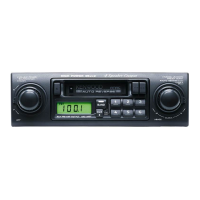
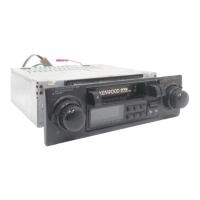
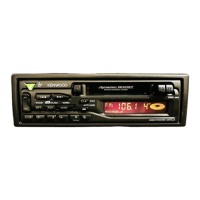
The KRC-165 is a cassette receiver designed for in-car audio systems, combining a radio tuner with a cassette player. This service manual provides comprehensive information for maintenance, repair, and adjustment of the device.
The KRC-165 functions as a complete audio entertainment system for vehicles. It integrates an AM/FM tuner, allowing users to listen to radio broadcasts across various frequency bands. The tuner section includes features for selecting different channel spacing (e.g., 50kHz/200kHz for FM, 9kHz/10kHz for AM) to accommodate regional broadcast standards. The receiver also incorporates a cassette deck for playing audio cassettes, supporting standard tape speeds and offering features like fast forward (FF) and rewind (REW).
The device's audio output is powered by an internal amplifier, capable of driving four speakers, providing a stereo sound experience within the vehicle. It also includes pre-out connections, allowing for the integration of external amplifiers for enhanced audio performance. Sound control features such as Bass, Treble, Balance, and Fader adjustments are available, enabling users to customize the audio output to their preferences. A "Dynamic Boost" sound control system is also integrated, likely enhancing the perceived loudness and clarity of the audio.
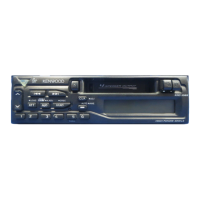
The user interface consists of a panel assembly with various buttons and a 7-segment LCD display. Buttons are provided for power (PWR), source selection (SRC), cassette deck controls (FF, REW, PROG), radio functions (BAND, AUTO AME), and audio adjustments (LOUD, BAME, CRSC, ATT, AUD). A clock adjustment (CLK-ADJ) feature is also present. The display provides visual feedback on selected functions, radio frequencies, and other operational parameters. Illumination for the display and buttons ensures visibility in various lighting conditions.
The KRC-165 is designed for straightforward operation within a vehicle. The front panel provides easy access to all primary functions. The "PWR" button controls the device's power, while "SRC" allows switching between the radio tuner and the cassette player. The cassette deck controls, including "FF" and "REW," facilitate navigation through cassette tapes. The "PROG" button likely offers program play or other cassette-related functions.
For radio operation, the "BAND" button cycles through available frequency bands (AM/FM). The "AUTO AME" function probably assists with automatic station tuning or memory storage. Audio customization is available through "LOUD" (loudness), "BAME" (bass/midrange), "CRSC" (crossover), "ATT" (attenuator), and "AUD" (audio settings) buttons, allowing users to tailor the sound profile. The "CLK-ADJ" button enables setting the clock. Preset buttons (1-6) allow users to store and quickly recall their favorite radio stations.
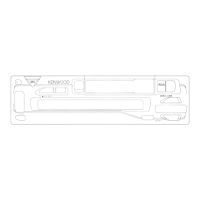
The device's design includes an escutcheon for a clean, integrated look when installed in a vehicle's dashboard. The mounting hardware assembly ensures secure installation.
The service manual outlines various aspects crucial for maintaining and repairing the KRC-165. It includes a detailed block diagram, illustrating the interconnections and signal flow between different functional blocks such as the synthesizer unit, power IC, and cassette media. This diagram is invaluable for troubleshooting and understanding the device's internal architecture.
A comprehensive "Components Description" section lists all key integrated circuits (ICs), transistors, and other components, along with their application and function. This information is essential for identifying faulty parts and understanding their role in the circuit. For example, the system MI-COM (IC1) controls overall system operation, while the E-VOL. & N.C. MPX (IC2) handles sound volume and multiplexing.
The "Microcomputer's Terminal Description" provides a pin-by-pin breakdown of the main microcomputer (IC1), detailing the function and processing operation of each terminal. This level of detail is critical for advanced diagnostics and repair, allowing technicians to verify signals and control lines.
The "Test Mode / Adjustment" section describes how to enter and exit a dedicated test mode, which facilitates various adjustments and checks. This mode allows technicians to set volume levels, adjust sound controls (Bass, Treble, Balance, Fader) to their full range, and inspect the LCD display. Specific adjustments for the cassette deck, such as head height and azimuth, are detailed, including the use of specialized tools like a 2-LINE TAPE and an AC voltmeter/oscilloscope. These adjustments are vital for ensuring optimal cassette playback quality.
The manual also includes "PC Board (Component Side View)" and "PC Board (Foil Side View)" diagrams, which are essential for locating components and tracing circuit paths on the printed circuit boards. An "Exploded View (Mechanism)" and "Exploded View (Unit)" provide visual guides for disassembling and reassembling the device, showing the placement of mechanical and unit-level components. A "Parts List" provides part numbers and descriptions for all components, facilitating ordering and replacement. Safety critical components are specifically marked, emphasizing the importance of using manufacturer-recommended parts for repair to ensure continued safety and performance.
 FM Tuner
| frequency range (50kHz) | 87.5MHz - 108.0MHz |
|---|---|
| frequency range (200kHz) | 87.9MHz - 107.9MHz |
| usable sensitivity (S/N: 30dB) | 9.3dBf (0.8 µV/75 Ω) |
| quieting sensitivity (S/N: 50dB) | 15.2dBf (1.6 µV/75 Ω) |
| frequency response (±3.0dB) | 30Hz-15kHz |
| signal to noise ratio | 70dB(MONO) |
| selectivity | ≥ 80 dB(±400 kHz) |
| stereo separation | 40dB(1kHz) |
AM Tuner| frequency range (9kHz) | 531kHz - 1611kHz |
|---|---|
| frequency range (10kHz) | 530kHz - 1700kHz |
| usable sensitivity (S/N: 20dB) | 28 dBµ (25 µV) |
Cassette Player| tape speed | 4.76 cm/sec. |
|---|---|
| wow & flutter | 0.12 % (WRMS) |
| frequency response (±3 dB) | 30 Hz -14 kHz (120 µs) |
| separation | 40 dB (1 kHz) |
| signal to noise ratio | 52 dB |
 Audio
Audio| maximum output power | 45 W x 4 |
|---|---|
| full bandwidth power (at less than 1% THD) | 22 W x 4 |
| bass tone action | 100 Hz ±10 dB |
| treble tone action | 10 kHz ±10 dB |
| preout level / load | 1800 mV / 10 kΩ |
| preout impedance | ≤ 600 Ω |
General Specifications| operating voltage | 14.4 V |
|---|---|
| current consumption | 10 A |
| installation size (W x H x D) | 182 x 53 x 158 mm |
| weight | 1.3 kg |

 To Next Page