Need help?
Do you have a question about the Kenwood KS-303HT and is the answer not in the manual?
Essential electrical safety measures to prevent shock and hazards.
Safe operating practices regarding placement, ventilation, and environment.
Proper physical handling, servicing, and repair safety.
Positioning speakers for optimal surround sound effect.
Guidelines for placing speakers near a television set without distortion.
Instructions and precautions for securely mounting speakers on walls.
Recommended method using speaker wires and pin-plug cord.
Optional method using only speaker wires.
Overview of the subwoofer's front panel features.
Details on rear panel connections, switches, and indicators.
Important notes to prevent sound distortion and damage.
Causes and solutions for the subwoofer not producing sound.
Troubleshooting steps for insufficient volume output.
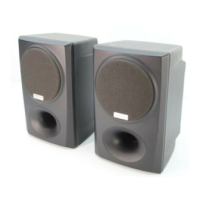
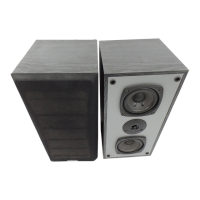
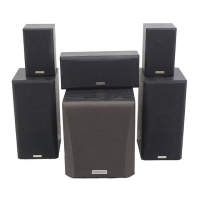
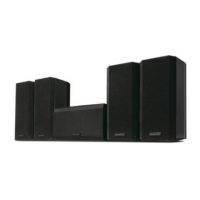
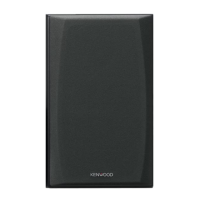
The KENWOOD KS-303HT is a speaker system designed to provide a full surround sound experience, making it an excellent choice for those who appreciate high-quality audio reproduction. This system is composed of front speakers, a subwoofer, a center speaker, and rear (surround) speakers, all working together to create an immersive listening environment.
The KS-303HT speaker system is engineered to deliver rich and detailed sound. The front and center speakers are responsible for reproducing the main audio channels, while the rear (surround) speakers enhance the spatial audio, creating a sense of depth and immersion. The subwoofer is a crucial component, providing powerful and deep bass frequencies that add impact and realism to movies, music, and games.
The subwoofer features a built-in amplifier and several controls to fine-tune its performance. The PHASE switch allows you to adjust the phase relationship between the subwoofer and the front speakers, ensuring optimal bass sound at your listening position. You can set it to NOR (normal phase) or REV (reversed phase) to achieve the best acoustic integration. The CROSSOVER knob enables you to adjust the optimal volume of the subwoofer and the frequency balance with the other speakers, allowing for seamless blending of sound. The VOLUME knob controls the overall volume of the subwoofer and speakers, giving you precise control over the sound output.
For connectivity, the subwoofer offers LINE INPUT (R • L/MONO) terminals for connecting to the SUBWOOFER PRE-OUT jacks on your receiver. If your receiver has only one SUBWOOFER PRE-OUT jack, you can use the L/MONO jack for connection. Additionally, LINE OUTPUT (R • L) terminals are provided to relay signals received at the LINE INPUT jacks. The Speaker Input/Output Terminals allow you to connect the subwoofer to your receiver's front-speaker output terminals (FROM AMPLIFIER) and then connect the front speakers to the subwoofer's TO SPEAKERS terminals. This setup ensures that the subwoofer processes the low-frequency signals before passing the rest to the front speakers. The POWER switch turns the subwoofer's power ON and OFF.
An important feature of the subwoofer is the STANDBY/ON indicator, which lights up green during normal operation and red when the subwoofer enters standby mode. This standby mode is activated by the AUTO SHUTOFF switch, which, when set to ON, automatically puts the subwoofer into standby if it doesn't receive a signal from the receiver for 30 minutes. The subwoofer will then automatically resume normal power when output from the receiver resumes, promoting energy efficiency. The subwoofer also includes a Duct to extend its low-frequency output and a Loudspeaker for sound projection.
To get the most out of your KS-303HT system, proper positioning is key. The front and right speakers should be placed on opposite sides of your TV, angled towards the listening area to enhance the stereo effect. The center speaker should be positioned above or below the TV, aligned with its center, and tilted to face the listening area directly. The rear (surround) speakers should be placed as high as possible, either directly to the sides or slightly behind the listening area, with their angles adjusted to face the listeners. For the deepest bass output, the subwoofer should be placed near a wall or, ideally, in a corner.
The front, center, and rear speakers are magnetically shielded, allowing them to be installed close to a TV without causing color distortion. However, if color distortion occurs, it's recommended to turn the TV off for 15-30 minutes to allow its degaussing circuitry to correct the magnetic field, or to move the speakers further from the TV if the problem persists.
The speakers can be placed on the floor or a shelf. For wall mounting, the front, center, and rear speakers include mount holes. They can be hung vertically using a single screw in the top mount hole, or horizontally using two screws spaced 76 mm (3 inches) apart, ensuring the screws project 7 to 9 mm (1/4 to 3/8 inches) from the wall surface for secure mounting. It's crucial to use appropriate screws and ensure the wall can support the speaker's weight. The subwoofer, however, cannot be wall-mounted and must be set up vertically, with its heat sink at least 10 cm (4 inches) away from the wall to ensure adequate ventilation.
When connecting the system, it is highly recommended to use the standard connection method with the included speaker wires and pin-plug cord. This involves connecting the front, center, and surround speakers to your receiver's terminals and the subwoofer's LINE IN (L/MONO) jack to the receiver's SUBWOOFER PRE-OUT jack. An alternative connection method using only speaker wires is also available, where the receiver's front-speaker terminals connect to the subwoofer's input terminals, and the subwoofer's output terminals connect to the front speakers. Always ensure that the receiver and subwoofer POWER switches are OFF before making any connections to prevent damage.
When operating the subwoofer, it's important to keep the input level within reasonable limits to avoid sound distortion and potential damage. Avoid over-boosting the bass at the receiver and turn the subwoofer volume to its minimum when making major changes to the sound input, such as switching on the amplifier or dropping a needle onto a vinyl record. If the subwoofer is installed too close to an analog record player, feedback (howling) may occur. This can be corrected by reducing the subwoofer volume or moving the subwoofer further away from the player.
Maintaining your KENWOOD KS-303HT speaker system is straightforward. The panels of the subwoofer and its casing can be cleaned by wiping them with a soft, dry cloth. It is crucial to avoid using volatile solvents such as alcohol, benzene, paint thinner, or gasoline, as these can cause discoloration or damage to the finish.
For electrical connections, it is important to never use contact restoring agents. These agents can cause the subwoofer to fail, and those containing oil may also lead to deformation of the plastic components.
In case of any operational issues, a troubleshooting guide is provided to help diagnose and resolve common problems. If there is no sound, check if the wires are securely connected and if the subwoofer volume is not turned all the way down. Also, ensure that the receiver's SUBWOOFER PRE-OUT signal is switched on if applicable. If the volume is too low, check for reversed speaker wires, an inappropriate phase setting, or if the receiver's SUBWOOFER PRE-OUT level is set to minimum. If the power fails to come on or operation is abnormal, it is recommended to set the POWER switch to OFF, unplug the power cord, and contact your dealer or nearest service center for repair.
The manual emphasizes several safety precautions, including not exposing the appliance to rain or moisture, avoiding removal of the enclosure, and referring servicing to qualified personnel. It also advises against placing the appliance near heat sources, in unstable locations, or where ventilation is blocked. These guidelines are crucial for ensuring the safe and reliable operation of the speaker system.
 Speaker Specifications
| front_speaker_system | 2 way |
|---|---|
| center_speaker_system | 2 way |
| rear_speaker_system | 1 way |
| front_speaker_woofer | 100 mm (4") Cone type |
| center_speaker_woofer | 100 mm (4") Cone type |
| front_speaker_tweeter | 50 mm (2") Cone type |
| center_speaker_tweeter | 50 mm (2") Cone type |
Impedance and Power| front_speaker_nominal_impedance | 8 O |
|---|---|
| center_speaker_nominal_impedance | 8 O |
| rear_speaker_nominal_impedance | 8 O |
| center_speaker_peak_input_power | 80 W |
| rear_speaker_peak_input_power | 80 W |
| front_speaker_maximum_input_power | 80 W |
| center_speaker_maximum_input_power | 40 W |
| rear_speaker_maximum_input_power | 40 W |
Sensitivity and Frequency| front_speaker_sensitivity | 88 dB / W at 1 m |
|---|---|
| center_speaker_sensitivity | 88 dB / W at 1 m |
| rear_speaker_sensitivity | 85 dB / W at 1 m |
| front_speaker_frequency_response | 100 Hz-20, 000 Hz |
| center_speaker_frequency_response | 100 Hz-20, 000 Hz |
| rear_speaker_frequency_response | 100 Hz-20, 000 Hz |
| front_speaker_crossover_frequency | 3, 000 Hz |
| center_speaker_crossover_frequency | 3, 000 Hz |
Speaker Dimensions| front_speaker_width | 129 mm (5-1/16") |
|---|---|
| center_speaker_width | 129 mm (5-1/16") |
| rear_speaker_width | 129 mm (5-1/16") |
| front_speaker_height | 198 mm (7-13/16") |
| center_speaker_height | 198 mm (7-13/16") |
| rear_speaker_height | 198 mm (7-13/16") |
| front_speaker_depth | 120 mm (4-3/4") |
| center_speaker_depth | 120 mm (4-3/4") |
| rear_speaker_depth | 120 mm (4-3/4") |
Speaker Weight| front_speaker_net_weight | 1.2 kg (2.6 lb) |
|---|---|
| center_speaker_net_weight | 1.0 kg (2.2 lb) |
| rear_speaker_net_weight | 0.8 kg (1.8 lb) |
Subwoofer Specifications| subwoofer_output_power | 50 Watts RMS |
|---|---|
| subwoofer_turn_over_frequency | 80 Hz ~ 160 Hz |
| subwoofer_enclosure | Bass-Reflex |
| subwoofer_loudspeaker | 200 mm (8") Cone type |
| subwoofer_nominal_impedance | 40 O |
| subwoofer_frequency_response | 40 Hz ~ 250 Hz |
Subwoofer Dimensions and Weight| subwoofer_width | 286 mm (11-1/4") |
|---|---|
| subwoofer_height | 368 mm (14-1/2") |
| subwoofer_depth | 356 mm (14") |
| subwoofer_net_weight | 11.2 kg (24.7 lb) |
Subwoofer Power and Input| subwoofer_supply_voltage | AC120V, 60 Hz |
|---|---|
| subwoofer_input_sensitivity_impedance_rca | 100 mV/43 kC2, 200 mV/43 ka |
| subwoofer_input_sensitivity_impedance_push | 1.8V/1.2 kQ |


 To Next Page