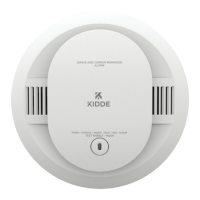
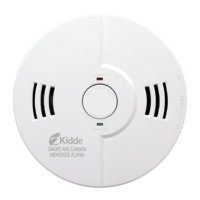
This document describes the Kidde Model 900-CUDR-V, a combination photoelectric smoke and carbon monoxide (CO) alarm with voice messages. This alarm is designed for residential use and is powered by two replaceable AA batteries. It incorporates a voice message system, a Hush™ feature to temporarily silence nuisance alarms, and self-testing capabilities.
Function Description
The Kidde Model 900-CUDR-V is a multi-criteria device engineered to detect both smoke and carbon monoxide from any source of combustion within a residential environment. It is not intended for use in recreational vehicles (RVs) or boats. The alarm provides distinct audible and visual indicators for smoke and CO events, as well as for various operational statuses like low battery, faults, and end of unit life.
When a smoke alarm condition is detected, the unit will sound three long beeps with a voice message stating "Fire!", repeating this pattern with a 1.5-second pause. The red LED will blink in sync with the alarm pattern. In the presence of both smoke and carbon monoxide, the smoke alarm takes precedence.
For a carbon monoxide alarm, the unit emits four quick beeps with a voice message "Warning! Carbon Monoxide", repeating every 5 seconds. The red LED blinks in time with this pattern. After 4 minutes in a CO alarm state, the alarm pattern will occur every 60 seconds.
The device is equipped with internal self-testing components that continuously monitor its operation. If an issue is detected, a fault signal will be generated. Weekly manual testing is also recommended to ensure proper functionality.
Usage Features
- Voice Message System: The alarm utilizes voice messages to clearly communicate the type of threat (Fire! or Warning! Carbon Monoxide), making it easier for occupants to understand the situation and react appropriately.
- Hush™ Mode: This feature allows users to temporarily silence nuisance smoke alarms for 8-10 minutes if the cause is known and not life-threatening (e.g., cooking smoke). Pressing the button on the alarming unit activates Hush™ mode. If the smoke is not too dense, the unit will silence. After the Hush™ period, the smoke alarm will automatically reset and sound again if combustion particles are still present. Hush™ mode can be used repeatedly until the air is clear. Dense smoke will override Hush™ and trigger a continuous alarm.
- CO Alarm Reset: During a CO alarm, pressing the button allows the unit to reset its calculations and re-check for the presence of CO. If the unit re-alarms within 6 minutes, it indicates high levels of CO, requiring immediate action.
- Alarm Memory: The unit retains memory of smoke or CO alarm events for 24 hours. If the unit has experienced a smoke or CO alarm, or has detected 100ppm CO or greater, the red LED will blink every 15 seconds for smoke memory (no voice) or two red LEDs will blink every 15 seconds for CO memory (with a voice message "Caution, carbon monoxide previously detected" after a button push). Pressing the button clears the alarm memory.
- Chirping Silence: When the alarm enters End of Unit Life or Low Battery chirping mode, these chirps can be temporarily silenced by pressing the button. However, it's crucial to replace the unit or batteries as soon as possible.
- Installation Flexibility: The alarm can be mounted on a wall or ceiling. It is designed for surface mount only and should not be recessed. The mounting bracket allows for installation in four positions (every 90 degrees) to ensure aesthetic alignment.
- Recommended Locations: Smoke alarms should be installed in all sleeping areas, along exit paths, in stairways, and on every floor level. Additional alarms are recommended in rooms with electrical appliances and rooms where doors are often closed during sleep. For CO alarms, installation on each level of the home, ideally near fuel-burning appliances and outside sleeping areas, is advised.
- Mobile Home Installation: For mobile homes, careful location selection is important to avoid thermal barriers. In older mobile homes with poor insulation, installing the alarm on an inside wall with the top edge a maximum of 12 inches (30.5 cm) below the ceiling is recommended.
Maintenance Features
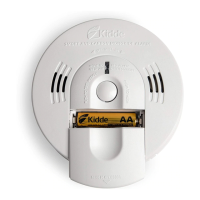
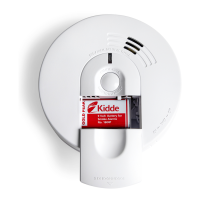
- Battery Power: The alarm is powered by two replaceable AA batteries. It's important to use only specified battery brands (Energizer E91, Gold Peak 15A, or Golden Power GLR6A) and to avoid mixing old and new batteries or different types (alkaline, standard, rechargeable). Lithium batteries should not be used.
- Low Battery Warning: The alarm is equipped with a low battery monitor circuit. When battery capacity is low, an amber LED will blink every 60 seconds, accompanied by a chirp and voice message "Low Battery" every 60 seconds (after 1 hour, voice occurs every 15 minutes). This notification can be silenced for 24 hours by pressing the button, but batteries must be replaced within 7 days of the first warning to maintain continuous detection.
- End of Unit Life Warning: Ten years after installation, the unit will automatically enter "End of Unit Life" mode, indicating it's time for replacement. An amber LED will blink twice every 60 seconds, accompanied by two chirps every 60 seconds. This notification can be silenced for 24 hours by pressing the button for the first 7 days.
- Cleaning: The alarm should be cleaned at least once a year. The interior (sensing chamber) can be cleaned using compressed air or a vacuum cleaner hose, blowing or vacuuming through the openings around the perimeter. The exterior can be wiped with a damp cloth, using only water. Detergents, solvents, or hair dryers should not be used, and the unit should never be painted or disassembled. Moving the alarm to another location is recommended when performing activities like staining, painting, wallpapering, or using adhesives, and storing it in a plastic bag during these projects can protect the sensors.
- Dust Cover: A dust cover is provided for use during construction projects to prevent contamination and false alarms. It must be removed once construction is complete and the area has been clear for at least 24 hours.
- CO Safety Tips: Regular inspection and cleaning of heating systems, vents, chimneys, and flues by a qualified technician are crucial. Appliances should be installed professionally and inspected after installation. Users should regularly examine vents and chimneys for improper connections, rust, or stains, and check for cracks in furnace heat exchangers. The color of pilot lights and burners should be blue; an amber or orange flame indicates incomplete combustion and potential CO release.

 Need help?
 General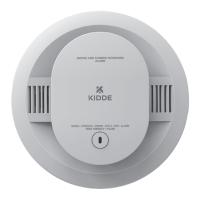

 To Next Page