Need help?
Do you have a question about the Kingspan Klargester BioAir DS1409P and is the answer not in the manual?
Comprehensive safety advice covering general practices, PPE, and maintenance procedures.
Guidance on resolving common problems like blower failure, plant flooding, and odor.
Steps for excavating the site and preparing the concrete base for unit installation.
Procedure for safely lowering and levelling the tank unit onto the prepared base.
Detailed steps for backfilling the tank, including second stage and final completion.
Key considerations for providing a safe and compliant electrical supply to the unit.
Diagram illustrating the first part of the control panel wiring.
Diagram illustrating the second part of the control panel wiring.
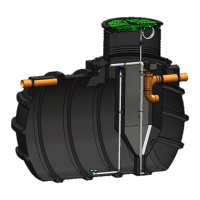
The Kingspan BioAir is a self-contained, single-piece sewage treatment system designed to process crude domestic sewage and produce an effluent suitable for discharge into a watercourse or soak-away system, subject to regulatory approval. This system is intended exclusively for treating sewage from domestic properties.
The BioAir system operates by introducing crude sewage into an inlet chamber, where it is aerated via a diffuser located at the bottom of the biozone. Naturally occurring microorganisms within this aerated mixture efficiently break down pollutants in the sewage. After a period, the aerated solids and liquids are transferred from the biozone to the Final Settlement Tank (FST) via a transfer port. Solids settle in the FST and are returned to the biozone through a sludge return pipe. Treated effluent is then discharged from the FST via a T-pipe. Periodic desludging of the FST is necessary to maintain effluent quality as solids accumulate.
An optional Integral Discharge Pump can be included. This pump sits within a molded chamber in the FST. Treated effluent flows by gravity into this chamber. When the liquid reaches a predetermined level, a float switch activates the pump, discharging effluent. The same float switches off the pump when the liquid level is sufficiently lowered, preventing dry running. For units with this option, a high-level alarm is recommended to warn of pump malfunction or failure.
| Unit | BioAir 2 | BioAir 3 | BioAir 5 |
|---|---|---|---|
| Length (mm) | 2500 | 2480 | 3190 |
| Width (mm) | 1540 | 1690 | 2010 |
| Inlet Invert depth (mm) | 455-755 | 575-875 | 645-945 |
| Depth below ground (mm) | 1805-2105 | 2075-2375 | 2485-2785 |
| Blower | JDK80 | JDK80 | JDK120 |
| Alternative Blower | LA80 | LA80 | LA120 |
| Integral Discharge Pump* rating (W) | 250 | 250 | 250 |
| Max PE | 6 | 9 | 15 |
| Max Daily BOD (kg) | 0.36 | 0.54 | 0.9 |
| Maximum Daily Flow (m³) | 0.9 | 1.35 | 2.25 |
| *Optional |
The main casing and cover of the BioAir are constructed from Medium Density Polyethylene. The unit's structural stability is tested in accordance with EN 12566-3.
The BioAir system is designed for ease of installation and safe operation. It can be supplied with either an isolator switch (economy specification) or a control panel (premium specification) for electrical control. The electrical installation must be carried out by a competent, qualified electrician adhering to the latest IEE regulations. A dedicated circuit with appropriate isolation and protection devices, independent of other household protection devices, is required. An earth leakage circuit breaker with a 30mA minimum trip current is recommended.
The control panel, if supplied, can be mounted in the blower housing, wall-mounted, or fixed to a mounting frame. It should be positioned in a frequently viewed, easily accessible location, but not reachable by someone standing in or on the unit, to ensure fault alarms are visible.
The control unit features a display for operational status and alarm messages. It can be programmed for various settings, including country selection, activation of different components (e.g., pumped outlet, loss of pressure sensor), and time-table entries for operations like desludging, motor/blower, and chemical dosing. The display shows current run times and next run times for these operations.
Alarms are triggered by conditions such as mains failure, low battery, loss of rotation, high-level float probe, auxiliary input, blower pressure, and various fuse failures. When an alarm occurs, a message appears on the display, a beeper sounds, a beacon flashes, and the common alarm telemetry relay de-energizes. The beeper can be muted for six hours, after which it will sound again if the alarm persists. Three volt-free contacts are available for external alarm reporting.
The control unit also includes a battery management system, displaying "Not Charging" when mains power is absent, "Standard charge" during initial power-up or reset (16-hour countdown), "Intelligent Charge" when power is interrupted and shows time until full charge, and "Trickle Charge" when fully charged and maintaining the battery.
Regular maintenance is crucial for efficient operation and is the responsibility of the owner/user. Kingspan recommends maintenance by qualified service personnel, but some self-help checks are outlined:
The control unit's menu allows access to an event log, which records the last ten alarm conditions with date and time, and when alarms clear. This aids in troubleshooting. Factory defaults can be restored via the menu, resetting settings like unit activation, country, timetables, event log, and inputs.
A warranty form is included for registration, and a notice detailing necessary maintenance should be fixed within the building. Kingspan provides contact numbers for service and replacement operating instructions.
 General
| Type | Sewage Treatment Plant |
|---|---|
| Inlet Diameter | 110mm |
| Outlet Diameter | 110mm |
| Material | Polyethylene |
| Air Blower Power | 60 W |
| Model | BioAir DS1409P |
| Application | Domestic |
| Weight | 280kg |
| Power Supply | 230V, 50Hz |


 To Next Page