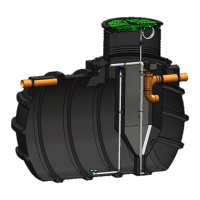
This document outlines the installation and operation guidelines for the Kingspan BioDisc® BN single-piece sewage treatment units. It emphasizes health and safety, technical specifications, handling, site planning, installation, start-up, operation, running checks, desludging, and warranty information.
Function Description
The Kingspan BioDisc® BN is a package sewage treatment plant designed to treat foul drainage from properties. It utilizes a biological treatment process where colonies of live natural micro-organisms (biomass) break down pollutants in sewage. The system is self-regulating and requires no specialized operational knowledge, but proper maintenance is crucial for efficient operation. The BioDisc units contain rotating machinery and associated transmission equipment, which facilitate the biological treatment process. The system is designed to handle typical domestic housing applications for a discharge consent of 20/30/20.
Important Technical Specifications
The manual provides detailed technical data for the BioDisc BN unit, including:
- PE (Population Equivalent): 300
- Maximum Daily BOD: 18 kg
- Maximum Daily Flow: 45 m³
- Peak Flow Rate: 7.5 m³
- BOD (mg/l): 20
- Suspended Solids (mg/l): 30
- Ammonium NH4+-N (mg/l): 20
- Inlet Invert Depth E: 600 mm or 1000 mm (options)
- Length D: 13100 mm
- Width: 2582 mm
- Depth Below Inlet Invert L: 1790 mm
- Outlet Invert Depth F: 750 mm or 1150 mm (options)
- Overall Height G: 2850 mm or 3250 mm (options)
- Height To Rim Cover H: 2490 mm or 2890 mm (options)
- Empty Weight: 5500 kg or 5650 kg (options)
- Standard Power Supply: 400V 3 Phase
- Motor Rating: 2 x 370 Watts (1 Phase)
- Full Load Current: 2 x 1.35 Amps (3 Phase)
- Sludge Return Pump Rating: 480 Watts
For optional pump stations:
- Diameter J: 900 mm
- Flange Height K: 2530 mm
- Standard Power Supply: 1ph
- Pump Rating: 480 Watts
The concrete specification for installation is in accordance with BS EN 206-1 (BS 8500-1), recommending C25/30 for reinforced concrete and C16/20 for unreinforced concrete, with minimum cement content of 270-280 Kg/M³ and 220-230 Kg/M³ respectively.
Usage Features
- Installation: Installation should only be carried out by suitably experienced contractors. The unit must be installed on a flat and level concrete base, ensuring it is level within ±5mm from side to side to avoid undue stress on bearings. Concrete backfill should be placed in layers, maintaining a water level inside the unit 250-500mm above the concrete backfill level.
- Control Panel: The control panel is supplied fixed to the pedestrian walkway and is suitable for internal or external wall mounting. It includes volt-free contacts for an optional beacon or telemetry.
- Start-Up: After installation, the unit should be filled with water and the motor switched on. If no operational power supply is available, the motor/gearbox unit should be removed and stored in a dry, heated environment until permanent operation is ready.
- Automatic Grease Cartridges: The shaft roller bearings are fitted with pressurized grease cartridges that need to be activated before starting the unit. The control knob should be turned to the figure 6 against the arrow for a 12-month lubrication period, then the red button depressed to secure the setting. Grease cartridges must be changed every 12 months.
- Optional Pump Station: Pumps should be set to pump little and often to prevent excessive loading on the BioDisc. The high-level float in the pump chamber must operate below the unit's inlet level.
- Process Initiation: The unit is filled with water during installation, which is gradually displaced by sewage. Colonization by micro-organisms takes 4-8 weeks to establish a full operating biomass.
- Automatic Restart: BioDiscs are designed to restart automatically after power is resumed. If the alarm activates after a power cut, the power supply should be switched off and on again. If the alarm persists, Kingspan should be contacted.
- Do's and Don'ts: Users are advised on acceptable household chemicals (washing machine/dishwasher detergents, floor cleaners, disinfectants, bleaches in minimum concentrations) and those to avoid (motor oil, grease, anti-freeze, cooking oil, weed-killers, insecticides, fungicides, paint, thinners, medicines, photographic developing fluids, nappies, sanitary towels, rags, soft toys, tennis balls). Dilution is crucial for acceptable chemicals.
Maintenance Features
- Routine Checks: Monthly checks include visually inspecting the plant for general condition, listening for unusual noises, checking the appearance of the biomass (light grey to brown, indicating overload if excessively thick or predominantly grey), ensuring fixings are secure, clearing debris from inlet/outlet pipes, and checking dosing buckets/transfer pipes.
- Loss of Rotation Alarm (LOR): The LOR alarm system should be checked regularly. To test, switch off drive motor circuit breakers; the alarm should activate after 2-3 minutes. Pushing "Beacon Off" stops flashing, leaving the red light illuminated. Switching breakers back on should cease the alarm after about a minute.
- Desludging: Routine desludging is required at approximately 3-month intervals for the BN model. The process involves isolating power, removing covers, removing surface scum from the Final Settlement Tank and Primary Settlement Zone, and removing settled sludge from specific points. It is crucial not to remove liquid from rotor sections or clean the gelatinous growth on the rotors. Sludge volumes for the BN model are 29,150 litres (6,412 gallons) from the Primary Settlement Zone and 14,300 litres (3,146 gallons) from the Final Settlement Zone.
- Mechanical and Electrical Maintenance: This must be performed by properly trained engineers with reference to the appropriate Maintenance Manual. Kingspan offers various contract maintenance packages.
- Warranty: The product comes with a 12-month warranty covering defects and failures under normal use, conditional on timely notification, inspection, and adherence to instructions.
- Service Contact: Kingspan Environmental Services can be contacted at 0844 846 0500 for maintenance services, replacement operating instructions, or warranty advice. The owner is legally responsible for ensuring the system does not cause pollution, health hazards, or nuisance. A log of all maintenance and service visits is recommended.

 Need help?
 General

 To Next Page