* At 760 mmHg pressure (atmospher-
ic). A higher boiling point is obtained
by using a radiator pressure cap
which permits the development of
pressure within the cooling system.
If cooling water freezes, it can dam-
age the engine and radiator. It is nec-
essary, if the ambient temperature
falls below 0° C (32° F), to remove
cooling water after operating or to
add anti-freeze to it.
1. There are two types of anti-freeze
available; use the permanent type
(PT) for this engine.
2. Before adding anti-freeze for the
rsttime,cleantheradiatorinterior
by pouring fresh water and draining
it a few times.
3. The procedure for mixing of water
and anti-freeze differs according
to the make of the anti-freeze and
the ambient temperature, basically
it should be referred to SAE J1034
standard,morespecicallyalsoto
SAE J814C.
4. Mix the anti-freeze with water, and
thenllintotheradiator.
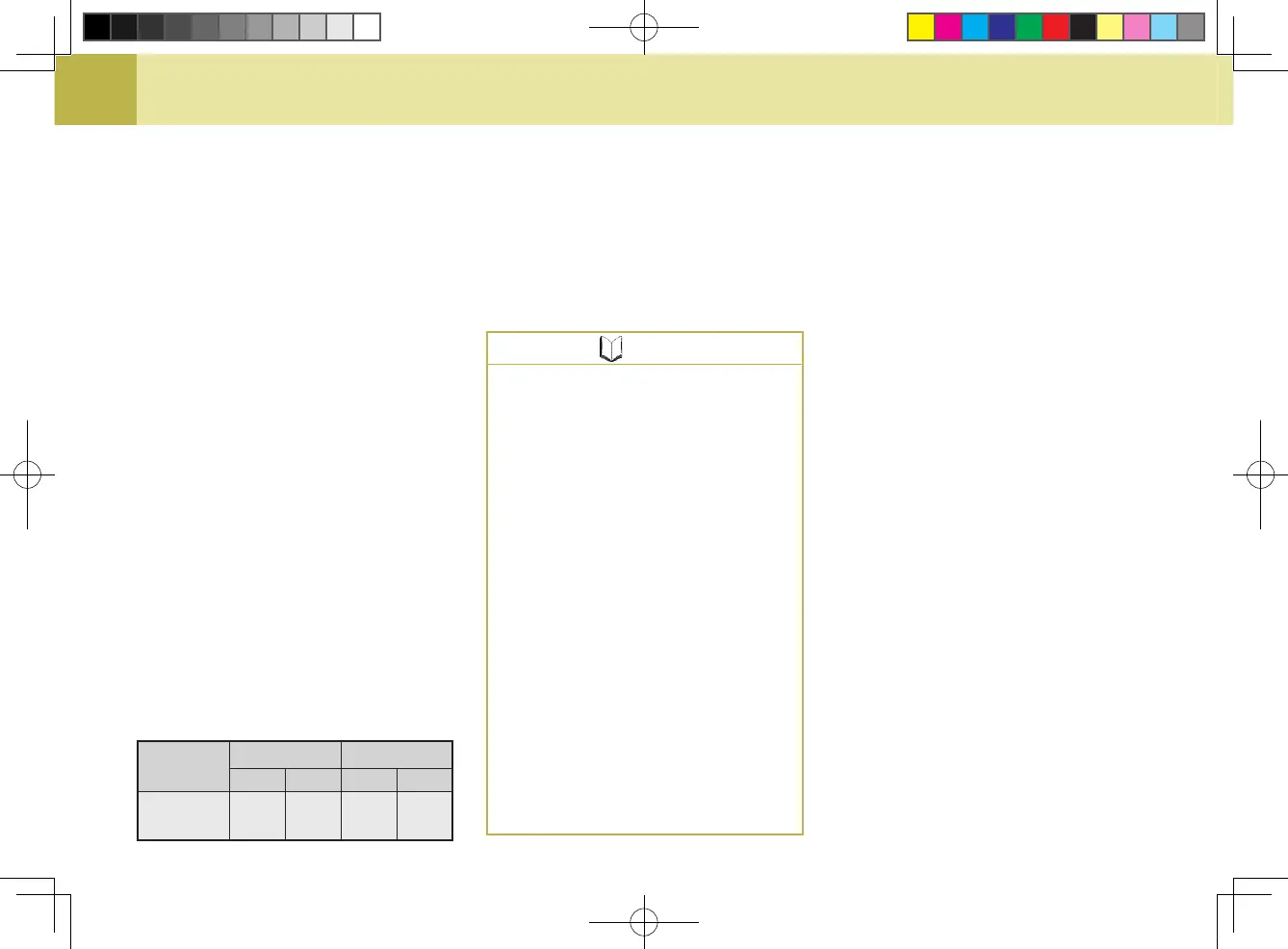
ANTI-FREEZE
Vol %
Anti-freeze
40
50
Freezing Point
C°
-24
-37
F°
-12
-34
Boiling Point*
C°
106
108
F°
222
226
Replace the hoses and clamps.
(See “Checking Radiator Hose and
Clamp” in every 200 hours mainte-
nance.)
REPLACING RADIATOR HOSE
(WATER PIPES)
REPLACING FUEL HOSE
Replace the hoses and clamps.
(See “Checking Fuel line” in every
100 hours maintenance.)
REPLACING POWER STEER-
ING HOSE
Replace the hoses and clamps.
(See “Checking power steering line”
in every 200 hours maintenance.)
The above date represents
industry standards that necessitate
a minimum glycol content in the
concentrated anti-freeze.
When the cooling water level
drops due to evaporation, add
water only. In case of leakage,
add anti-freeze and water in
thespeciedmixingratio.
Anti-freeze absorbs moisture.
Keep unused anti-freeze in a
tightly sealed container.
Do not use radiator cleaning
agents when anti-freeze has
been a dded to the c ooling
water. (Anti-freeze contains an
anti-corrosive agent, which will
react with the radiator cleaning
agent forming sludge which will
affect the engine parts.)
NOTE



 To Next Page