EasyManua.ls Logo

KitchenAid KSSS48FKX00 - User Manual

KitchenAid KSSS48FKX00
76 pages
Print Icon
To Next Page IconTo Next Page
Loading...
TECHNICAL EDUCATION
JOB AID 4317326A
KAR-11
2001 K MODEL
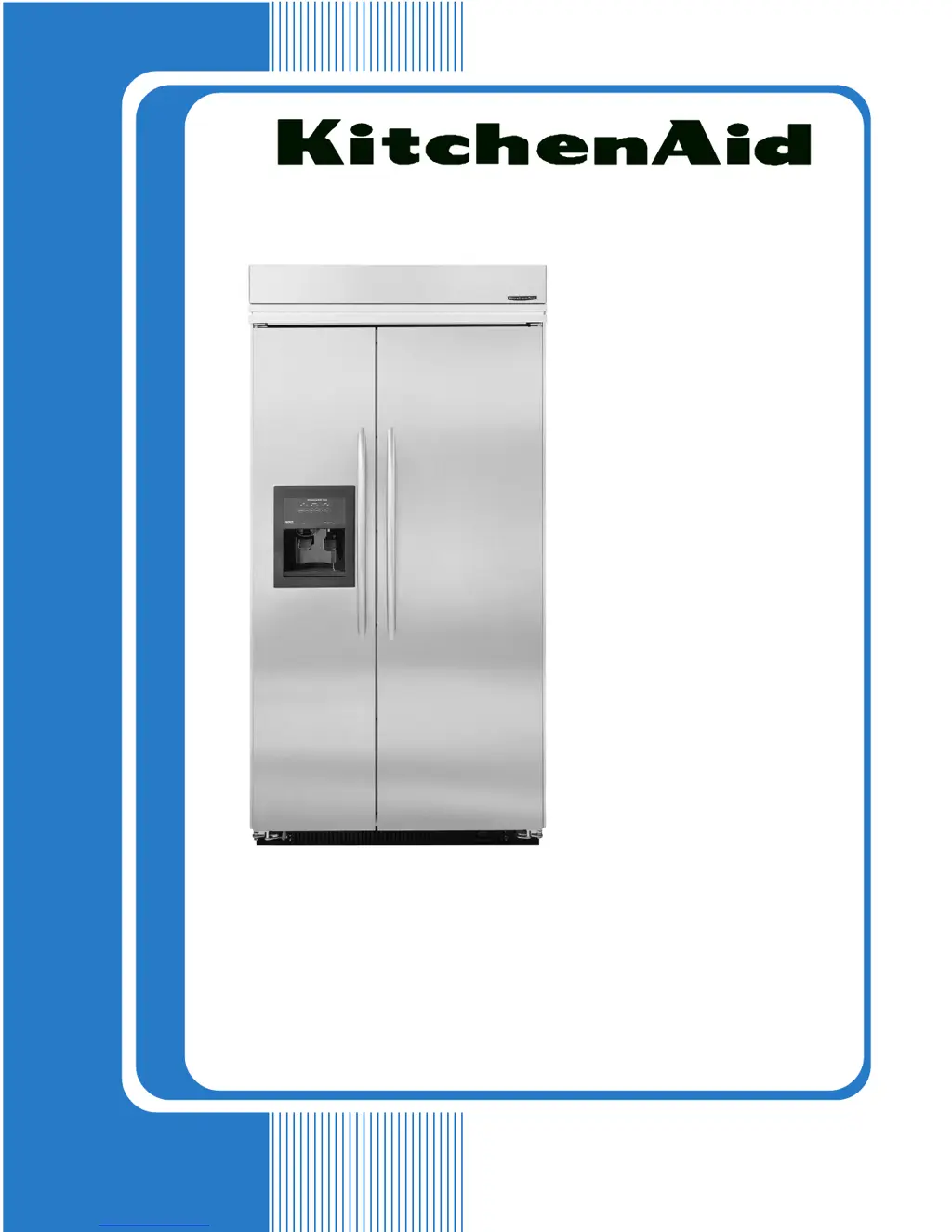
BUILT-IN SIDE-BY-SIDE
REFRIGERATOR WITH VARIABLE
CAPACITY COMPRESSOR
MODELS:
KSSC36FKB00
KSSC36FKS00
KSSC36QKS00
KSSC42FKB00
KSSC42FKS00
KSSC42QKS00
KSSC48FKB00
KSSC48FKS00
KSSC48QKS00
KSSP36QKS00
KSSP42QKS00
KSSP48QKS00
KSSS36FKB00
KSSS36FKT00
KSSS36FKW00
KSSS36FKX00
KSSS36QKB00
KSSS36QKT00
KSSS36QKW00
KSSS36QKX00
KSSS42FKB00
KSSS42FKT00
KSSS42FKW00
KSSS42FKX00
KSSS42QKB00
KSSS42QKT00
KSSS42QKW00
KSSS42QKX00
KSSS48FKB00
KSSS48FKT00
KSSS48FKW00
KSSS48FKX00
KSSS48QKB00
KSSS48QKT00
KSSS48QKW00
KSSS48QKX00

Questions and Answers

  • L
    Lisa AlexanderAug 19, 2025
    Why is my KitchenAid Refrigerator compartment too cold?
    • A
      Ann EspinozaAug 19, 2025
      If your KitchenAid Refrigerator compartment is too cold, here are some possible causes: * The refrigerator control may be set too cold. Try setting it to a higher temperature. * The refrigerator thermistor could be malfunctioning. Check the wires and connectors. Run diagnostics, and if a defective thermistor is indicated, confirm with an ohms test. * The air door might be stuck open or inoperative. Look for ice or other blockages in the air door. Run a diagnostics test to operate the air door. Check for proper DC input voltage. If the voltage is normal and the door still won't operate, replace the air door. * The air door seal might be missing or damaged. Repair or replace the seal. * There could be an issue with the main PC board. Run a diagnostics test to operate the air door.
  • M
    Matthew HodgesAug 23, 2025
    Why is my KitchenAid Refrigerator freezer too cold?
    • D
      Debra BernardAug 23, 2025
      If your KitchenAid Refrigerator's freezer compartment is too cold: * The freezer control may be set too cold. Set it to a higher temperature. * The refrigerator may be operating in Max Cool or Automatic Max Ice Mode. This is normal operation. * The freezer thermistor might be faulty. Check the wires and connectors. Run diagnostics, and if a defective thermistor is indicated, confirm with an ohms test. * There might be no evaporator fan motor feedback. The fan motor will run at 3000 rpm.
  • K
    kathymartinezAug 27, 2025
    What to do if the 'Call Service' icon lights up on my KitchenAid KSSS48FKX00?
    • C
      Carla CampbellAug 27, 2025
      If the "Call Service" icon lights up and/or the alarm is activated on your KitchenAid Refrigerator, it could be due to several reasons: * The main control board may be overheating, possibly due to blocked condenser airflow or a malfunctioning condenser fan motor. Check these components. * The refrigerator temperature might be above 48°F or the freezer above 15°F for more than 3 hours. In this case, run diagnostics to test all components. * Both thermistors might have failed. Run diagnostics and test the thermistors and their leads. * There might be no feedback from the evaporator fan motor. Run diagnostics and test the fan motor and its wiring.
  • H
    huangallisonAug 30, 2025
    What to do if the condenser fan runs but the compressor won't start on my KitchenAid KSSS48FKX00?
    • V
      Victor Watts MDAug 30, 2025
      If the condenser fan runs but the compressor won't start on your KitchenAid Refrigerator, the following could be the issue: * There may be no DC control voltage from the main PCB to the inverter board. * The control voltage wires may be loose or reversed. Check the connections and repair as needed. * There may be an issue with the compressor. * There may be an issue with the inverter board.
  • C
    chavezanitaSep 3, 2025
    Why does my KitchenAid Refrigerator run too long?
    • K
      Karl LopezSep 3, 2025
      It is normal for your KitchenAid Refrigerator to run for extended periods. It is designed to run almost constantly at the lowest possible compressor speed because starting and stopping the compressor uses more power than continuous low rpm operation.
  • M
    Melissa LopezSep 7, 2025
    How to fix no temperature display and no interior lights on my KitchenAid KSSS48FKX00?
    • J
      Jamie DickersonSep 7, 2025
      If there is no temperature display and no interior lights on your KitchenAid Refrigerator, consider these possibilities: * The unit may be set to Holiday Mode. Press the Holiday Mode key to cancel this operation. * Either door may have been open for over 10 minutes. Close the door and/or check the door switches.
  • A
    Andrea JonesNov 11, 2025
    Why is my KitchenAid KSSS48FKX00 Refrigerator compartment too warm?
    • S
      Sabrina BlevinsNov 11, 2025
      If your KitchenAid Refrigerator compartment is too warm, there are several potential causes: * The refrigerator control might be set too warm. Try setting it to a lower temperature. * There might be an issue with the refrigerator thermistor. Check the wires and connectors. Run diagnostics, and if the thermistor is indicated as defective, confirm with an ohms test. * The air door could be stuck closed or inoperative. Look for ice or other blockages. Run a diagnostics test to operate the air door. * The evaporator fan motor may not be running. Run a diagnostics test to operate the evaporator fan motor. Check for a blocked fan blade and repair if necessary. Check for 5-17vdc from pin P7-9 to P7-10; if the voltage is correct, replace the motor. * There could be blocked airflow. Chec...
  • S
    Stephanie PhelpsNov 15, 2025
    Why is my KitchenAid KSSS48FKX00 freezer compartment too warm?
    • M
      Mitchell GordonNov 15, 2025
      If your KitchenAid Refrigerator's freezer compartment is too warm, consider the following: * The freezer control might be set too warm. Set it to a lower temperature. * The freezer thermistor may be faulty. Check the wires and connectors. Run diagnostics, and if a defective thermistor is indicated, confirm with an ohms test. * The evaporator fan motor might not be running. Run a diagnostics test to operate the evaporator fan motor. Check for a blocked fan blade and repair as necessary. Check for 5-17vdc from pin P7-9 to P7-10; if the voltage is correct, replace the motor. * The condenser fan motor may not be running. Check for a blocked fan blade and repair as necessary. * Frost may be blocking the evaporator. Run diagnostics to operate the defrost system, and test the defrost h...

Summary

Document Introduction and Goals

Forward Statement

Provides an overview of the Job Aid's purpose and scope for servicing KitchenAid refrigerators.

Goals and Objectives of the Job Aid

Outlines the primary goal and specific objectives for technicians using this service manual.

General Information and Safety

Safety First Guidelines

Essential safety precautions and hazard warnings to ensure safe operation and servicing of the appliance.

Electrical Power and Grounding Requirements

Detailed requirements for safe electrical power connection and proper grounding to prevent shock hazards.

Electrostatic Discharge (ESD) Precautions

Procedures to protect sensitive electronic components from damage caused by static electricity discharge.

Anti-Tip Safety Measures

Crucial steps and warnings to prevent the refrigerator from tipping over during installation and use.

Appliance Identification and Specifications

Model and Serial Number Designations

Explanation of model number structure and serial number format for appliance identification.

Model and Serial Number Label Locations

Visual guide indicating the specific locations of the model and serial number labels on the unit.

Product Specifications Overview

Detailed technical specifications for various refrigerator models, including dimensions and capacities.

Refrigerator Warranty Information

Details of the KitchenAid built-in refrigerator warranty coverage, terms, and limitations.

Installation Guidelines and Procedures

Product Dimensions and Clearances

Key dimensions and required clearances for proper installation of the built-in refrigerator.

Cabinet Opening and Electrical Requirements

Specifications for cabinet openings, wall stud locations, and electrical outlet placement for installation.

Water Supply and Anti-Tip Installation

Requirements for water line connection and installation of anti-tip boards for secure appliance mounting.

Leveling and Door Adjustment Procedures

Instructions for leveling the refrigerator and adjusting door alignment for optimal function.

Theory of Operation

Electronic Control Panel Overview

Description of the electronic temperature control panel, its functions, and display indicators.

Temperature Management System

Explanation of how the electronic control manages refrigerator and freezer temperatures via VCC and air door.

Core Component Functions

Description of the operational principles of the compressor, evaporator fan motor, and air door.

Defrost Cycles and Operational Modes

Details on adaptive defrost, pulsed defrost, power interruption behavior, and failure defaults.

Special Operating Modes

Explanation of Max Cool, Automatic Max Ice, and Holiday Mode features and their operation.

User Alarms and Indicators

Information on Over-Temperature, Call Service, Door Open alarms, and Sales Demonstration Mode.

Air Circulation and System Schematics

Air Circulation Principles

Explanation of airflow between freezer and refrigerator compartments for optimal temperature management.

Sealed Refrigeration System Schematic

Diagram illustrating the components and flow of the sealed refrigeration system.

Component Access and Removal

Component Locations Identification

Visual identification of key components within the refrigerator and freezer compartments.

Removing the Unit Compartment Cover

Step-by-step instructions for safely removing the main unit compartment cover.

Removing Switches and Electronic Modules

Procedures for removing door switches, power switch, inverter assembly, and main control board.

Removing the Condenser Fan Motor

Detailed instructions for safely accessing and removing the condenser fan motor.

Removing the Compressor and Filter;Drier

Step-by-step guide for the removal of the compressor and filter/drier assembly.

Removing Evaporator, Fan, Heater, and Bimetal

Instructions for removing the evaporator assembly, fan motor, defrost heater, and bimetal.

Removing Display Board and Motorized Air Door

Procedures for removing the touch/display board and the motorized air door assembly.

Removing Ice Maker and Auger Motor Assembly

Instructions for removing the ice maker, auger motor, and crush/cube solenoid.

Removing Thermistors

Step-by-step guide for safely removing and replacing refrigerator and freezer thermistors.

Removing Light Sockets

Instructions for safely accessing and removing the refrigerator and freezer light sockets.

Removing the Water Reservoir

Procedure for safely removing the water reservoir and its associated tubing.

Removing the Water Valve

Step-by-step instructions for safely removing the water inlet and outlet valve.

Removing the Water and Ice Dispenser

Procedures for removing the front panel and the main dispenser assembly.

Removing a Door Gasket

Instructions for removing and replacing the refrigerator or freezer door gasket.

Removing Refrigerator or Freezer Doors

Step-by-step guide for safely removing the refrigerator and freezer doors.

Component Testing Procedures

Testing Thermistors

Procedure to test thermistor resistance and voltage output for accurate temperature readings.

Testing Fan Motors (Evaporator & Condenser)

Methods for testing the resistance and operation of the evaporator and condenser fan motors.

Testing Compressor and Inverter

Steps to test compressor resistance and inverter board voltage outputs for proper operation.

Testing Air Door and Defrost Components

Procedures for testing the motorized air door motor and the defrost heater/bimetal resistance.

Testing the Main Control Board

Guide to testing inputs and outputs on the main control board using voltage and pin specifications.

Testing Solenoids and Auger Motor

Resistance testing procedures for the crush/cube solenoid and ice maker auger motor.

Testing Water Valve Solenoids and Door Switches

Resistance testing for water valve solenoids and continuity checks for door switches.

Diagnosis and Troubleshooting

Diagnostic Modes and Pre-Checks

Procedure to enter diagnostic mode and perform pre-checks on thermistors, fans, and compressor.

Diagnostics Chart and Tests

Reference chart for diagnostic test steps, results, comments, and water filter input tests.

Comprehensive Troubleshooting Guide

Chart listing common problems, possible causes, and recommended test procedures for resolution.

Wiring Diagrams and Strip Circuits

Bottom Mount Wiring Diagram

Schematic illustrating the electrical connections for bottom mount refrigerator models.

Side-by-Side Models Wiring Diagram

Schematic detailing the electrical wiring for side-by-side refrigerator configurations.

Strip Circuits: Compressor and Fan Motors

Simplified circuit diagrams showing the compressor and condenser fan motor electrical paths.

Strip Circuits: Defrost and Ice Maker

Simplified circuit diagrams for defrost heater, evaporator fan, and ice maker module connections.

Strip Circuits: Lighting and Door Switches

Simplified circuit diagrams illustrating the electrical paths for interior lights and door switches.

Product Support Contacts

KitchenAid KSSS48FKX00 Specifications

General IconGeneral
BrandKitchenAid
ModelKSSS48FKX00
CategoryRefrigerator
TypeSide by Side
Ice MakerYes
Water DispenserYes
FinishStainless Steel
Energy Star CertifiedYes
Width48 in.

Related product manuals