Need help?
Do you have a question about the KLA Tencor P-6 and is the answer not in the manual?
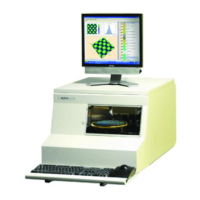
Provides an overview of the KLA-Tencor P-16+ / P-6 Profiler system and its capabilities.
Details safety issues involved in using the P-16+ or P-6 Profiler system, including symbols and procedures.
Explains the safety procedure for notifying employees, shutting down the system, and securing the power cord.
Discusses potential hazards related to stage and head movements, interlocks, and manual loading procedures.
Details the procedure for powering up the computer and system, including launching Windows and logging into profiler security.
Explains how to start the Profiler application, the interface for scan functions, and the start-up procedure.
Details system provisions for stylus protection and potential stylus damage during scans.
Provides procedures for creating and editing scan recipes, including accessing the editor and defining parameters.
Details the procedure for setting leveling cursors in the Analysis screen for accurate data leveling.
Describes the Feature Detection function for automatic detection of common profile features in 2D scans.
Explains how to change magnification using zoom icons or menu items for feature identification and scan placement.
Details how to sharpen the image in the video window using focus knobs after null and focus procedures.
Describes how to move the stage in X, Y, and theta directions to orient the sample image for scan positioning.
Explains how to use die grid navigation to teach scan and sequence sites by die location with pattern recognition.
Provides procedures for aligning the sample image with the X-axis using a straight feature on the sample.
Describes the View Scan Window's function for observing scan progress and adjusting parameters for optimum results.
Explains the 3D View Scan screen's similarities and additions to the 2D screen for 3D analysis and monitoring.
Details the procedure for creating a sequence recipe, including loading samples and using die grid navigation.
Explains how to automate repetitive measurements on multiple samples using manual deskew.
Describes how to compensate for small rotational errors by performing a second deskew in Pattern Recognition.
Explains setting deskew options for pattern search when the pattern is not found within the field of view.
Describes how to store an offset from a taught pattern for any scan in the sequence for effective positioning.
Details how to start the 3D analysis application by clicking Scan Data or Sequence Data in the Catalog window.
Describes the features of the 3D Analysis screen, including image orientation options and tool bar buttons.
Provides a tool for leveling 3D images where planes at the same Z level are detected for error removal.
Explains the theoretical basis of stress measurement, including the Stoney equation and curvature calculations.
Presents the Stoney equation for calculating stress in a thin-film layer deposited on a substrate.
Describes the Polynomial Fit method for fitting data to local irregularities and computing new y values.
Details the 2D Stress Application Window, including the Stress Screen Tool Bar and its icons.
Guides the user through creating a stress recipe, including setting scan parameters and substrate specifications.
Provides procedures for creating stress data, including loading wafers and taking pre- and post-stress scans.
Details how to change access levels by logging off and logging back into the profiler software.
Provides steps to modify security settings by navigating to and editing sections in the Security Configuration Editor.
Details the procedure to change the AutoLogonUser password, including importing users and editing accounts.
 General
| Vertical Resolution | 0.1 nm |
|---|---|
| Data Acquisition | High-speed data acquisition system |
| Wavelength Range | N/A (Contact method) |
| Spot Size | N/A (Contact method) |
| Applications | thin film thickness, surface roughness, step height |


 To Next Page